Physical hazard · Desensitised explosives
H207 — Fire or projection hazard; increased risk of explosion if desensitising agent is reduced
Physical hazard statements describe what the substance itself can do — explode, ignite, react, corrode metal. No substance with a harmonised EU classification carries this code.
01 · Wording
What H207 says
Fire or projection hazard; increased risk of explosion if desensitising agent is reduced.
CLP Annex III · Physical hazards
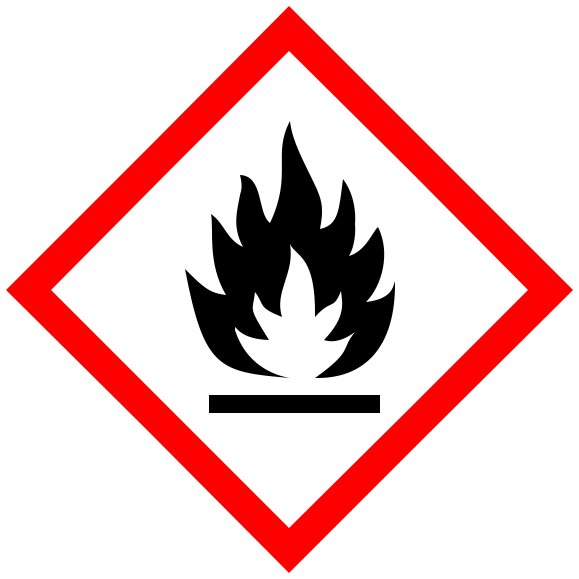
Desensitised explosives GHS chapter 2.17
Categories 2, 3 · pictogram GHS02 (flame) · signal word Danger or Warning
By category: 2 — GHS02, Danger; 3 — GHS02, Warning
Introduced in Rev.6 (2015).
Added by UN GHS Rev.6 and unchanged through Rev.11 (2025). Jurisdictions that sit on an earlier revision do not have this code at all.
Nine editions of the UN model text, 86 hazard statements, 19 of which ever moved. Read the full story in what changed in UN GHS Rev.11.
02 · Languages
H207 in the 24 official EU languages
A label put on the market in an EU country must carry the wording of that country's own language version of CLP — not a translation of the English one. These 24 lines are quoted from the consolidated regulation, Annex III, and are the text to print.
| Language | Official wording of H207 |
|---|---|
| BG български Bulgarian | Опасност от пожар или разпръскване; повишен риск от експлозия при понижено съдържание на десенсибилизиращ агент. |
| ES español Spanish | Peligro de incendio o proyección; mayor riesgo de explosión si se reduce el agente insensibilizante. |
| CS čeština Czech | Nebezpečí požáru nebo zasažení částicemi; zvýšené nebezpečí výbuchu, sníží-li se objem znecitlivujícího prostředku. |
| DA dansk Danish | Fare for brand eller udslyngning af fragmenter; øget risiko for eksplosion, hvis det desensibiliserende middel reduceres. |
| DE Deutsch German | Gefahr durch Feuer oder Sprengstücke; erhöhte Explosionsgefahr wenn das Desensibilisierungsmittel reduziert wird. |
| ET eesti Estonian | Süttimis- või laialipaiskumisoht, desensibilisaatori vähenemise korral suurenenud plahvatusoht. |
| EL ελληνικά Greek | Κίνδυνος πυρκαγιάς ή εκτόξευσης· αυξημένος κίνδυνος έκρηξης εάν μειωθεί ο παράγοντας απευαισθητοποίησης. |
| EN English English | Fire or projection hazard; increased risk of explosion if desensitising agent is reduced. |
| FR français French | Danger d'incendie ou de projection; risque accru d'explosion si la quantité d'agent désensibilisateur est réduite. |
| GA Gaeilge Irish | Guais dóiteáin nó teilgin; baol méadaithe pléasctha má laghdaítear an dí-íogróir. |
| HR hrvatski Croatian | Opasnost od vatre ili rasprskavanja; povećan rizik od eksplozije ako je smanjen udio desenzitirajućeg agensa. |
| IT italiano Italian | Pericolo d'incendio o di proiezione; maggior rischio di esplosione se l'agente desensibilizzante è ridotto. |
| LV latviešu Latvian | Ugunsbīstamība vai izmetbīstamība; ja desensibilizācijas līdzekļa daudzums samazinājies, palielinās eksplozijas risks. |
| LT lietuvių Lithuanian | Gaisro arba išsvaidymo pavojus; sumažėjus desensibilizacijos veiksnio poveikiui kyla didesnė sprogimo rizika. |
| HU magyar Hungarian | Tűz vagy kivetés veszélye; fokozott robbanásveszély a deszenzibilizáló szer csökkenésével. |
| MT Malti Maltese | Periklu ta' nar jew projezzjoni; riskju ikbar ta' splużjoni jekk l-aġent disensitizzanti jitnaqqas. |
| NL Nederlands Dutch | Gevaar voor brand of scherfwerking; toegenomen ontploffingsgevaar als de ongevoeligheidsagens wordt verminderd. |
| PL polski Polish | Zagrożenie pożarem lub rozrzutem; zwiększone ryzyko wybuchu jeśli zawartość środka odczulającego została zmniejszona. |
| PT português Portuguese | Perigo de incêndio ou projeções; risco acrescido de explosão se houver redução do agente dessensibilizante. |
| RO română Romanian | Pericol de incendiu sau proiectare; risc sporit de explozie dacă se reduce agentul de desensibilizare. |
| SK slovenčina Slovak | Nebezpečenstvo požiaru alebo rozletenia úlomkov; zvýšené riziko výbuchu, ak sa zníži obsah desenzibilizačného činidla. |
| SL slovenščina Slovenian | Nevarnost za nastanek požara ali drobcev; povečana nevarnost eksplozije, če se zmanjša vsebnost desenzibilizatorja. |
| FI suomi Finnish | Palo- tai sirpalevaara; suurentunut, jos flegmatointitekijää vähennetään. |
| SV svenska Swedish | Fara för brand eller splitter och kaststycken. ökad explosionsrisk om det okänsliggörande ämnet minskas. |
Source: CELEX:02008R1272-20260501, Annex III. © European Union, https://eur-lex.europa.eu — only the electronic Official Journal of the European Union is authentic. Irish is one of the 24 official languages and its H and P texts are printed inside the multilingual Annex tables, but no consolidated CLP has ever been published in Irish — which is why an Irish-primary label cannot be built here.
03 · Legal status
Where H207 is current
GHS is a United Nations model text, revised every two years, and each jurisdiction adopts a revision on its own timetable. A code can be legally current in one system and deleted in another — that is normal, not an error.
| Jurisdiction | Basis | Status of H207 |
|---|---|---|
| EU CLP | Regulation (EC) 1272/2008 CLP Annex IV, Part 2 (consolidated) | Current |
| US OSHA HazCom | 29 CFR 1910.1200 Appendix C UN GHS Rev.7 (final rule of 20 May 2024) | Current |
| US HazCom 2012 | legacy · GHS Rev.3 UN GHS Rev.3, Annex 3 | not in this system |
| UN GHS | Rev.11 (2025) UN GHS Rev.11, Annex 3 | Current |
Currently in force under: EU CLP, US OSHA HazCom, UN GHS. Sources: EU CLP · US OSHA HazCom · US HazCom 2012 · UN GHS
04 · Substances
Substances carrying H207
No substance with a harmonised classification in CLP Annex VI carries this code. That does not mean it is unused — suppliers apply it to their own mixtures.
All hazard statements
The full list of H-codes with the jurisdiction switch lives on the hazard statements hub. For what to do about the hazard, see precautionary statements (P-codes).
Wording quoted from the regulation named above. Substance counts come from harmonised classifications in CLP Annex VI — the statements on a real product also depend on the supplier's own classification. Always check the supplier safety data sheet.