Reference · Hazard pictograms
GHS pictograms: all nine hazard symbols
The nine pictograms in one chart — what each one means, the signal word it carries, the hazard classes that require it, and how many of the substances with a harmonised classification in CLP Annex VI actually get it.
01 · The chart
All nine, at a glance
A hazard pictogram is a black symbol on a white background inside a red diamond. Nine of them exist and no tenth is coming without a change to the UN model regulation. Each card links to the full page for that pictogram — hazard classes, H-codes, the substances that carry it and a free SVG.
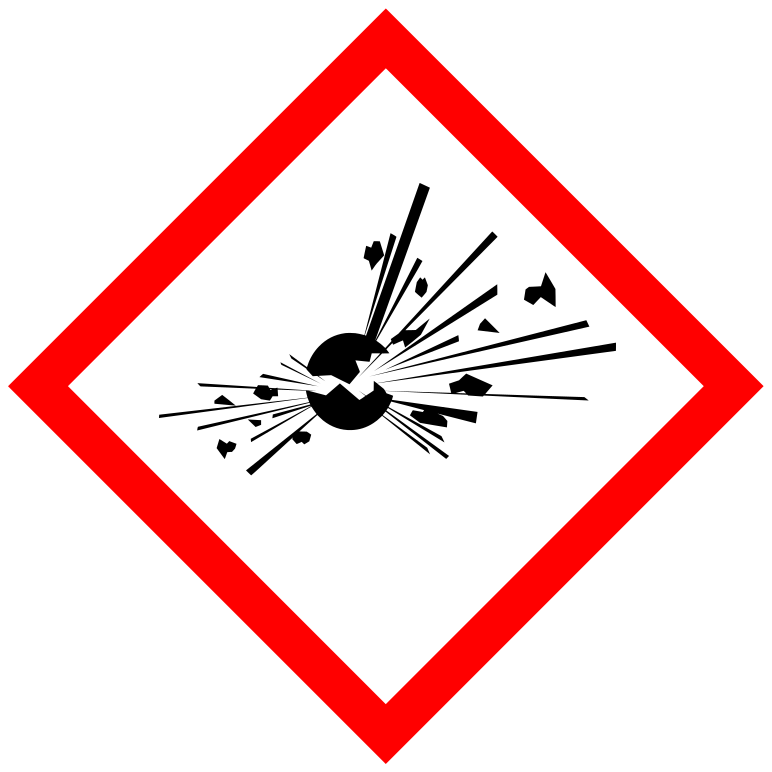
Exploding Bomb
Explodes, or is self-reactive or a peroxide violent enough to behave like one.
3 classes· 7 H-codes· 39 substances
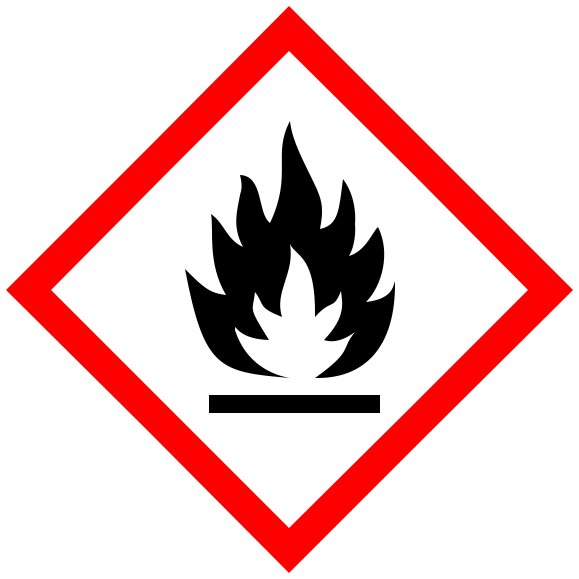
Flame
Catches fire easily, heats itself, ignites in air, or gives off flammable gas in water.
11 classes· 21 H-codes· 516 substances
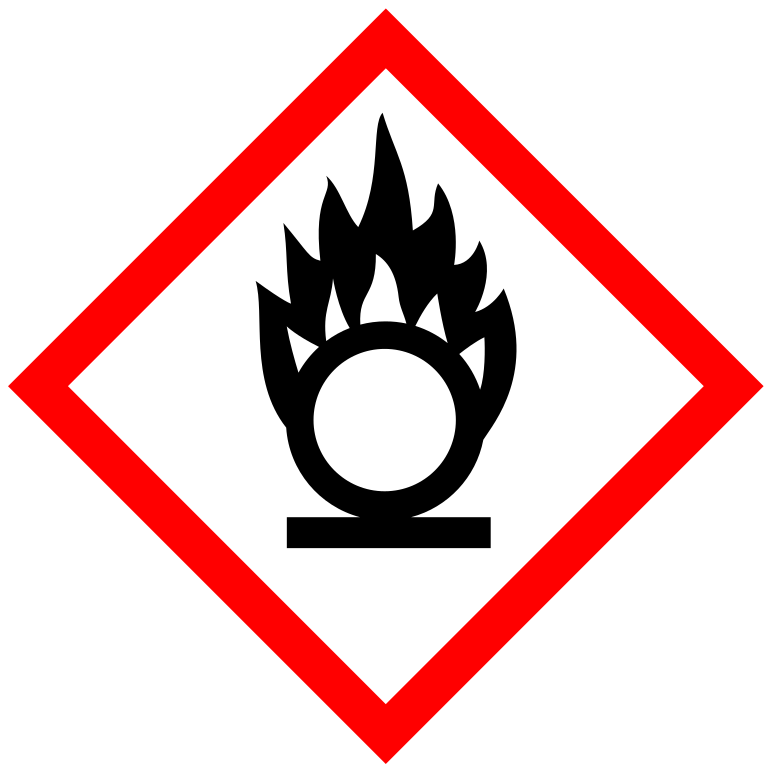
Flame Over Circle
Does not have to burn itself — it supplies the oxygen that makes everything else burn harder.
3 classes· 3 H-codes· 37 substances
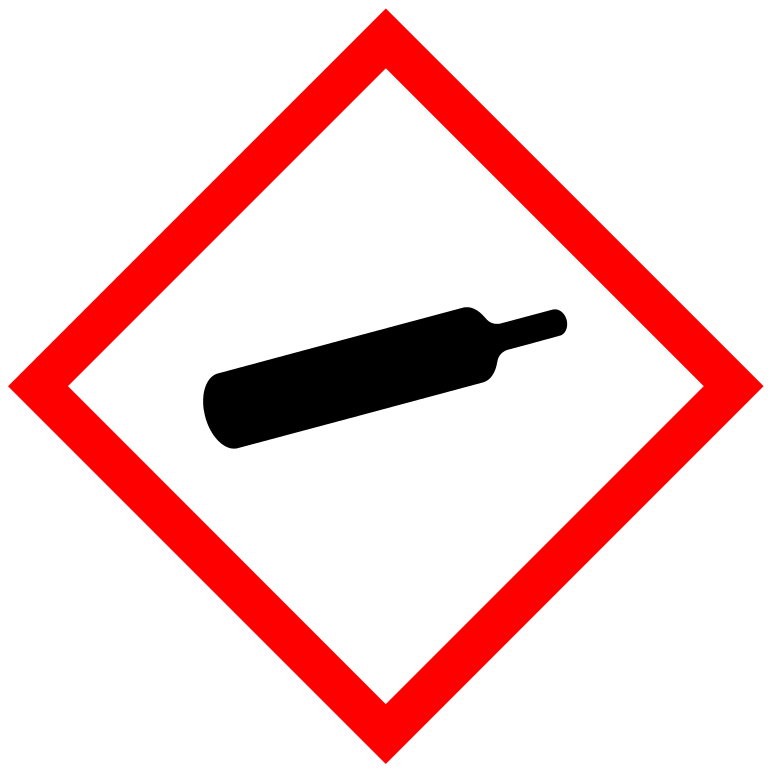
Gas Cylinder
Gas held under pressure. The container is the hazard as much as the contents.
1 class· 2 H-codes· 188 substances
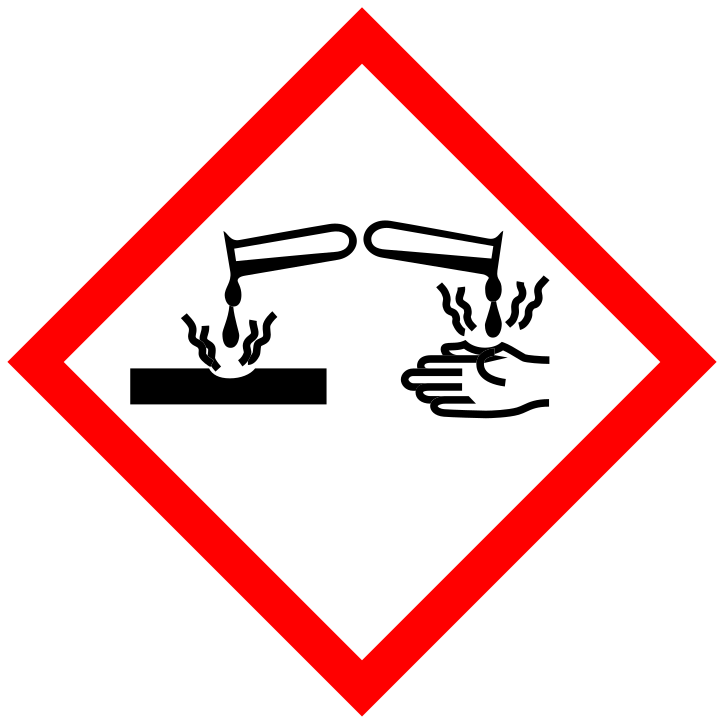
Corrosion
Destroys skin and eyes on contact, or eats through metal. Two very different readings of one symbol.
3 classes· 3 H-codes· 737 substances
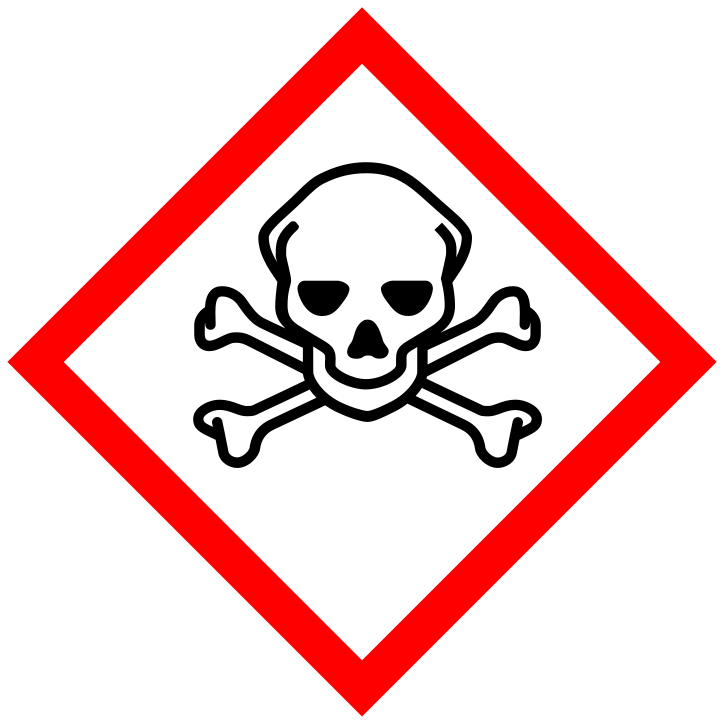
Skull and Crossbones
A small dose can kill. Acute toxicity categories 1 to 3, by any route. Always “Danger”.
3 classes· 6 H-codes· 604 substances
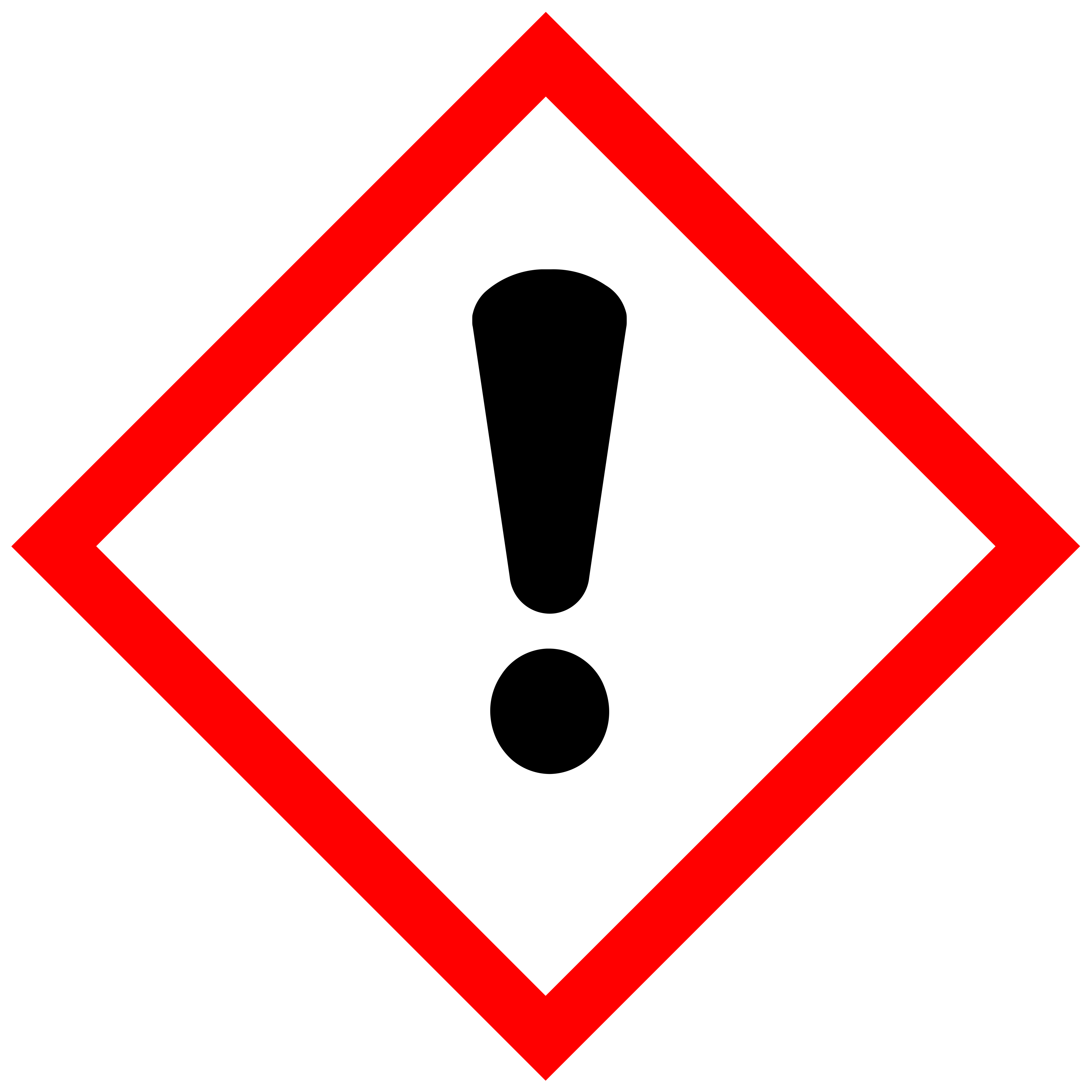
Exclamation Mark
Harmful, irritating, sensitising or narcotic — serious, but below the lethal band. Always “Warning”.
8 classes· 9 H-codes· 1,592 substances
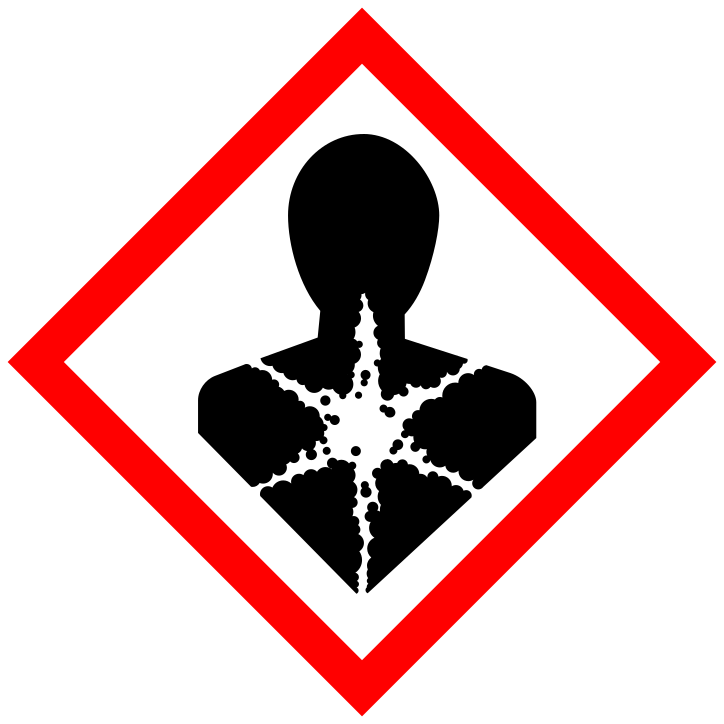
Health Hazard
Damage that shows up later: cancer, genes, fertility, organs, or lungs after swallowing.
7 classes· 12 H-codes· 1,791 substances
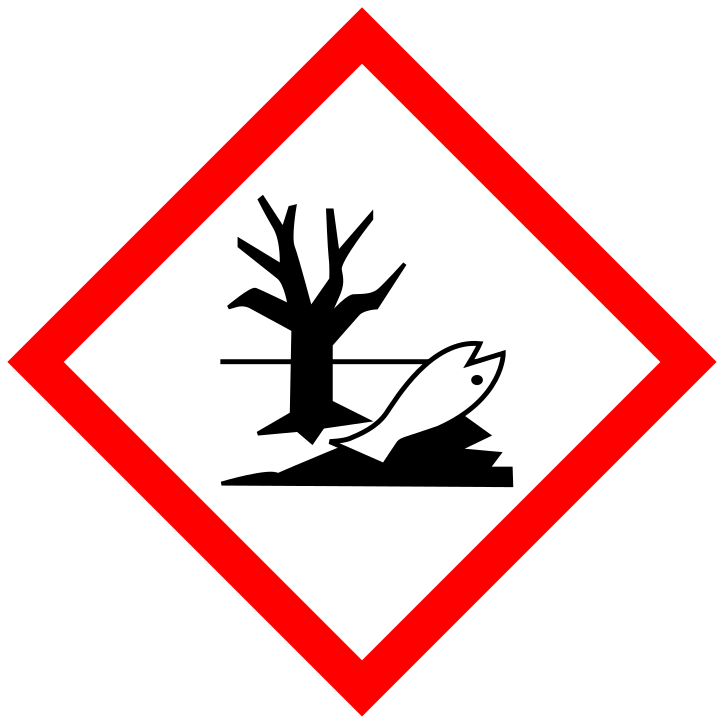
Environmental Hazard
Toxic to fish and the aquatic environment, immediately or over the long term.
2 classes· 3 H-codes· 1,495 substances
Symbol or pictogram? The symbol is the black drawing — a flame, a skull, an exclamation mark. The pictogram is the finished label element: that symbol, on white, inside the red diamond. UN GHS names the symbols, CLP Annex V draws the pictograms. In everyday use “GHS symbol” and “GHS pictogram” mean the same nine images.
02 · The classification behind each symbol
Every CLP hazard class, and the pictogram it triggers
A pictogram is never chosen — it falls out of the classification. These are all 33 hazard classes of CLP that carry a pictogram, sorted under the nine images, with the chapter number of Annex I next to each. Read it in reverse and it answers the harder question: given a pictogram on a drum, which hazard could have put it there. The last column is the transport class that usually travels with it; three of the nine have no transport equivalent at all.
| Pictogram | CLP hazard classes that require it | ADR |
|---|---|---|
| GHS01 Exploding Bomb | Explosives2.1 ·Self-reactive substances and mixtures2.8 ·Organic peroxides2.15 | Class 1 |
| GHS02 Flame | Flammable gases2.2 ·Aerosols2.3 ·Flammable liquids2.6 ·Flammable solids2.7 ·Self-reactive substances and mixtures2.8 ·Pyrophoric liquids2.9 ·Pyrophoric solids2.10 ·Self-heating substances and mixtures2.11 ·In contact with water emits flammable gases2.12 ·Organic peroxides2.15 ·Desensitised explosives2.17 | Class 2 |
| GHS03 Flame Over Circle | Oxidising gases2.4 ·Oxidising liquids2.13 ·Oxidising solids2.14 | Class 2.2 |
| GHS04 Gas Cylinder | Gases under pressure2.5 | Class 2.2 |
| GHS05 Corrosion | Corrosive to metals2.16 ·Skin corrosion/irritation3.2 ·Serious eye damage/eye irritation3.3 | Class 8 |
| GHS06 Skull and Crossbones | Acute toxicity - oral3.1 ·Acute toxicity - dermal3.1 ·Acute toxicity - inhalation3.1 | Class 6.1 |
| GHS07 Exclamation Mark | Acute toxicity - oral3.1 ·Acute toxicity - dermal3.1 ·Acute toxicity - inhalation3.1 ·Skin corrosion/irritation3.2 ·Serious eye damage/eye irritation3.3 ·Skin sensitisation3.4 ·Specific target organ toxicity - single exposure3.8 ·Hazardous to the ozone layer5.1 | no equivalent |
| GHS08 Health Hazard | Respiratory sensitisation3.4 ·Germ cell mutagenicity3.5 ·Carcinogenicity3.6 ·Reproductive toxicity3.7 ·Specific target organ toxicity - single exposure3.8 ·Specific target organ toxicity - repeated exposure3.9 ·Aspiration hazard3.10 | no equivalent |
| GHS09 Environmental Hazard | Hazardous to the aquatic environment - acute4.1 ·Hazardous to the aquatic environment - chronic4.1 | no equivalent |
Why GHS07, GHS08 and GHS09 have no ADR class. Transport regulations classify by the hazard that matters while a package is moving — fire, pressure, acute toxicity, corrosion. Irritation, cancer and long-term aquatic harm do not change how a lorry is loaded, so they have no placard. A drum can legally travel with no transport label and still need three GHS pictograms on the container. Look a number up in the UN number reference to see the transport classification and the CLP label elements of the same material side by side.
03 · Choosing
Which pictogram does my chemical need?
Start from what the substance does, not from the code. Each line goes to the page that lists the exact hazard classes and categories behind it — the classification decides the pictogram, never the other way round.
It can explode GHS01 · explosives, self-reactives type A–B, peroxides type A–B It catches fire GHS02 · flammable gas, liquid, solid, aerosol, pyrophoric, self-heating It gives off flammable gas in water GHS02 · water-reactive, chapter 2.12 It makes other things burn GHS03 · oxidising gas, liquid or solid It is a gas under pressure GHS04 · compressed, liquefied, refrigerated or dissolved It burns skin or damages eyes GHS05 · skin corrosion 1A–1C, serious eye damage 1 It corrodes metal GHS05 · corrosive to metals, category 1 — signal word “Warning” A small dose can kill GHS06 · acute toxicity 1–3, oral, dermal or inhalation It irritates skin or eyes GHS07 · skin irritation 2, eye irritation 2A It causes an allergic skin reaction GHS07 · skin sensitisation 1, 1A, 1B It causes cancer, or damages genes or fertility GHS08 · carcinogenicity, mutagenicity, reproductive toxicity Swallowing it can flood the lungs GHS08 · aspiration hazard, category 1 Breathing it in causes asthma GHS08 · respiratory sensitisation 1, 1A, 1B It is toxic to fish and water life GHS09 · aquatic acute 1, aquatic chronic 1–2 And the cases with no pictogram at all. A hazard class can require a signal word and an H-statement and still carry no image. Aquatic chronic categories 3 and 4 (H412, H413) get a statement only. So do effects on or via lactation (H362), aerosols category 3 (H229), explosives of division 1.6, and organic peroxides and self-reactives of type G. A label with no diamond on it is not automatically a label with no hazard.
04 · Precedence
When two pictograms collide, CLP removes one
Article 26 of CLP sets five rules that cut the number of diamonds on a label. Most reference pages quote them and stop. Under each rule below is what it actually does to the 3,642 classified substances in our copy of Annex VI — which is how you find out that one of these rules is nearly always in play and another almost never is.
If GHS01 applies, GHS02 and GHS03 become optional — unless more than one of them is compulsory.
In Annex VI only 2 of the 39 entries carrying GHS01 also carry GHS02, and none carries GHS03. The bomb almost always travels alone.
If GHS06 applies, GHS07 shall not appear. No exception, no discretion.
Exactly 1 of the 604 GHS06 entries lists GHS07 as well — DNOC, index 609-020-00-X, where the exclamation mark comes from skin irritation and sensitisation. Annex VI prints the classification; Article 26 takes GHS07 off the label. Everything else obeys the rule already.
If GHS05 applies, GHS07 shall not appear for skin or eye irritation — and only for that.
366 of 737 GHS05 entries still carry GHS07, and that is correct: their exclamation mark comes from acute toxicity category 4, sensitisation or narcotic effects, none of which the rule touches. Read as a blanket ban, it would strip 49.7% of these labels of a warning they are required to show.
If GHS08 applies for respiratory sensitisation, GHS07 shall not appear for skin sensitisation or for skin and eye irritation.
The narrowest of the five: it fires only when the health-hazard diamond is there because of asthma, not because of cancer or organ damage. 478 entries carry GHS07 and GHS08 together; the rule reaches only the respiratory-sensitiser slice of them.
If GHS02 or GHS06 applies, GHS04 is optional. Added to CLP by amendment, and routinely missed.
This is the rule that fires constantly: 173 of the 188 gas-cylinder entries — 92% — also carry GHS02, and another 17 carry GHS06. On almost every real cylinder label the gas-cylinder diamond is a choice, not an obligation.
Where one hazard class would produce more than one pictogram, the label shows the one for the most severe category in that class.
This is why acute toxicity category 4 never puts a skull next to an exclamation mark: same class, one pictogram, the worse category wins.
How many diamonds end up on one label
Counted before Article 26 is applied, so these are upper bounds — the real label is often one diamond shorter. No harmonised entry in CLP Annex VI reaches 6. Build the label and the constructor applies the precedence rules for you.
05 · On the label
Shape, colour and minimum size
CLP Annex I section 1.2.1 is short and specific, and it is where most home-made labels fail. A pictogram is a square set at a point — a diamond — with a black symbol on a white background and a red frame wide enough to be clearly visible. An all-black frame is not a CLP pictogram.
| Capacity of the package | Minimum label size | Minimum size of each pictogram |
|---|---|---|
| Not exceeding 3 litres | If possible, at least 52 × 74 mm | Not smaller than 10 × 10 mm; if possible at least 16 × 16 mm |
| Over 3 l, up to 50 l | At least 74 × 105 mm | At least 23 × 23 mm |
| Over 50 l, up to 500 l | At least 105 × 148 mm | At least 32 × 32 mm |
| Over 500 litres | At least 148 × 210 mm | At least 46 × 46 mm |
Two rules that override the table. Each pictogram must cover at least one fifteenth of the minimum label area required by Article 17, and no pictogram may ever be smaller than 1 cm² — so on a very small bottle the 1 cm² floor, not the 10 × 10 mm line, is what binds. Source: Regulation (EC) No 1272/2008, Annex I, sections 1.2.1.1 to 1.2.1.4 and Table 1.3.
06 · Questions
Common questions
How many GHS pictograms are there?
Nine. GHS01 exploding bomb, GHS02 flame, GHS03 flame over circle, GHS04 gas cylinder, GHS05 corrosion, GHS06 skull and crossbones, GHS07 exclamation mark, GHS08 health hazard, GHS09 environment. The set has not changed since GHS was first adopted, and a tenth would require a change to the UN model text.
What is the difference between a GHS symbol and a GHS pictogram?
The symbol is the black drawing — flame, skull, exclamation mark. The pictogram is the complete label element: that symbol on a white background inside a red diamond. UN GHS names symbols; CLP Annex V publishes the pictograms. In practice the two words are used for the same nine images.
Is the biohazard sign a GHS pictogram?
No. Neither is the radiation trefoil nor the NFPA 704 fire diamond. GHS covers chemical hazards only, and only these nine images are GHS pictograms. NFPA 704 is a US fire-service rating system with a different shape, different colours and a different meaning.
Which pictogram means toxic?
GHS06, the skull and crossbones, for acute toxicity categories 1 to 3 — the band where a small dose can be fatal. Category 4, harmful rather than fatal, gets GHS07, the exclamation mark. Long-term toxicity such as cancer or organ damage is GHS08 and is a different question entirely.
Can one label carry more than one pictogram?
Yes, and most do. Of the 3,642 harmonised substances that carry a pictogram at all, 1,509 carry one, 1,123 carry two, 821 carry three, 164 carry four and 25 carry five. None carries six. Article 26 of CLP then removes some of them before printing.
Where can I download the GHS pictograms?
Every pictogram page here has a free SVG download — vector, so it stays sharp at any label size. The official artwork is published by UNECE, and CLP Annex V is the legal reference for the EU. Do not redraw them by hand: the proportions and the red frame are part of the requirement.
Does the frame have to be red?
Under CLP, yes — a black symbol on a white background with a red frame wide enough to be clearly visible. The red border is not decoration; a black-bordered diamond is a transport label, not a CLP hazard pictogram.
Counts on this page are computed from the harmonised classifications in CLP Annex VI and from our own CLP class-to-pictogram mapping, rebuilt on every deploy. The pictograms on a real product also depend on the supplier's classification of the mixture — always check the supplier safety data sheet.
From the symbol to the label
The pictogram is one of six label elements. Hazard statements say what the danger is, precautionary statements say what to do about it, the label constructor puts all of them on an actual label with the precedence rules applied, and the substance database looks up any harmonised entry by name or CAS.