Physical hazard · Self-heating substances and mixtures
H252 — Self-heating in large quantities; may catch fire
Physical hazard statements describe what the substance itself can do — explode, ignite, react, corrode metal. 1 substances with a harmonised EU classification carry this code.
01 · Wording
What H252 says
Self-heating in large quantities; may catch fire.
CLP Annex III · Physical hazards
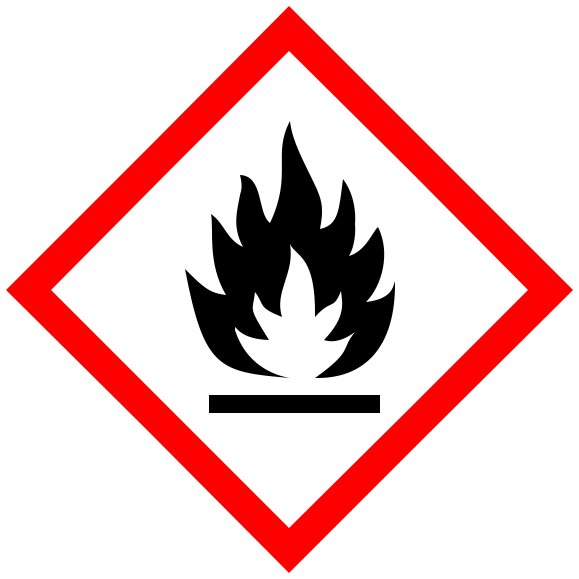
Self-heating substances and mixtures GHS chapter 2.11
Category 2 · pictogram GHS02 (flame) · signal word Warning
Unchanged since 2009.
Present in every UN GHS edition from Rev.3 (2009) to Rev.11 (2025), with the same wording throughout.
Nine editions of the UN model text, 86 hazard statements, 19 of which ever moved. Read the full story in what changed in UN GHS Rev.11.
02 · Languages
H252 in the 24 official EU languages
A label put on the market in an EU country must carry the wording of that country's own language version of CLP — not a translation of the English one. These 24 lines are quoted from the consolidated regulation, Annex III, and are the text to print.
| Language | Official wording of H252 |
|---|---|
| BG български Bulgarian | Самонагряващо се в големи количества; може да се запали. |
| ES español Spanish | Se calienta espontáneamente en grandes cantidades; puede inflamarse. |
| CS čeština Czech | Ve velkém množství se samovolně zahřívá; může se vznítit. |
| DA dansk Danish | Selvopvarmende i store mængder, kan selvantænde. |
| DE Deutsch German | In großen Mengen selbsterhitzungsfähig; kann in Brand geraten. |
| ET eesti Estonian | Suurtes kogustes isekuumenev, võib süttida. |
| EL ελληνικά Greek | Σε μεγάλες ποσότητες αυτοθερμαίνεται: μπορεί να αναφλεγεί. |
| EN English English | Self-heating in large quantities; may catch fire. |
| FR français French | Matière auto-échauffante en grandes quantités; peut s'enflammer. |
| GA Gaeilge Irish | Féintéamh ina mhórchainníochtaí; d'fhéadfadh sé dul trí thine. |
| HR hrvatski Croatian | Samozagrijavanje u velikim količinama; može se zapaliti. |
| IT italiano Italian | Autoriscaldante in grandi quantità; può infiammarsi. |
| LV latviešu Latvian | Lielos apjomos pašsasilstošs; var aizdegties. |
| LT lietuvių Lithuanian | Laikant dideliais kiekiais savaime kaista, gali užsidegti. |
| HU magyar Hungarian | Nagy mennyiségben önmelegedő; meggyulladhat. |
| MT Malti Maltese | Jisħon waħdu f'kwantitajiet kbar; jista' jieħu n-nar. |
| NL Nederlands Dutch | In grote hoeveelheden vatbaar voor zelfverhitting; kan vlam vatten. |
| PL polski Polish | Substancja samonagrzewająca się w dużych ilościach; może się zapalić. |
| PT português Portuguese | Susceptível de auto-aquecimento em grandes quantidades: risco de inflamação. |
| RO română Romanian | Se autoîncălzește în cantități mari; pericol de aprindere. |
| SK slovenčina Slovak | Vo veľkých množstvách sa samovoľne zahrieva; môže sa vznietiť. |
| SL slovenščina Slovenian | Samosegrevanje v velikih količinah; lahko povzroči požar. |
| FI suomi Finnish | Suurina määrinä itsestään kuumeneva; voi syttyä palamaan. |
| SV svenska Swedish | Självupphettande i stora mängder. Kan börja brinna. |
Source: CELEX:02008R1272-20260501, Annex III. © European Union, https://eur-lex.europa.eu — only the electronic Official Journal of the European Union is authentic. Irish is one of the 24 official languages and its H and P texts are printed inside the multilingual Annex tables, but no consolidated CLP has ever been published in Irish — which is why an Irish-primary label cannot be built here.
03 · Legal status
Where H252 is current
GHS is a United Nations model text, revised every two years, and each jurisdiction adopts a revision on its own timetable. A code can be legally current in one system and deleted in another — that is normal, not an error.
| Jurisdiction | Basis | Status of H252 |
|---|---|---|
| EU CLP | Regulation (EC) 1272/2008 CLP Annex IV, Part 2 (consolidated) | Current |
| US OSHA HazCom | 29 CFR 1910.1200 Appendix C UN GHS Rev.7 (final rule of 20 May 2024) | Current |
| US HazCom 2012 | legacy · GHS Rev.3 UN GHS Rev.3, Annex 3 | Current |
| UN GHS | Rev.11 (2025) UN GHS Rev.11, Annex 3 | Current |
Currently in force under: EU CLP, US OSHA HazCom, US HazCom 2012, UN GHS. Sources: EU CLP · US OSHA HazCom · US HazCom 2012 · UN GHS
04 · Substances
Substances carrying H252
Every entry whose harmonised CLP Annex VI classification includes this hazard statement. Substances with a reference page here open on this site; the rest open on ghssymbols.com. Of these, 1 is a group entry such as “salts of picric acid” or “beryllium compounds” — Annex VI gives them no CAS number, so they are listed by Index No and have no page of their own.
- potassium iron(III) 1,3-propanediamine-N,N,N',N'-tetraa… Index No 607-263-00-6
Nothing matches that filter.
All hazard statements
The full list of H-codes with the jurisdiction switch lives on the hazard statements hub. For what to do about the hazard, see precautionary statements (P-codes).
Wording quoted from the regulation named above. Substance counts come from harmonised classifications in CLP Annex VI — the statements on a real product also depend on the supplier's own classification. Always check the supplier safety data sheet.