Physical hazard · In contact with water emits flammable gases
H261 — In contact with water releases flammable gases
Physical hazard statements describe what the substance itself can do — explode, ignite, react, corrode metal. 3 substances with a harmonised EU classification carry this code.
01 · Wording
What H261 says
In contact with water releases flammable gases.
CLP Annex III · Physical hazards
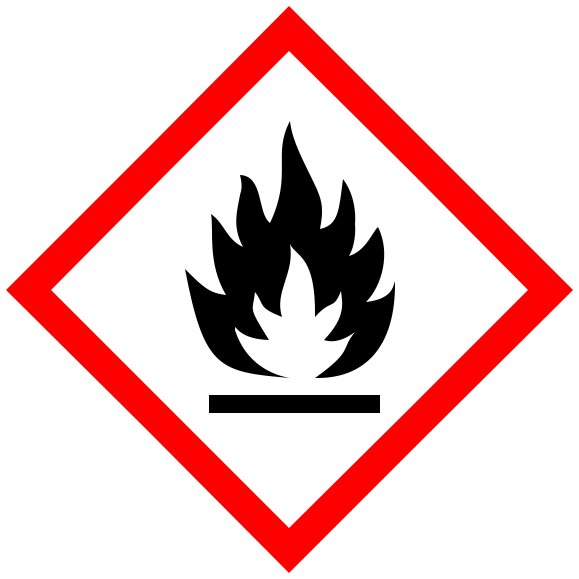
In contact with water emits flammable gases GHS chapter 2.12
Categories 2, 3 · pictogram GHS02 (flame) · signal word Danger or Warning
By category: 2 — GHS02, Danger; 3 — GHS02, Warning
Unchanged since 2009.
Present in every UN GHS edition from Rev.3 (2009) to Rev.11 (2025), with the same wording throughout.
Nine editions of the UN model text, 86 hazard statements, 19 of which ever moved. Read the full story in what changed in UN GHS Rev.11.
02 · Languages
H261 in the 24 official EU languages
A label put on the market in an EU country must carry the wording of that country's own language version of CLP — not a translation of the English one. These 24 lines are quoted from the consolidated regulation, Annex III, and are the text to print.
| Language | Official wording of H261 |
|---|---|
| BG български Bulgarian | При контакт с вода отделя запалими газове. |
| ES español Spanish | En contacto con el agua desprende gases inflamables. |
| CS čeština Czech | Při styku s vodou uvolňuje hořlavé plyny. |
| DA dansk Danish | Ved kontakt med vand udvikles brandfarlige gasser. |
| DE Deutsch German | In Berührung mit Wasser entstehen entzündbare Gase. |
| ET eesti Estonian | Kokkupuutel veega eraldab tuleohtlikke gaase. |
| EL ελληνικά Greek | Σε επαφή με το νερό ελευθερώνει εύφλεκτα αέρια. |
| EN English English | In contact with water releases flammable gases. |
| FR français French | Dégage au contact de l'eau des gaz inflammables. |
| GA Gaeilge Irish | I dteagmháil le huisce scaoiltear gáis inadhainte. |
| HR hrvatski Croatian | U dodiru s vodom oslobađa zapaljive plinove. |
| IT italiano Italian | A contatto con l'acqua libera gas infiammabili. |
| LV latviešu Latvian | Nonākot saskarē ar ūdeni, izdala uzliesmojošu gāzi. |
| LT lietuvių Lithuanian | Kontaktuodami su vandeniu išskiria degias dujas |
| HU magyar Hungarian | Vízzel érintkezve tűzveszélyes gázokat bocsát ki. |
| MT Malti Maltese | Meta jmiss ma' l-ilma jerħi gassijiet li jaqbdu. |
| NL Nederlands Dutch | In contact met water komen ontvlambare gassen vrij. |
| PL polski Polish | W kontakcie z wodą uwalnia łatwopalne gazy. |
| PT português Portuguese | Em contacto com a água liberta gases inflamáveis. |
| RO română Romanian | În contact cu apa degajă gaze inflamabile. |
| SK slovenčina Slovak | Pri kontakte s vodou uvoľňuje horľavé plyny. |
| SL slovenščina Slovenian | V stiku z vodo se sproščajo vnetljivi plini. |
| FI suomi Finnish | Kehittää syttyviä kaasuja veden kanssa. |
| SV svenska Swedish | Vid kontakt med vatten utvecklas brandfarliga gaser. |
Source: CELEX:02008R1272-20260501, Annex III. © European Union, https://eur-lex.europa.eu — only the electronic Official Journal of the European Union is authentic. Irish is one of the 24 official languages and its H and P texts are printed inside the multilingual Annex tables, but no consolidated CLP has ever been published in Irish — which is why an Irish-primary label cannot be built here.
03 · Legal status
Where H261 is current
GHS is a United Nations model text, revised every two years, and each jurisdiction adopts a revision on its own timetable. A code can be legally current in one system and deleted in another — that is normal, not an error.
| Jurisdiction | Basis | Status of H261 |
|---|---|---|
| EU CLP | Regulation (EC) 1272/2008 CLP Annex IV, Part 2 (consolidated) | Current |
| US OSHA HazCom | 29 CFR 1910.1200 Appendix C UN GHS Rev.7 (final rule of 20 May 2024) | Current |
| US HazCom 2012 | legacy · GHS Rev.3 UN GHS Rev.3, Annex 3 | Current |
| UN GHS | Rev.11 (2025) UN GHS Rev.11, Annex 3 | Current |
Currently in force under: EU CLP, US OSHA HazCom, US HazCom 2012, UN GHS. Sources: EU CLP · US OSHA HazCom · US HazCom 2012 · UN GHS
04 · Substances
Substances carrying H261
Every entry whose harmonised CLP Annex VI classification includes this hazard statement. Substances with a reference page here open on this site; the rest open on ghssymbols.com. Of these, 1 is a group entry such as “salts of picric acid” or “beryllium compounds” — Annex VI gives them no CAS number, so they are listed by Index No and have no page of their own.
- aluminium powder (pyrophoric) CAS 7429-90-5
- Calcium CAS 7440-70-2
- magnesium, powder or turnings Index No 012-002-00-9
Nothing matches that filter.
All hazard statements
The full list of H-codes with the jurisdiction switch lives on the hazard statements hub. For what to do about the hazard, see precautionary statements (P-codes).
Wording quoted from the regulation named above. Substance counts come from harmonised classifications in CLP Annex VI — the statements on a real product also depend on the supplier's own classification. Always check the supplier safety data sheet.