Health hazard · Reproductive toxicity
H361 — Suspected of damaging fertility or the unborn child
Health hazard statements describe what the substance does to a person exposed to it. 1 substances with a harmonised EU classification carry this code.
01 · Wording
What H361 says
Suspected of damaging fertility or the unborn child <state specific effect if known> <state route of exposure if it is conclusively proven that no other routes of exposure cause the hazard>. The wording is incomplete on purpose. The specific effect, if known, and the route of exposure under the same condition. CLP Annex VI expresses the known effects as separate codes: H361f, H361d, H361fd.
Suspected of damaging fertility or the unborn child. How it usually reads on a label and on a safety data sheet. We show it separately rather than presenting a filled-in blank as the regulation's own text.
CLP Annex III · Health hazards
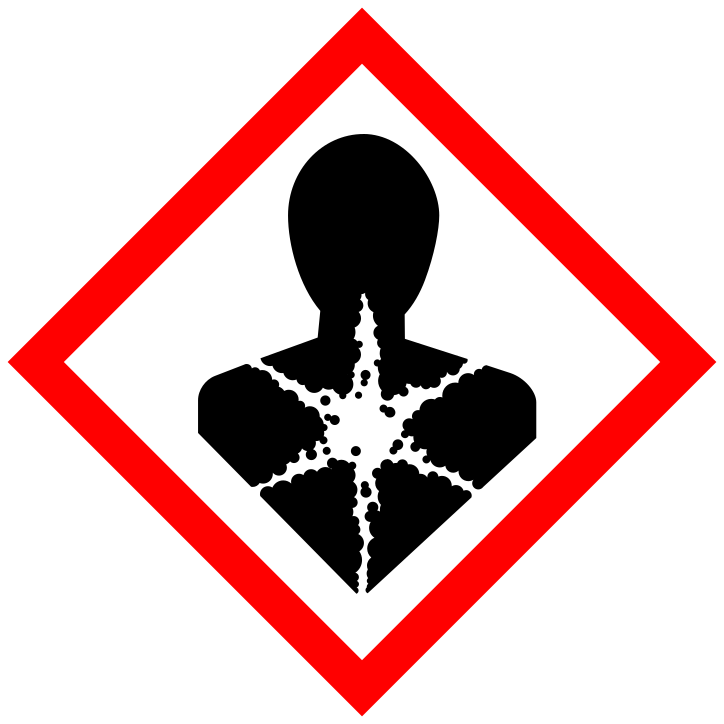
Reproductive toxicity GHS chapter 3.7
Category 2 · pictogram GHS08 (health hazard) · signal word Warning
Reading the official wording. <angle brackets> mark a blank the supplier fills in — not a truncated sentence.· UN GHS prints the same blanks in round brackets, CLP in angle ones.· P-codes use a different notation — an ellipsis and square brackets.
Unchanged since 2009.
Present in every UN GHS edition from Rev.3 (2009) to Rev.11 (2025), with the same wording throughout.
Nine editions of the UN model text, 86 hazard statements, 19 of which ever moved. Read the full story in what changed in UN GHS Rev.11.
02 · Languages
H361 in the 24 official EU languages
A label put on the market in an EU country must carry the wording of that country's own language version of CLP — not a translation of the English one. These 24 lines are quoted from the consolidated regulation, Annex III, and are the text to print.
| Language | Official wording of H361 |
|---|---|
| BG български Bulgarian | Предполага се, че уврежда оплодителната способност или плода < да се посочи конкретното въздействие, ако е известно > < да се посочи пътят на експозицията, ако е доказано убедително, че няма друг път на експозиция, който води до същата опасност >. |
| ES español Spanish | Se sospecha que puede perjudicar la fertilidad o dañar el feto <indíquese el efecto específico si se conoce> <indíquese la vía de exposición si se ha demostrado concluyentemente que el peligro no se produce por ninguna otra vía>. |
| CS čeština Czech | Podezření na poškození reprodukční schopnosti nebo plodu v těle matky <uveďte specifický účinek, je-li znám> <uveďte cestu expozice, je-li přesvědčivě prokázáno, že ostatní cesty expozice nejsou nebezpečné>. |
| DA dansk Danish | Mistænkt for at skade forplantningsevnen eller det ufødte barn <angiv specifik effekt, hvis kendt> <angiv eksponeringsvej, hvis det er endeligt påvist, at faren ikke kan frembringes ad nogen anden eksponeringsvej>. |
| DE Deutsch German | Kann vermutlich die Fruchtbarkeit beeinträchtigen oder das Kind im Mutterleib schädigen <konkrete Wirkung angeben, sofern bekannt> <Expositionsweg angeben, sofern schlüssig belegt ist, dass die Gefahr bei keinem anderen Expositionsweg besteht> |
| ET eesti Estonian | Arvatavasti kahjustab viljakust või loodet <märkida spetsiifiline toime, kui see on teada> <märkida kokkupuuteviis, kui on veenvalt tõestatud, et muud kokkupuuteviisid ei ole ohtlikud>. |
| EL ελληνικά Greek | Ύποπτο για πρόκληση βλάβης στη γονιμότητα ή στο έμβρυο <αναφέρεται η ειδική επίπτωση εάν είναι γνωστή> <αναφέρεται η οδός έκθεσης αν έχει αποδειχθεί αδιαμφισβήτητα ότι δεν υπάρχει κίνδυνος από τις άλλες οδούς έκθεσης>. |
| EN English English | Suspected of damaging fertility or the unborn child <state specific effect if known> <state route of exposure if it is conclusively proven that no other routes of exposure cause the hazard>. |
| FR français French | Susceptible de nuire à la fertilité ou au fœtus <indiquer l'effet s'il est connu> <indiquer la voie d'exposition s'il est formellement prouvé qu'aucune autre voie d'exposition ne conduit au même danger>. |
| GA Gaeilge Irish | Ceaptar go bhféadfadh sé damáiste a dhéanamh do thorthúlacht nó don leanbh sa bhroinn <tabhair an tsainéifeacht más eol > <tabhair an bealach nochta má tá sé cruthaithe go cinntitheach nach bealach nochta ar bith eile is cúis leis an nguais>. |
| HR hrvatski Croatian | Sumnja na moguće štetno djelovanje na plodnost ili mogućnost štetnog djelovanja na nerođeno dijete <navesti konkretan učinak ako je poznat > <navesti način izloženosti ako je nedvojbeno dokazano da niti jedan drugi način izloženosti ne uzrokuje takvu opasnost>. |
| IT italiano Italian | Sospettato di nuocere alla fertilità o al feto <indicare l'effetto specifico, se noto> <indicare la via di esposizione se è accertato che nessun'altra via di esposizione comporta il medesimo pericolo>. |
| LV latviešu Latvian | Ir aizdomas, ka var kaitēt auglībai vai nedzimušajam bērnam <norādīt īpašo ietekmi, ja tā ir zināma> <norādīt iedarbības ceļu, ja ir nepārprotami pierādīts, ka citi iedarbības ceļi nerada bīstamību>. |
| LT lietuvių Lithuanian | Įtariama, kad kenkia vaisingumui arba negimusiam vaikui <nurodyti konkretų poveikį, jeigu žinomas> <nurodyti veikimo būdą, jeigu įtikinamai nustatyta, kad kiti veikimo būdai nepavojingi>. |
| HU magyar Hungarian | Feltehetően károsítja a termékenységet vagy a születendő gyermeket < ha ismert, meg kell adni a konkrét hatást > < meg kell adni az expozíciós útvonalat, ha meggyőzően bizonyított, hogy más expozíciós útvonal nem okozza a veszélyt >. |
| MT Malti Maltese | Suspettat li jagħmel ħsara lill-fertilità jew lit-tarbija li għadha fil-ġuf <semmi l-effett speċifiku jekk ikun magħruf> <semmi l-mod ta' espożizzjoni jekk ikun pruvat b'mod konklużiv li l-ebda mod ta' espożizzjoni ieħor ma jikkawża l-periklu >. |
| NL Nederlands Dutch | Kan mogelijks de vruchtbaarheid of het ongeboren kind schaden <specifiek effect vermelden indien bekend> <blootstellingsroute vermelden indien afdoende bewezen is dat het gevaar bij andere blootstellingsroutes niet aanwezig is>. |
| PL polski Polish | Podejrzewa się, że działa szkodliwie na płodność lub na dziecko w łonie matki <podać szczególny skutek, jeżeli jest znany> <podać drogę narażenia, jeżeli definitywnie udowodniono, że inne drogi narażenia nie stwarzają zagrożenia>. |
| PT português Portuguese | Suspeito de afectar a fertilidade ou o nascituro <indicar o efeito específico se este for conhecido> <indicar a via de exposição se existirem provas concludentes de que o perigo não decorre de nenhuma outra via de exposição>. |
| RO română Romanian | Susceptibil de a dăuna fertilității sau fătului <indicați efectul specific, dacă este cunoscut><indicați calea de expunere, dacă există probe concludente că nicio altă cale de expunere nu provoacă acest pericol>. |
| SK slovenčina Slovak | Podozrenie, že spôsobuje poškodenie plodnosti alebo nenarodeného dieťaťa <uveďte konkrétny účinok, ak je známy > <uveďte spôsob expozície, ak sa presvedčivo preukáže, že iné spôsoby expozície nevyvolávajú nebezpečenstvo>. |
| SL slovenščina Slovenian | Sum škodljivosti za plodnost ali nerojenega otroka <navesti posebni učinek, če je znan> <navesti način izpostavljenosti, če je prepričljivo dokazano, da noben drug način izpostavljenosti ne povzroča takšne nevarnosti>. |
| FI suomi Finnish | Epäillään heikentävän hedelmällisyyttä tai vaurioittavan sikiötä <mainitaan tiedetty spesifinen vaikutus> <mainitaan altistumisreitti, jos on kiistatta osoitettu, että vaara ei voi aiheutua muiden altistumisreittien kautta>. |
| SV svenska Swedish | Misstänks kunna skada fertiliteten eller det ofödda barnet <ange specifik effekt om denna är känd> <ange exponeringsväg om det är definitivt bevisat att faran inte kan orsakas av några andra exponeringsvägar>. |
Source: CELEX:02008R1272-20260501, Annex III. © European Union, https://eur-lex.europa.eu — only the electronic Official Journal of the European Union is authentic. Irish is one of the 24 official languages and its H and P texts are printed inside the multilingual Annex tables, but no consolidated CLP has ever been published in Irish — which is why an Irish-primary label cannot be built here.
03 · Legal status
Where H361 is current
GHS is a United Nations model text, revised every two years, and each jurisdiction adopts a revision on its own timetable. A code can be legally current in one system and deleted in another — that is normal, not an error.
| Jurisdiction | Basis | Status of H361 |
|---|---|---|
| EU CLP | Regulation (EC) 1272/2008 CLP Annex IV, Part 2 (consolidated) | Current |
| US OSHA HazCom | 29 CFR 1910.1200 Appendix C UN GHS Rev.7 (final rule of 20 May 2024) | Current |
| US HazCom 2012 | legacy · GHS Rev.3 UN GHS Rev.3, Annex 3 | Current |
| UN GHS | Rev.11 (2025) UN GHS Rev.11, Annex 3 | Current |
Currently in force under: EU CLP, US OSHA HazCom, US HazCom 2012, UN GHS. Sources: EU CLP · US OSHA HazCom · US HazCom 2012 · UN GHS
04 · Substances
Substances carrying H361
Every entry whose harmonised CLP Annex VI classification includes this hazard statement. Substances with a reference page here open on this site; the rest open on ghssymbols.com.
- Hexabromocyclododecane [1] 1,2,5,6,9,10-hexabromocyclod… CAS 25637-99-4
Nothing matches that filter.
All hazard statements
The full list of H-codes with the jurisdiction switch lives on the hazard statements hub. For what to do about the hazard, see precautionary statements (P-codes).
Wording quoted from the regulation named above. Substance counts come from harmonised classifications in CLP Annex VI — the statements on a real product also depend on the supplier's own classification. Always check the supplier safety data sheet.