Safety data sheet reference · CAS 68-12-2
Dimethylformamide SDS
also: dimethylformamide MSDS · safety data sheet · HCON(CH3)2 · CAS 68-12-2 · EC 200-679-5 · DMF
Official PDF from supplier
This page is a reference, not the legal document.
CAS number
68-12-2
EC number
200-679-5
CLP Annex VI index
616-001-00-X
Molecular formula
C3H7NO
Structural formula
HCON(CH3)2
Molar mass
73.09 g/mol
§ 02 · Hazards identification
Dimethylformamide harmonised EU classification
CLP Annex VI · Index 616-001-00-X. A supplier SDS may add self-classified hazards — this is the legal minimum.
Precautionary statements
Codes ending in a colon introduce the action that follows — on a label they are printed as combined statements, such as P305+P351+P338.
§ 03 · Composition and identifiers
Dimethylformamide molecular structure
Dimethylformamide is a molecular compound. The skeletal formula below is drawn from its PubChem SMILES string, and every value in this section is computed from that structure.
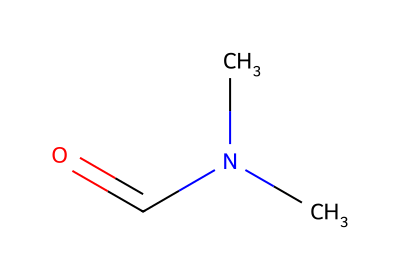
2D skeletal formula · HCON(CH3)2
Functional groups
tertiary amine, amide
Hybridisation
C sp³ ×2, sp² · N sp² · O sp²
Electron count
30 valence e⁻ · 3 lone pairs
Identifiers from PubChem (NIH, public domain). Structure diagram drawn with RDKit from the SMILES string. Geometry and hybridisation are computed from the connection table, not measured.
§ 04 · First-aid measures
Dimethylformamide first aid measures
Call your national emergency number first. These are published first-aid measures, not medical advice, and they do not replace emergency services, a poison control centre or the supplier's safety data sheet.
§4–§6 below reproduce the CAMEO Chemicals entry N,N-DIMETHYLFORMAMIDE. CAMEO publishes response data per product entry, so the entry can describe a solution, a refrigerated liquid or a molten form rather than the pure substance in §9 — check it matches what you are handling.
EYES
First check the victim for contact lenses and remove if present. Flush victim's eyes with water or normal saline solution for 20 to 30 minutes while simultaneously calling a hospital or poison control center. Do not put any ointments, oils, or medication in the victim's eyes without specific instructions from a physician. IMMEDIATELY transport the victim after flushing eyes to a hospital even if no symptoms (such as redness or irritation) develop.
SKIN
IMMEDIATELY flood affected skin with water while removing and isolating all contaminated clothing. Gently wash all affected skin areas thoroughly with soap and water. If symptoms such as redness or irritation develop, IMMEDIATELY call a physician and be prepared to transport the victim to a hospital for treatment.
INHALATION
IMMEDIATELY leave the contaminated area; take deep breaths of fresh air. If symptoms (such as wheezing, coughing, shortness of breath, or burning in the mouth, throat, or chest) develop, call a physician and be prepared to transport the victim to a hospital. Provide proper respiratory protection to rescuers entering an unknown atmosphere. Whenever possible, Self-Contained Breathing Apparatus (SCBA) should be used; if not available, use a level of protection greater than or equal to that advised under Protective Clothing.
INGESTION
DO NOT INDUCE VOMITING. If the victim is conscious and not convulsing, give 1 or 2 glasses of water to dilute the chemical and IMMEDIATELY call a hospital or poison control center. Be prepared to transport the victim to a hospital if advised by a physician. If the victim is convulsing or unconscious, do not give anything by mouth, ensure that the victim's airway is open and lay the victim on his/her side with the head lower than the body. DO NOT INDUCE VOMITING. IMMEDIATELY transport the victim to a hospital.
Source: NTP, 1992 — via CAMEO Chemicals (NOAA), public domain.
§ 05 · Fire-fighting measures
Dimethylformamide fire fighting measures
ERG 2024 · GUIDE 129 Flammable Liquids (Water-Miscible / Noxious)ERG guidance is written per response guide, not per substance — Guide 129 covers every material assigned to it, so a few sentences reference other UN numbers in the same group.
Fire and explosion hazard
Special Hazards of Combustion Products: Vapors are irritating
Extinguishing media and tactics
CAUTIONThe majority of these products have a very low flash point. Use of water spray when fighting fire may be inefficient.
SMALL FIREDry chemical, CO2, water spray or alcohol-resistant foam. Do not use dry chemical extinguishers to control fires involving nitromethane (UN1261) or nitroethane (UN2842).
LARGE FIREWater spray, fog or alcohol-resistant foam. Avoid aiming straight or solid streams directly onto the product. If it can be done safely, move undamaged containers away from the area around the fire.
FIRE INVOLVING TANKS, RAIL TANK CARS OR HIGHWAY TANKSFight fire from maximum distance or use unmanned master stream devices or monitor nozzles. Cool containers with flooding quantities of water until well after fire is out. Withdraw immediately in case of rising sound from venting safety devices or discoloration of tank. ALWAYS stay away from tanks in direct contact with flames. For massive fire, use unmanned master stream devices or monitor nozzles; if this is impossible, withdraw from area and let fire burn.
Source: ERG, 2024 — via CAMEO Chemicals (NOAA), public domain. Entry: N,N-DIMETHYLFORMAMIDE.
§ 06 · Accidental release measures
Dimethylformamide spill and leak response
Containment and clean-up
ELIMINATE all ignition sources (no smoking, flares, sparks or flames) from immediate area. All equipment used when handling the product must be grounded. Do not touch or walk through spilled material. Stop leak if you can do it without risk. Prevent entry into waterways, sewers, basements or confined areas. A vapor-suppressing foam may be used to reduce vapors. Absorb or cover with dry earth, sand or other non-combustible material and transfer to containers. Use clean, non-sparking tools to collect absorbed material.
LARGE SPILLDike far ahead of liquid spill for later disposal. Water spray may reduce vapor, but may not prevent ignition in closed spaces.
Initial isolation and evacuation
IMMEDIATE PRECAUTIONARY MEASUREIsolate spill or leak area for at least 50 meters (150 feet) in all directions.
LARGE SPILLConsider initial downwind evacuation for at least 300 meters (1000 feet).
FIREIf tank, rail tank car or highway tank is involved in a fire, ISOLATE for 800 meters (1/2 mile) in all directions; also, consider initial evacuation for 800 meters (1/2 mile) in all directions.
Source: ERG, 2024 — via CAMEO Chemicals (NOAA), public domain. Entry: N,N-DIMETHYLFORMAMIDE.
§ 07 · Handling and storage
Dimethylformamide computed storage compatibility
Derived from CLP Annex VI classification and CAMEO reactive-group data — not copied from a PDF.
Full interactive verdict — reactions, gas release on contact, ADR forms →
§ 08 · Exposure controls
Dimethylformamide exposure limits (IDLH)
IDLH
Immediately Dangerous to Life or Health
500 ppm
NIOSH Pocket Guide — Dimethylformamide →
IDLH from the NIOSH Pocket Guide to Chemical Hazards (CDC, U.S. public domain), via CAMEO Chemicals. Occupational exposure limits — OSHA PEL, NIOSH REL and EU IOELV — are not published on this page yet.
§ 09 · Physical and chemical properties
Dimethylformamide physical properties
Fire-relevant values first — flash point and explosion limits decide the storage and ventilation regime.
Flash point
67.2 °C
Explosion limits
2.2 – 15.2 %
LEL / UEL in air, vol.
Autoignition
445 °C
Source: CAMEO Chemicals (NOAA, public domain); per-value source references stored in the database.
§ 10 · Stability and reactivity
Reactive group (CAMEO/NOAA): Amides and Imides. Our database documents 11 incompatible and 16 caution reaction-partner groups for dimethylformamide — including which combinations release gas on contact. See the per-partner breakdown with gas release →
11
Incompatible
16
Caution
§ 13 · Disposal considerations
Dispose of waste and residues in accordance with local and national regulations — in the EU under the Waste Framework Directive 2008/98/EC. Never discharge to drains or municipal waste; hand contaminated packaging and unused product to an authorised waste-disposal company. The supplier's SDS section 13 lists the applicable waste codes for the specific product.
MSDS vs SDS
Dimethylformamide MSDS vs SDS: is there a difference?
MSDS (Material Safety Data Sheet) is the older name for the same document. In the US, OSHA's Hazard Communication Standard (2012) adopted the GHS-standardised 16-section Safety Data Sheet; in the EU the format is set by REACH Annex II. So a "dimethylformamide MSDS" and a "dimethylformamide SDS" refer to the same document — today it is issued as an SDS. Full breakdown of the differences →
Substance profile
What dimethylformamide is
Physical and chemical properties with the conditions each value was measured under, synonyms, formula and the harmonised CLP classification →
Compliance hub
From classification to SDS
The classification above corresponds to Section 2 of a Safety Data Sheet. Learn how a compliant 16-section SDS is structured and authored →
GHS label maker
Build the label for dimethylformamide
Pictograms, signal word and H-statements combined into a compliant label layout →
Mixture classifier
dimethylformamide inside a formulation
This sheet classifies dimethylformamide on its own. In a mixture its concentration decides: the calculator applies the Annex I limits to the whole composition and quotes the rule behind every class →
§ 16 · Sources
- Classification: Regulation (EC) No 1272/2008 (CLP), Annex VI
- Transport: UN ADR 2025 (UNECE), Table A
- Reactivity: NOAA CAMEO Chemicals reactive-group matrix (public domain)
- Physical properties: CAMEO Chemicals (NOAA, public domain) — per-value source references stored in the database
- Emergency response (§4–§6): ERG 2024 (PHMSA) · NIOSH Pocket Guide (CDC) · CHRIS (USCG) · NTP · EPA — via CAMEO Chemicals (NOAA), all US federal public domain, reproduced verbatim
- Substance data: PubChem · ECHA
Reference aid only. This page summarises the harmonised EU classification and computed storage guidance — it is not a Safety Data Sheet and does not replace one. Always verify hazards, handling and storage against the supplier's SDS (sections 7 and 10) and local regulations before use. Page updated 2026-10-10.
Frequently asked questions about dimethylformamide
Is an MSDS the same as an SDS?
In practice, yes. MSDS (Material Safety Data Sheet) is the older name for the same document. In the US, OSHA's Hazard Communication Standard (2012) adopted the GHS-standardised 16-section Safety Data Sheet; in the EU the SDS format is set by REACH Annex II. A document you find labelled "dimethylformamide MSDS" is today issued as an SDS.
What GHS pictograms does dimethylformamide require?
Under the harmonised EU classification (CLP Annex VI), dimethylformamide carries GHS07 and GHS08 with the signal word "Danger". Hazard statements: H360D, H332, H312, H319. A supplier's SDS may add self-classified hazards on top of this harmonised minimum.
Where can I download an official dimethylformamide SDS PDF?
From your own supplier — an SDS is issued per product and supplier, so the correct PDF for an inspection is the one matching the product you actually purchased. The supplier links on this page lead to the official SDS libraries of major distributors.
Call emergency services first
112 in the EU · 911 in the US. This screen is published response information, not medical advice, and it does not replace emergency services, a poison centre or the supplier's safety data sheet.
Text below is the CAMEO Chemicals entry N,N-DIMETHYLFORMAMIDE — confirm it matches the form in front of you.
01 · First aid
What to do for the person
EYES
First check the victim for contact lenses and remove if present. Flush victim's eyes with water or normal saline solution for 20 to 30 minutes while simultaneously calling a hospital or poison control center. Do not put any ointments, oils, or medication in the victim's eyes without specific instructions from a physician. IMMEDIATELY transport the victim after flushing eyes to a hospital even if no symptoms (such as redness or irritation) develop.
SKIN
IMMEDIATELY flood affected skin with water while removing and isolating all contaminated clothing. Gently wash all affected skin areas thoroughly with soap and water. If symptoms such as redness or irritation develop, IMMEDIATELY call a physician and be prepared to transport the victim to a hospital for treatment.
INHALATION
IMMEDIATELY leave the contaminated area; take deep breaths of fresh air. If symptoms (such as wheezing, coughing, shortness of breath, or burning in the mouth, throat, or chest) develop, call a physician and be prepared to transport the victim to a hospital. Provide proper respiratory protection to rescuers entering an unknown atmosphere. Whenever possible, Self-Contained Breathing Apparatus (SCBA) should be used; if not available, use a level of protection greater than or equal to that advised under Protective Clothing.
INGESTION
DO NOT INDUCE VOMITING. If the victim is conscious and not convulsing, give 1 or 2 glasses of water to dilute the chemical and IMMEDIATELY call a hospital or poison control center. Be prepared to transport the victim to a hospital if advised by a physician. If the victim is convulsing or unconscious, do not give anything by mouth, ensure that the victim's airway is open and lay the victim on his/her side with the head lower than the body. DO NOT INDUCE VOMITING. IMMEDIATELY transport the victim to a hospital.
02 · Fire
Extinguishing and tactics
Fire and explosion hazard
Special Hazards of Combustion Products: Vapors are irritating
Extinguishing media and tactics
CAUTIONThe majority of these products have a very low flash point. Use of water spray when fighting fire may be inefficient.
SMALL FIREDry chemical, CO2, water spray or alcohol-resistant foam. Do not use dry chemical extinguishers to control fires involving nitromethane (UN1261) or nitroethane (UN2842).
LARGE FIREWater spray, fog or alcohol-resistant foam. Avoid aiming straight or solid streams directly onto the product. If it can be done safely, move undamaged containers away from the area around the fire.
FIRE INVOLVING TANKS, RAIL TANK CARS OR HIGHWAY TANKSFight fire from maximum distance or use unmanned master stream devices or monitor nozzles. Cool containers with flooding quantities of water until well after fire is out. Withdraw immediately in case of rising sound from venting safety devices or discoloration of tank. ALWAYS stay away from tanks in direct contact with flames. For massive fire, use unmanned master stream devices or monitor nozzles; if this is impossible, withdraw from area and let fire burn.
03 · Spill
Containment, isolation, evacuation
Containment and clean-up
ELIMINATE all ignition sources (no smoking, flares, sparks or flames) from immediate area. All equipment used when handling the product must be grounded. Do not touch or walk through spilled material. Stop leak if you can do it without risk. Prevent entry into waterways, sewers, basements or confined areas. A vapor-suppressing foam may be used to reduce vapors. Absorb or cover with dry earth, sand or other non-combustible material and transfer to containers. Use clean, non-sparking tools to collect absorbed material.
LARGE SPILLDike far ahead of liquid spill for later disposal. Water spray may reduce vapor, but may not prevent ignition in closed spaces.
Initial isolation and evacuation
IMMEDIATE PRECAUTIONARY MEASUREIsolate spill or leak area for at least 50 meters (150 feet) in all directions.
LARGE SPILLConsider initial downwind evacuation for at least 300 meters (1000 feet).
FIREIf tank, rail tank car or highway tank is involved in a fire, ISOLATE for 800 meters (1/2 mile) in all directions; also, consider initial evacuation for 800 meters (1/2 mile) in all directions.
Sources: ERG 2024 (PHMSA) · NIOSH Pocket Guide (CDC) · CHRIS (USCG) · NTP · EPA — via CAMEO Chemicals (NOAA), public domain. Text reproduced verbatim.