Substance profile
2,4,6-trinitroresorcinol
2,4,6-trinitroresorcinol: CBI; Wet Solid.
01 · Identification
What 2,4,6-trinitroresorcinol is
2,4,6-trinitroresorcinol: CBI; Wet Solid. Its molecular formula is C6H3N3O8 and its molecular weight is 245.1 g/mol.
Under the GHS it carries the signal word Danger. It is classed as flammable agents - 4th degree.
02 · Identifiers
2,4,6-trinitroresorcinol identifiers and molecular data
2,4,6-trinitroresorcinol CAS number and EC number
2,4,6-trinitroresorcinol molecular formula and molecular weight
Other names for 2,4,6-trinitroresorcinol
- styphnic acid
03 · GHS classification
2,4,6-trinitroresorcinol hazard classification
Harmonised classification under CLP Annex VI. This is the legally binding classification in the EU; other jurisdictions may differ.
2,4,6-trinitroresorcinol pictograms and signal word
2,4,6-trinitroresorcinol hazard class and category
| Hazard class | Category | From code | Pictogram |
|---|---|---|---|
| Explosives GHS chapter 2.1 | Category 1.1 | H201 | GHS01 |
| Acute toxicity - oral GHS chapter 3.1 | Category 4 | H302 | GHS07 |
| Acute toxicity - dermal GHS chapter 3.1 | Category 4 | H312 | GHS07 |
| Acute toxicity - inhalation GHS chapter 3.1 | Category 4 | H332 | GHS07 |
2,4,6-trinitroresorcinol hazard statements (H-codes)
| Code | Hazard statement |
|---|---|
| H201 | Explosive; mass explosion hazard. |
| H332 | Harmful if inhaled. |
| H312 | Harmful in contact with skin. |
| H302 | Harmful if swallowed. |
This page lists only the codes assigned to 2,4,6-trinitroresorcinol. The full reference lives on the hazard statements hub, the precautionary statements hub and the GHS pictograms hub.
Safety Data Sheet
Getting an SDS for 2,4,6-trinitroresorcinol
A Safety Data Sheet is written for a product, not for a substance: the supplier of the grade you actually buy issues it, so two suppliers of 2,4,6-trinitroresorcin… issue two different sheets. That is why there is no single authoritative SDS for a substance to download — what there is, is the job of collecting the sheets for the products you hold and keeping them current as suppliers revise them.
04 · Precautionary statements
2,4,6-trinitroresorcinol precautionary statements
CLP Annex VI assigns 11 precautionary statements to 2,4,6-trinitroresorcinol. They are grouped the way a label groups them: what to do before handling, what to do when something has already happened, how to store it and how to dispose of it.
Prevention
What to do before and during handling so the hazard never happens.
Response
What to do once exposure, spillage or fire has already happened.
Reading the notation. … is a blank the supplier fills in — not a truncated sentence.· [square brackets] mark a part printed only when it applies.
05 · Names in the regulation
2,4,6-trinitroresorcinol name in 23 EU languages
CLP Annex VI Part 3 is published in every language edition of the regulation, and the identification column is written out in each of them. Nothing below is translated by us: each line is the name as that edition prints it. Under Art. 18(2) the substance name from Annex VI is a lawful product identifier, so this is the wording to put on a label going to that market — and where the cell lists several designations, any one of them qualifies.
| Language | Name in CLP Annex VI Part 3 |
|---|---|
| Bulgarian български | 2,4,6-тринитрорезорцинол стифнинова киселина |
| Spanish español | 2,4,6-Trinitro-resorcinol ácido estífnico |
| Czech čeština | 2,4,6-trinitroresorcinol styfnová kyselina |
| Danish dansk | 2,4,6-trinitroresorcinol styphninsyre |
| German Deutsch | 2,4,6-Trinitroresorcin Styphninsäure2,4,6-Trinitro-1,3-dihydroxybenzol |
| Estonian eesti | 2,4,6-trinitroresortsinool v stüfniinhape |
| Greek ελληνικά | 2,4,6-τρινιτρορεσορκίνη στυφνικό οξύ |
| English English | 2,4,6-trinitroresorcinol styphnic acid |
| French français | 2,4,6-trinitrorésorcinol acide styphnique |
| Croatian hrvatski | 2,4,6-trinitrorezorcinol stifninska kiselina |
| Italian italiano | 2,4,6-trinitroresorcinolo acido stifnico |
| Latvian latviešu | 2,4,6-trinitrorezorcīns stifnīnskābe |
| Lithuanian lietuvių | 2,4,6-trinitrorezorcinolis stifno rūgštis |
| Hungarian magyar | 2,4,6-trinitrorezorcin sztifninsav |
| Maltese Malti | 2,4,6-trinitroresorċinol aċid stifniku |
| Dutch Nederlands | 2,4,6-trinitroresorcinol styfninezuur |
| Polish polski | 2,4,6-trinitrorezorcynol 2,4,6-trinitrorezorcynakwas styfninowy |
| Portuguese português | 2,4,6-trinitrorresorcinol ácido estífnico |
| Romanian română | 2,4,6-trinitroresorcinol acid stifnic |
| Slovak slovenčina | 2,4,6-trinitrobenzén-1,3-diol kyselina styfnová |
| Slovenian slovenščina | 2,4,6-trinitrorezorcinol stifninska kislina |
| Finnish suomi | 2,4,6-trinitroresorsinoli styfniinihappo |
| Swedish svenska | 2,4,6-trinitroresorcinol styfninsyra |
All 23 language editions of Annex VI carry this entry. Irish is the twenty-fourth official EU language and has no line here for a different reason: no consolidated CLP text has ever been published in Irish, so there is no Irish edition of Annex VI to quote a name from. Source: consolidated CLP, CELEX 02008R1272, language editions. © European Union, https://eur-lex.europa.eu — only the electronic Official Journal of the European Union is authentic.
06 · Label elements
2,4,6-trinitroresorcinol GHS label elements
Everything CLP Annex VI fixes for 2,4,6-trinitroresorcinol, laid out the way it appears on a label. The greyed lines are the parts only the supplier can fill in.
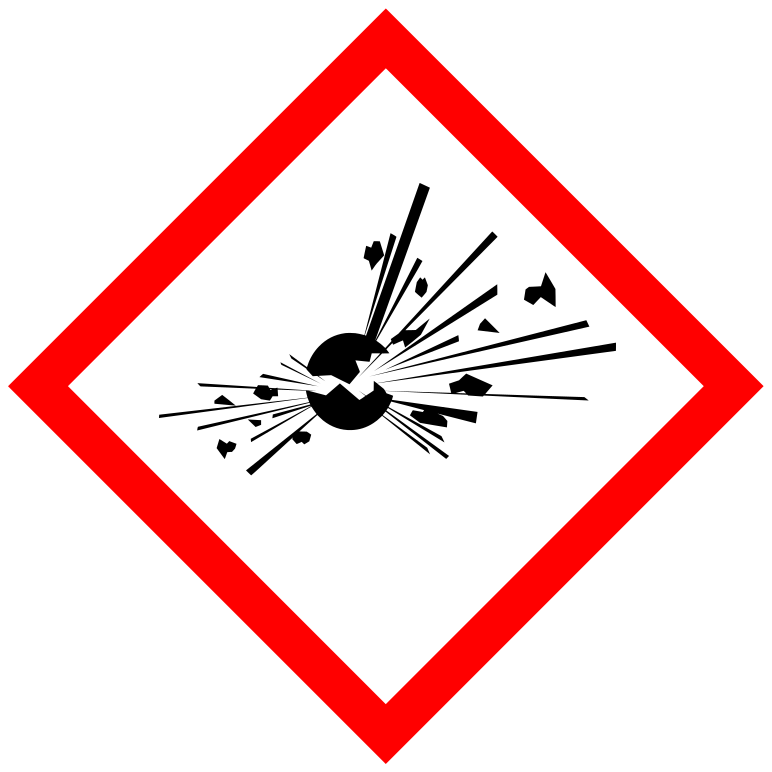

Danger
2,4,6-trinitroresorcinol
- Explosive; mass explosion hazard.
- Harmful if inhaled.
- Harmful in contact with skin.
- Harmful if swallowed.
- Keep away from heat, hot surfaces, sparks, open flames and other ignition sources. No smoking.
- Do not breathe dust/fume/gas/mist/vapours/spray.
- Do not eat, drink or smoke when using this product.
- Use only outdoors or in a well-ventilated area.
- Wear protective gloves/protective clothing/eye protection/face protection/hearing protection/…
- IF SWALLOWED:
- IF ON SKIN:
- IF INHALED:
- Call a POISON CENTER/doctor/… if you feel unwell.
- Rinse mouth.
- Wash with plenty of water/…
Supplier name, address and telephone number· Product identifier·Nominal quantity
Need this as an actual label? Open 2,4,6-trinitroresorcinol in the GHS label constructor →
07 · Health hazards
2,4,6-trinitroresorcinol health hazards and exposure limits
2,4,6-trinitroresorcinol hazard summary
A strong oxidizing agent; Highly sensitive to heat and may explode; [CAMEO] Explosive; A skin and eye irritant; May cause CNS depression and methemoglobinemia followed by liver and kidney injury; Toxic to the kidney, blood, and nervous system; Harmful by ingestion, inhalation, and skin absorption; [Olin Winchester Ammunition MSDS] See Barium styphnate. See 1,3,5-Trinitrobenzene.
Source: Haz-Map, Information on Hazardous Chemicals and Occupational Diseases
08 · Handling and storage
2,4,6-trinitroresorcinol storage and handling
2,4,6-trinitroresorcinol reactivity
Aromatic nitro compounds, such as TRINITRORESORCINOL, range from slight to strong oxidizing agents. If mixed with reducing agents, including hydrides, sulfides and nitrides, they may begin a vigorous reaction that culminates in a detonation. The aromatic nitro compounds may explode in the presence of a base such as sodium hydroxide or potassium hydroxide even in the presence of water or organic solvents. The explosive tendencies of aromatic nitro compounds are increased by the presence of multiple nitro groups.
Source: CAMEO Chemicals
Planning storage for a mix of chemicals? Check 2,4,6-trinitroresorcinol in the storage compatibility matrix →
09 · Questions
2,4,6-trinitroresorcinol — frequently asked questions
What is the CAS number of 2,4,6-trinitroresorcinol?
The CAS number of 2,4,6-trinitroresorcinol is 82-71-3. Its EC number is 201-436-6.
What is the chemical formula of 2,4,6-trinitroresorcinol?
The molecular formula of 2,4,6-trinitroresorcinol is C6H3N3O8 and its molecular weight is 245.1 g/mol.
What does a 2,4,6-trinitroresorcinol label have to show?
Under CLP Annex VI the label for 2,4,6-trinitroresorcinol carries the pictograms Exploding bomb and Exclamation mark and the signal word is Danger.
Is 2,4,6-trinitroresorcinol flammable?
CLP Annex VI assigns 2,4,6-trinitroresorcinol no flammability hazard class. That is not a statement that it cannot burn: the harmonised list only records the hazards that were assessed for it.
Is 2,4,6-trinitroresorcinol a carcinogen?
CLP Annex VI records no harmonised carcinogenicity classification for 2,4,6-trinitroresorcinol. Annex VI is a list of agreed classifications, not a list of substances found safe, so this is an absence of a classification rather than a clean bill of health.
Nearby
Substances next to 2,4,6-trinitroresorcinol
Keep going: substances starting with 0–9, or search the whole database by name, CAS number, pictogram or signal word.