Substance profile
2,6-dimethylheptan-4-one
2,6-dimethylheptan-4-one is a water clear liquid with a peppermint odor.
01 · Identification
What 2,6-dimethylheptan-4-one is
2,6-dimethylheptan-4-one is a water clear liquid with a peppermint odor. It boils at 168 °C, melts at -41.6 °C, is miscible with water.
Under the GHS it carries the signal word Warning. It is classed as flammable agents - 2nd degree.
02 · Identifiers
2,6-dimethylheptan-4-one identifiers and molecular data
2,6-dimethylheptan-4-one CAS number and EC number
2,6-dimethylheptan-4-one molecular formula and molecular weight
Other names for 2,6-dimethylheptan-4-one
- di-isobutyl ketone
03 · GHS classification
2,6-dimethylheptan-4-one hazard classification
Harmonised classification under CLP Annex VI. This is the legally binding classification in the EU; other jurisdictions may differ.
2,6-dimethylheptan-4-one pictograms and signal word
2,6-dimethylheptan-4-one hazard class and category
| Hazard class | Category | From code | Pictogram |
|---|---|---|---|
| Flammable liquids GHS chapter 2.6 | Category 3 | H226 | GHS02 |
| Specific target organ toxicity - single exposure GHS chapter 3.8 | Category 3 | H335 | GHS07 |
2,6-dimethylheptan-4-one hazard statements (H-codes)
| Code | Hazard statement |
|---|---|
| H226 | Flammable liquid and vapour. |
| H335 | May cause respiratory irritation. |
This page lists only the codes assigned to 2,6-dimethylheptan-4-one. The full reference lives on the hazard statements hub, the precautionary statements hub and the GHS pictograms hub.
Safety Data Sheet
Getting an SDS for 2,6-dimethylheptan-4-one
A Safety Data Sheet is written for a product, not for a substance: the supplier of the grade you actually buy issues it, so two suppliers of 2,6-dimethylheptan-4-o… issue two different sheets. That is why there is no single authoritative SDS for a substance to download — what there is, is the job of collecting the sheets for the products you hold and keeping them current as suppliers revise them.
04 · Precautionary statements
2,6-dimethylheptan-4-one precautionary statements
CLP Annex VI assigns 5 precautionary statements to 2,6-dimethylheptan-4-one. They are grouped the way a label groups them: what to do before handling, what to do when something has already happened, how to store it and how to dispose of it.
Prevention
What to do before and during handling so the hazard never happens.
Reading the notation. … is a blank the supplier fills in — not a truncated sentence.· [square brackets] mark a part printed only when it applies.
05 · Names in the regulation
2,6-dimethylheptan-4-one name in 23 EU languages
CLP Annex VI Part 3 is published in every language edition of the regulation, and the identification column is written out in each of them. Nothing below is translated by us: each line is the name as that edition prints it. Under Art. 18(2) the substance name from Annex VI is a lawful product identifier, so this is the wording to put on a label going to that market — and where the cell lists several designations, any one of them qualifies.
| Language | Name in CLP Annex VI Part 3 |
|---|---|
| Bulgarian български | 2,6-диметилхептан-4-он диизобутилкетон |
| Spanish español | 2,6-Dimetilheptan-4-ona diisobutilcetona |
| Czech čeština | 2,6-dimethylheptan-4-on diisobutylketon |
| Danish dansk | 2,6-dimethyl-4-heptanon diisobutylketon |
| German Deutsch | 2,6-Dimethylheptan-4-on Diisobutylketon |
| Estonian eesti | 2,6-dimetüülheptaan-4-oon diisobutüülketoon |
| Greek ελληνικά | 2,6-διμεθυλεπταν-4-όνη διισοβουτυλοκετόνη |
| English English | 2,6-dimethylheptan-4-one di-isobutyl ketone |
| French français | 2,6-diméthylheptan-4-one di-isobutylcétone |
| Croatian hrvatski | 2,6-dimetilheptan-4-on diizobutil-keton |
| Italian italiano | 2,6-dimetil-eptan-4-one diisobutilchetone |
| Latvian latviešu | 2,6-dimetilheptān-4-ons diizobutilketons |
| Lithuanian lietuvių | 2,6-dimetil-4-heptanonas diizobutilketonas |
| Hungarian magyar | 2,6-dimetilheptán-4-on diizobutil-keton |
| Maltese Malti | 2,6-dimetilettan-4-on keton tad-di-isobutil |
| Dutch Nederlands | 2,6-dimethylheptaan-4-on diisobutylketon |
| Polish polski | 2,6-dimetyloheptan-4-on keton diizobutylowy |
| Portuguese português | 2,6-dimetil-4-heptanona diisobutilcetona |
| Romanian română | 2,6-dimetilheptan-4-onă di-izobutil-cetonă |
| Slovak slovenčina | 2,6-dimetylheptán-4-ón diizobutylketón |
| Slovenian slovenščina | 2,6-dimetilheptan-4-on diizobutil keton |
| Finnish suomi | 2,6-dimetyyliheptan-4-oni di-isobutyyliketoni |
| Swedish svenska | 2,6-dimetylheptan-4-on diisobutylketon |
All 23 language editions of Annex VI carry this entry. Irish is the twenty-fourth official EU language and has no line here for a different reason: no consolidated CLP text has ever been published in Irish, so there is no Irish edition of Annex VI to quote a name from. Source: consolidated CLP, CELEX 02008R1272, language editions. © European Union, https://eur-lex.europa.eu — only the electronic Official Journal of the European Union is authentic.
06 · Label elements
2,6-dimethylheptan-4-one GHS label elements
Everything CLP Annex VI fixes for 2,6-dimethylheptan-4-one, laid out the way it appears on a label. The greyed lines are the parts only the supplier can fill in.
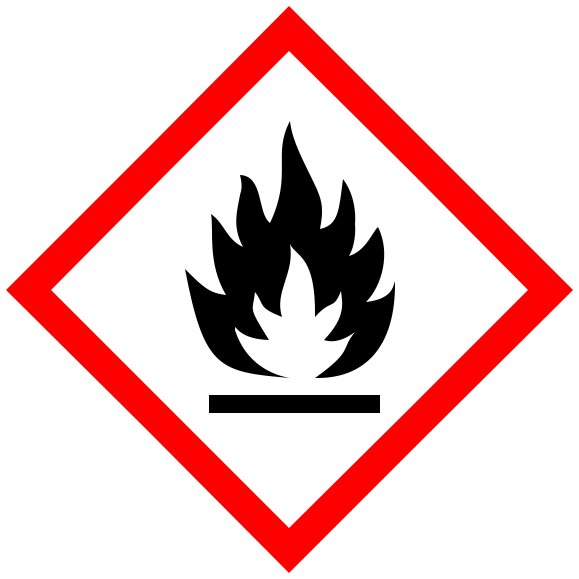

Warning
2,6-dimethylheptan-4-one
- Flammable liquid and vapour.
- May cause respiratory irritation.
- Keep away from heat, hot surfaces, sparks, open flames and other ignition sources. No smoking.
- Keep container tightly closed.
- Use explosion-proof [electrical/ventilating/lighting/…] equipment.
- Use only non-sparking tools.
- Store in a well-ventilated place.
Supplier name, address and telephone number· Product identifier·Nominal quantity
Need this as an actual label? Open 2,6-dimethylheptan-4-one in the GHS label constructor →
07 · Health hazards
2,6-dimethylheptan-4-one health hazards and exposure limits
2,6-dimethylheptan-4-one hazard summary
Humans experience offensive irritating effects below concentrations that cause CNS depression in experimental animals. [HSDB]
Source: Haz-Map, Information on Hazardous Chemicals and Occupational Diseases
2,6-dimethylheptan-4-one occupational exposure limits
| Limit | Value | Source |
|---|---|---|
| PEL | 50.0 [ppm] | Haz-Map, Information on Hazardous Chemicals and Occupational Diseases |
| PEL | 50 ppm (290 mg/m³) | Occupational Safety and Health Administration (OSHA) |
| PEL | TWA 50 ppm (290 mg/m3) See Appendix G | The National Institute for Occupational Safety and Health (NIOSH) |
| REL | 25 ppm (150 mg/m³) | Occupational Safety and Health Administration (OSHA) |
| REL | TWA 25 ppm (150 mg/m3) | The National Institute for Occupational Safety and Health (NIOSH) |
| IDLH | 500 ppm (NIOSH, 2024) | CAMEO Chemicals |
| IDLH | 500.0 [ppm] | Haz-Map, Information on Hazardous Chemicals and Occupational Diseases |
| IDLH | Excerpts from Documentation for IDLHs: Human data: It has been reported that a 3hour exposure at 50 or 100 ppm caused slight irritation to the eyes, nose, and throat [Smyth et al. 1949]. | Haz-Map, Information on Hazardous Chemicals and Occupational Diseases |
These are United States values. The European Union sets its own indicative and binding limits, and the figure that applies at a given workplace is the one in the local regulation — not the one shown here.
08 · Physical and chemical properties
2,6-dimethylheptan-4-one properties
Every value is shown with the conditions it was measured under and the source it came from. Where sources disagree, all values are listed rather than one being picked — the difference is usually a different form of the substance, not an error.
2,6-dimethylheptan-4-one boiling point
| Property | Value | Conditions | Source |
|---|---|---|---|
| Boiling point | 169.4 °C (336.9 °F) | HSDB | |
| 167.78 °C (334 °F) | NIOSH | ||
| 166.11 °C (331 °F) | at 760 mmHg | CAMEO |
2,6-dimethylheptan-4-one melting point
| Property | Value | Conditions | Source |
|---|---|---|---|
| Melting point | -41.5 °C (-42.7 °F) | HSDB | |
| -41.67 °C (-43 °F) | NIOSH | ||
| -46.39 °C (-51.5 °F) | CAMEO |
2,6-dimethylheptan-4-one density
| Property | Value | Conditions | Source |
|---|---|---|---|
| Density | 0.81 g/cm³ | NIOSH | |
| 0.8062 g/cm³ | at 20 °C | HSDB | |
| Bulk density: 6.7 lb/gal at 20 °C; coefficient of expansion: 0.00101 at 20 °C | at 20 °C | HSDB |
2,6-dimethylheptan-4-one solubility
| Property | Value | Conditions | Source |
|---|---|---|---|
| Solubility | Miscible with ethanol, ether; soluble in carbon tetrachloride | HSDB | |
| SOL IN CHLOROFORM | HSDB | ||
| Miscible with benzene | HSDB |
2,6-dimethylheptan-4-one vapor pressure
| Property | Value | Conditions | Source |
|---|---|---|---|
| Vapor pressure | 2 mmHg | NIOSH | |
| 2.4 mmHg | CAMEO | ||
| 1.65 mmHg | at 25 °C | HSDB |
2,6-dimethylheptan-4-one flash point
| Property | Value | Conditions | Source |
|---|---|---|---|
| Flash point | 48.89 °C (120 °F) | HSDB | |
| 60 °C (140 °F) | CAMEO |
2,6-dimethylheptan-4-one autoignition temperature
| Property | Value | Conditions | Source |
|---|---|---|---|
| Autoignition temperature | 396.11 °C (745 °F) | HSDB | |
| 396 °C (744.8 °F) | ICSC |
2,6-dimethylheptan-4-one lower explosive limit (LEL)
| Property | Value | Conditions | Source |
|---|---|---|---|
| Lower explosive limit (LEL) | 0.8 % by volume | DOE PAC | |
| 0.8 % by volume | at 93.33 °C | HSDB | |
| 0.8 % by volume | at 100 °C | HSDB |
2,6-dimethylheptan-4-one upper explosive limit (UEL)
| Property | Value | Conditions | Source |
|---|---|---|---|
| Upper explosive limit (UEL) | 7.1 % by volume | at 93.33 °C | HSDB |
| 6.2 % by volume | at 100 °C | HSDB |
2,6-dimethylheptan-4-one vapor density
| Property | Value | Conditions | Source |
|---|---|---|---|
| Vapor density | 4.9 (air = 1) | HSDB |
2,6-dimethylheptan-4-one odor threshold
| Property | Value | Conditions | Source |
|---|---|---|---|
| Odor threshold | < 0.11 ppm | HSDB | |
| 3.1X10⁻¹ ppm (recognition in air, purity not specified) | HSDB | ||
| Odor (high)= 1.8600 mg/cu m, odor (low)= 0.660 mg/cu m, irritating concn 150.00 mg/cu m. | HSDB |
Values compiled from PubChem Laboratory Chemical Safety Summary. Temperatures converted to Fahrenheit for reference.
09 · Fire and explosion
2,6-dimethylheptan-4-one fire and explosion behaviour
These are descriptions rather than measured values, so they are kept out of the table above and quoted here with the source that reported them.
2,6-dimethylheptan-4-one fire potential
Flammable liquid when exposed to heat or flame ...
Source: Hazardous Substances Data Bank (HSDB)
10 · Handling and storage
2,6-dimethylheptan-4-one storage and handling
2,6-dimethylheptan-4-one safe storage
Fireproof. Separated from strong oxidants.
Source: ILO-WHO International Chemical Safety Cards (ICSCs)
2,6-dimethylheptan-4-one storage conditions
MATERIALS WHICH ARE TOXIC AS STORED OR WHICH CAN DECOMPOSE INTO TOXIC COMPONENTS ... SHOULD BE STORED IN A COOL, WELL VENTILATED PLACE, OUT OF THE DIRECT RAYS OF THE SUN, AWAY FROM AREAS OF HIGH FIRE HAZARD, AND SHOULD BE PERIODICALLY INSPECTED. IMCOMPATIBLE MATERIALS SHOULD BE ISOLATED.
Source: Hazardous Substances Data Bank (HSDB)
2,6-dimethylheptan-4-one incompatible materials
Reacts with oxidants. Attacks some forms of plastics.
Source: Hazardous Substances Data Bank (HSDB)
2,6-dimethylheptan-4-one reactivity
DIISOBUTYL KETONE may attack some plastics. It reacts with oxidizers. (NTP, 1992)
Source: CAMEO Chemicals
Planning storage for a mix of chemicals? Check 2,6-dimethylheptan-4-one in the storage compatibility matrix →
11 · Questions
2,6-dimethylheptan-4-one — frequently asked questions
What is the CAS number of 2,6-dimethylheptan-4-one?
The CAS number of 2,6-dimethylheptan-4-one is 108-83-8. Its EC number is 203-620-1.
What does a 2,6-dimethylheptan-4-one label have to show?
Under CLP Annex VI the label for 2,6-dimethylheptan-4-one carries the pictograms Flame and Exclamation mark and the signal word is Warning.
Is 2,6-dimethylheptan-4-one flammable?
Yes. CLP Annex VI assigns 2,6-dimethylheptan-4-one H226 — flammable liquid and vapour. Its flash point is 48.9 °C (120 °F), a figure on which HSDB and NIOSH agree.
Is 2,6-dimethylheptan-4-one a carcinogen?
CLP Annex VI records no harmonised carcinogenicity classification for 2,6-dimethylheptan-4-one. Annex VI is a list of agreed classifications, not a list of substances found safe, so this is an absence of a classification rather than a clean bill of health.
What is the exposure limit for 2,6-dimethylheptan-4-one?
The US occupational exposure limit reported for 2,6-dimethylheptan-4-one is 50.0 [ppm] (Haz-Map, Information on Hazardous Chemicals and Occupational Diseases). Limits differ by country: the EU sets its own indicative and binding values, and the figure that applies at a given workplace is the one in the local regulation.
What is the boiling point of 2,6-dimethylheptan-4-one?
The boiling point of 2,6-dimethylheptan-4-one is 168 °C (334 °F), a figure on which HSDB, NIOSH and NTP via CAMEO agree.
What is the melting point of 2,6-dimethylheptan-4-one?
The melting point of 2,6-dimethylheptan-4-one is -41.6 °C (-43 °F), a figure on which HSDB and NIOSH agree.
How should 2,6-dimethylheptan-4-one be stored?
CLP Annex VI assigns 2,6-dimethylheptan-4-one the storage statement P403. MATERIALS WHICH ARE TOXIC AS STORED OR WHICH CAN DECOMPOSE INTO TOXIC COMPONENTS ... SHOULD BE STORED IN A COOL, WELL VENTILATED PLACE, OUT OF THE DIRECT RAYS OF THE SUN, AWAY FROM AREAS OF HIGH FIRE HAZARD, AND SHOULD BE PERIODICALLY INSPECTED. IMCOMPATIBLE MATERIALS SHOULD BE ISOLATED. (Hazardous Substances Data Bank (HSDB))
Nearby
Substances next to 2,6-dimethylheptan-4-one
Keep going: substances starting with 0–9, or search the whole database by name, CAS number, pictogram or signal word.