Substance profile
Aromatic hydrocarbons, C20-28, polycyclic, mixed coal-tar pitch-polyethylene-polypropylene pyrolysis-derived
Aromatic hydrocarbons, C20-28, polycyclic, mixed coal-tar pitch-polyethylene-polypropylene pyrolysis-derived is a substance with a harmonised classification under EU CLP.
01 · Identification
What Aromatic hydrocarbons… is
Aromatic hydrocarbons, C20-28, polycyclic, mixed coal-tar pitch-polyethylene-polypropylene pyrolysis-derived is a substance with a harmonised classification under EU CLP.
Under the GHS it carries the signal word Danger.
02 · Identifiers
Aromatic hydrocarbons… identifiers and molecular data
Aromatic hydrocarbons… CAS number and EC number
Other names for Aromatic hydrocarbons…
- Pyrolysis Products
- [A complex combination hydrocarbons obtained from mixed coal tar pitch-polyethylene-polypropylene pyrolysis. Composed primarily of polycyclic aromatic hydrocarbons having carbon numbers predominantly in the range of C20 through C28 and having a softening point of 100 °C to 220 °C (212 °F to 428 °F) according to DIN 52025.]
03 · GHS classification
Aromatic hydrocarbons… hazard classification
Harmonised classification under CLP Annex VI. This is the legally binding classification in the EU; other jurisdictions may differ.
Aromatic hydrocarbons… pictograms and signal word
Aromatic hydrocarbons… hazard class and category
| Hazard class | Category | From code | Pictogram |
|---|---|---|---|
| Carcinogenicity GHS chapter 3.6 | Category 1A or 1B | H350 | GHS08 |
Where two values are shown with “or”, the hazard statement is shared by more than one category or by more than one class, and the code alone does not say which. H272, for example, belongs to oxidising liquids and to oxidising solids — the physical state decides. The binding answer for a specific entry is in the CLP Annex VI table itself.
Aromatic hydrocarbons… hazard statements (H-codes)
| Code | Hazard statement |
|---|---|
| H350 | May cause cancer <state route of exposure if it is conclusively proven that no other routes of exposure cause the hazard>. |
This page lists only the codes assigned to Aromatic hydrocarbons…. The full reference lives on the hazard statements hub, the precautionary statements hub and the GHS pictograms hub.
Safety Data Sheet
Getting an SDS for Aromatic hydrocarbons…
A Safety Data Sheet is written for a product, not for a substance: the supplier of the grade you actually buy issues it, so two suppliers of Aromatic hydrocarbons… issue two different sheets. That is why there is no single authoritative SDS for a substance to download — what there is, is the job of collecting the sheets for the products you hold and keeping them current as suppliers revise them.
04 · Precautionary statements
Aromatic hydrocarbons… precautionary statements
CLP Annex VI assigns 4 precautionary statements to Aromatic hydrocarbons…. They are grouped the way a label groups them: what to do before handling, what to do when something has already happened, how to store it and how to dispose of it.
Prevention
What to do before and during handling so the hazard never happens.
Response
What to do once exposure, spillage or fire has already happened.
Reading the notation. … is a blank the supplier fills in — not a truncated sentence.· [square brackets] mark a part printed only when it applies.
05 · Names in the regulation
Aromatic hydrocarbons… name in 23 EU languages
CLP Annex VI Part 3 is published in every language edition of the regulation, and the identification column is written out in each of them. Nothing below is translated by us: each line is the name as that edition prints it. Under Art. 18(2) the substance name from Annex VI is a lawful product identifier, so this is the wording to put on a label going to that market — and where the cell lists several designations, any one of them qualifies.
| Language | Name in CLP Annex VI Part 3 |
|---|---|
| Bulgarian български | Ароматни въглеводороди, C 20 -C 28 , многопръстенни, получени чрез пиролиза на смес смола от каменовъглен катран-полиетилен-полипропилен Пиролизни продукти |
| Spanish español | Hidrocarburos aromáticos, C 20-28 , policíclicos, derivados de la pirólisis de una mezcla de polipropileno-polietileno-brea de alquitrán de hulla productos de pirólisis |
| Czech čeština | aromatické uhlovodíky, C 20-28 , polycyklické, vzniklé pyrolýzou směsi dehtová smola – polyethylen – polypropylen pyrolýzní produkty |
| Danish dansk | aromatiske carbonhydrider, C 20-28 -, polycycliske, blandet kultjærebeg, polyethylen og polypropylen, pyrolyse-afledte pyrolyseprodukter |
| German Deutsch | Aromatische Kohlenwasserstoffe, C 20-28 , polycyclisch, aus der Pyrolyse von gemischtem Kohlenteerpech, Polyethylen und Polypropylen erhalten Pyrolyseprodukte |
| Estonian eesti | aromaatsed süsivesinikud, C 20–28 , polütsüklilised, kivisöetõrva pigi ja polüetüleeni-polüpropüleeni segu pürolüüsi derivaadid pürolüüsisaadused |
| Greek ελληνικά | Αρωματικοί υδρογονάνθρακες, C 20-28 , πολυκυκλικοί, από μείγμα λιθανθρακόπισσας και κατραμιού προερχόμενου από πυρόλυση πολυαιθυλενίου και πολυπροπυλενίου Προϊόντα πυρόλυσης[Πολύπλοκος συνδυασμός υδρογονανθράκων που λαμβάνεται από μείγμα πισσασφάλτου και πίσσας από πυρόλυση πολυαιθυλενίου-πολυπροπυλενίου. Αποτελείται κυρίως από πολυκυκλικούς αρωματικούς υδρογονάνθρακες με αριθμό ατόμων άνθρακα κυρίως στην περιοχή από C 20 έως και C 28 και με σημείο μαλάκυνσης από 100 o C έως 220 o C (212 o F έως 428 o F) κατά DIN 52025.]. |
| English English | Aromatic hydrocarbons, C 20-28 , polycyclic, mixed coal-tar pitch-polyethylene-polypropylene pyrolysis-derived Pyrolysis Products |
| French français | Hydrocarbures aromatiques polycycliques en C 20-28 , dérivés par pyrolyse d'un mélange brai de houille-polyéthylène-polypropylène produits de pyrolyse |
| Croatian hrvatski | aromatski ugljikovodici, C 20-28 , policiklički, dobiveni pirolizom smjese smola ugljenog katrana – polietilen – polipropilen produkti pirolize |
| Italian italiano | idrocarburi aromatici, C 20-28 , policiclici, derivati da pirolisi mista pece di catrame di carbone-polietilene-polipropilene prodotti di pirolisi |
| Latvian latviešu | Aromātiskie ogļūdeņraži, C 20-28 , policikliski, pirolīzē iegūti no ogļu darvas piķa, polietilēna un polipropilēna maisījuma Pirolīzes produkti |
| Lithuanian lietuvių | Aromatiniai angliavandeniliai, C 20-28 , policikliniai, gauti anglių-deguto pikio polietileno-polipropileno mišinio pirolize pirolizės produktai |
| Hungarian magyar | Aromás szénhidrogének, C 20-28 , policiklusos, kőszénkátrány szurok-polietilén-polipropilén keverék pirolízis terméke Pirolízis termékek |
| Maltese Malti | Idrokarburi aromatiċi, C 20-28 , poliċikliċi, faħam-qatran żift-polietilen-polipropilen imħalltin derivati mill-piroliżi Prodotti tal-Piroliżi |
| Dutch Nederlands | aromatische koolwaterstoffen, C 20-28 -, polycyclisch, afkomstig uit de pyrolyse van gemengde koolteerpek, polyethyleen en polypropyleen pyrolyseproducten |
| Polish polski | Wielopierścieniowe (policykliczne) węglowodory aromatyczne C 20-28 , pochodne pirolizy z mieszaniny smoły węglowej i paku polietyleno-polipropylenowego Produkty pirolizy |
| Portuguese português | hidrocarbonetos aromáticos, C 20-28 , policíclicos, de pirólise de misturas de breu de alcatrão de carvão-polietileno-polipropileno produtos de pirólise |
| Romanian română | Hidrocarburi aromatice policiclice cu C 20-28 , derivate prin piroliza unui amestec de smoală de gudron-polietenă-polipropilenă Produși de piroliză |
| Slovak slovenčina | polycyklické aromatické C 20-28 -uhľovodíky, zo zmesi koksárenskej smoly, polyetylénu a polypropénu, získavané pyrolýzou produkty pyrolýzy |
| Slovenian slovenščina | aromatski ogljikovodiki, C 20–28 , policiklični, mešani, dobljeni pri pirolizi polietilen-polipropilenske smole premogovega katrana pirolizni produkti |
| Finnish suomi | Aromaattiset hiilivedyt, C 20–28 , polysyklinen, sekoitetun kivihiiliterva-pikipolyetyleenipolypropyleenin pyrolyysistä johdettu Pyrolyysituotteet |
| Swedish svenska | Aromatiska kolväten, C 20-28 , polycykliska, pyrolysprodukt av blandat koltjärebeck, polyeten och polypropylen |
All 23 language editions of Annex VI carry this entry. Irish is the twenty-fourth official EU language and has no line here for a different reason: no consolidated CLP text has ever been published in Irish, so there is no Irish edition of Annex VI to quote a name from. Source: consolidated CLP, CELEX 02008R1272, language editions. © European Union, https://eur-lex.europa.eu — only the electronic Official Journal of the European Union is authentic.
06 · Label elements
Aromatic hydrocarbons… GHS label elements
Everything CLP Annex VI fixes for Aromatic hydrocarbons…, laid out the way it appears on a label. The greyed lines are the parts only the supplier can fill in.
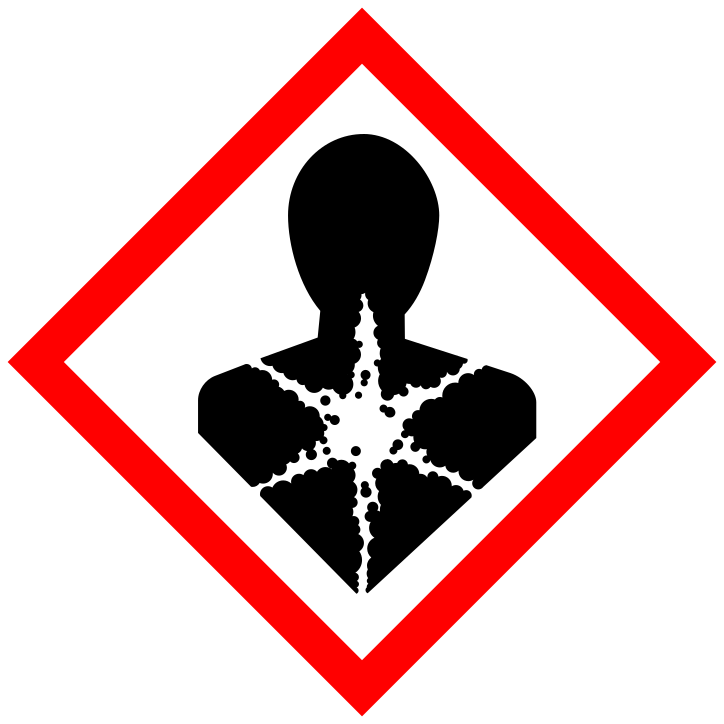
Danger
Aromatic hydrocarbons…
- May cause cancer <state route of exposure if it is conclusively proven that no other routes of exposure cause the hazard>.
- Obtain special instructions before use.
- Wear protective gloves/protective clothing/eye protection/face protection/hearing protection/…
- IF exposed or concerned:
- Get medical advice/attention.
Supplier name, address and telephone number· Product identifier·Nominal quantity
Need this as an actual label? Open Aromatic hydrocarbons… in the GHS label constructor →
07 · Questions
Aromatic hydrocarbons… — frequently asked questions
What is the CAS number of Aromatic hydrocarbons…?
The CAS number of Aromatic hydrocarbons… is 101794-74-5. Its EC number is 309-956-6.
What does a Aromatic hydrocarbons… label have to show?
Under CLP Annex VI the label for Aromatic hydrocarbons… carries the pictogram Health hazard and the signal word is Danger.
Is Aromatic hydrocarbons… flammable?
CLP Annex VI assigns Aromatic hydrocarbons… no flammability hazard class. That is not a statement that it cannot burn: the harmonised list only records the hazards that were assessed for it.
Is Aromatic hydrocarbons… a carcinogen?
Yes. CLP Annex VI classifies Aromatic hydrocarbons… as a category 1A or 1B carcinogen and assigns it H350: may cause cancer.
Nearby
Substances next to Aromatic hydrocarbons…
Keep going: substances starting with A, or search the whole database by name, CAS number, pictogram or signal word.