Substance profile
Distillates (petroleum), catalytic cracked heavy tar light
Distillates (petroleum), catalytic cracked heavy tar light is a substance with a harmonised classification under EU CLP.
01 · Identification
What Distillates (petroleum)… is
Distillates (petroleum), catalytic cracked heavy tar light is a substance with a harmonised classification under EU CLP.
Under the GHS it carries the signal word Danger.
02 · Identifiers
Distillates (petroleum)… identifiers and molecular data
Distillates (petroleum)… CAS number and EC number
Other names for Distillates (petroleum)…
- Cracked kerosine
- [A complex combination of hydrocarbons obtained by distillation of catalytic cracking heavy tars. It consists predominantly of highly alkylated aromatic hydrocarbons boiling in the range of approximately 100 °C to 250 °C (212 °F to 482 °F).]
03 · GHS classification
Distillates (petroleum)… hazard classification
Harmonised classification under CLP Annex VI. This is the legally binding classification in the EU; other jurisdictions may differ.
Distillates (petroleum)… pictograms and signal word
Distillates (petroleum)… hazard class and category
| Hazard class | Category | From code | Pictogram |
|---|---|---|---|
| Aspiration hazard GHS chapter 3.10 | Category 1 | H304 | GHS08 |
Distillates (petroleum)… hazard statements (H-codes)
| Code | Hazard statement |
|---|---|
| H304 | May be fatal if swallowed and enters airways. |
This page lists only the codes assigned to Distillates (petroleum)…. The full reference lives on the hazard statements hub, the precautionary statements hub and the GHS pictograms hub.
Safety Data Sheet
Getting an SDS for Distillates (petroleum)…
A Safety Data Sheet is written for a product, not for a substance: the supplier of the grade you actually buy issues it, so two suppliers of Distillates (petroleum… issue two different sheets. That is why there is no single authoritative SDS for a substance to download — what there is, is the job of collecting the sheets for the products you hold and keeping them current as suppliers revise them.
04 · Precautionary statements
Distillates (petroleum)… precautionary statements
CLP Annex VI assigns 4 precautionary statements to Distillates (petroleum)…. They are grouped the way a label groups them: what to do before handling, what to do when something has already happened, how to store it and how to dispose of it.
General
Statements that belong on the label whoever handles the product.
Disposal
What has to happen to the contents and the empty container.
Reading the notation. … is a blank the supplier fills in — not a truncated sentence.· [square brackets] mark a part printed only when it applies.
05 · Names in the regulation
Distillates (petroleum)… name in 23 EU languages
CLP Annex VI Part 3 is published in every language edition of the regulation, and the identification column is written out in each of them. Nothing below is translated by us: each line is the name as that edition prints it. Under Art. 18(2) the substance name from Annex VI is a lawful product identifier, so this is the wording to put on a label going to that market — and where the cell lists several designations, any one of them qualifies.
| Language | Name in CLP Annex VI Part 3 |
|---|---|
| Bulgarian български | Дестилати (нефт), леки, от каталитично крекирани тежки катранени фракции Крекиран керосин |
| Spanish español | Destilados (petróleo), fracción ligera de alquitrán pesado craqueado catalíticamente queroseno craqueado[combinación compleja de hidrocarburos obtenida de la destilación de alquitranes pesados de craqueo catalíticocompuesta en su mayor parte de hidrocarburos aromáticos muy alquilados con un intervalo de ebullición aproximado de 100 o C a 250 o C (de 212 o F a (482 o F).] |
| Czech čeština | destiláty (ropné), katalyticky krakovaný těžký dehet, lehké krakový petrolej |
| Danish dansk | destillater (råolie), katalytisk krakket tung tjære, lette krakket petroleum |
| German Deutsch | Destillate (Erdöl), katalytisch gecrackter schwerer Teer, leicht gecracktes Kerosin |
| Estonian eesti | destillaadid (nafta), katalüütiliselt krakitud raskete tõrvade kergkeev fraktsioon krakitud petrooleum[Paljude süsivesinike segu, mis on saadud katalüütiliselt krakitud raskete tõrvade destillatsioonil. Koosneb peamiselt tugevalt alküülitud aromaatsetest süsivesinikest keemisvahemikuga umbes 100–250 o C (212–482 o F). |
| Greek ελληνικά | Αποστάγματα (πετρελαίου), ελαφρά, καταλυτικά πυρολυμένα, βαρείας πίσσας Πυρολυμένη κηροζίνη |
| English English | Distillates (petroleum), catalytic cracked heavy tar light Cracked kerosine |
| French français | Distillats légers (pétrole), goudron lourd de craquage catalytique kérosène de craquage[combinaison complexe d'hydrocarbures obtenue par distillation de goudrons lourds de craquage catalytique. Se compose principalement d'hydrocarbures aromatiques très alkylés dont l'intervalle d'ébullition est compris approximativement entre 100 et 250 o C (entre 212 et 482 o F). |
| Croatian hrvatski | destilati (nafta), katalitički krekiran teški katran, laki krekirani kerozin |
| Italian italiano | distillati (petrolio), leggeri da cracking catalitico di catrame pesante cherosene da cracking |
| Latvian latviešu | Destilāti (naftas), katalītiskā krekinga smagās darvas, vieglie Krekinga petroleja |
| Lithuanian lietuvių | Distiliatai (naftos), sunkiosios dervos katalitinio krekingo lengvieji žibalo krekingas |
| Hungarian magyar | Párlatok (ásványolaj), katalitikusan krakkolt nehéz kátrány, könnyű Krakkolt kerozin[Katalitikusan krakkolt nehéz kátrányok desztillációjával nyert összetett szénhidrogénkeverék. Főként többszörösen alkilezett aromás szénhidrogénekből áll, melyek hozzávetőleges forráspont-tartománya 100 o C-250 o C (212 o F-482 o F). |
| Maltese Malti | Distillati (żejt mhux maħdum), ħfief tal-qatran tqil krekkjat katalitikament Kerosin krekkjat |
| Dutch Nederlands | destillaten (aardolie), lichte uit katalytisch gekraakte zware teer gekraakte kerosine |
| Polish polski | Destylaty lekkie z krakowania katalitycznego smół ciężkich Frakcja naftowa z krakowania |
| Portuguese português | destilados (petróleo), leves, de alcatrões pesados de cracking catalítico petróleo de iluminação sujeito a cracking |
| Romanian română | Distilate ușoare (petrol), gudron greu de la cracarea catalitică Kerosen de cracare |
| Slovak slovenčina | destiláty (ropné), z katalytického krakovania ťažkých dechtov, ľahká frakcia krakovaný petrolej |
| Slovenian slovenščina | destilati (nafta), katalitično krekirani težki katran, lahki krekirani kerozin |
| Finnish suomi | Tisleet (maaöljy), katalyyttisesti krakatun raskaan tervan kevyt osa Krakattu kerosiini |
| Swedish svenska | Destillat (petroleum), katalytiskt krackad tung tjära lätt Krackad fotogenKomplex blandning av kolväten erhållen genom destillation av tunga tjäror från katalytisk krackning. Består främst av högalkylerade aromatiska kolväten, med ungefärligt kokpunktsintervall från 100 o C till 250 o C.] |
All 23 language editions of Annex VI carry this entry. Irish is the twenty-fourth official EU language and has no line here for a different reason: no consolidated CLP text has ever been published in Irish, so there is no Irish edition of Annex VI to quote a name from. Source: consolidated CLP, CELEX 02008R1272, language editions. © European Union, https://eur-lex.europa.eu — only the electronic Official Journal of the European Union is authentic.
06 · Label elements
Distillates (petroleum)… GHS label elements
Everything CLP Annex VI fixes for Distillates (petroleum)…, laid out the way it appears on a label. The greyed lines are the parts only the supplier can fill in.
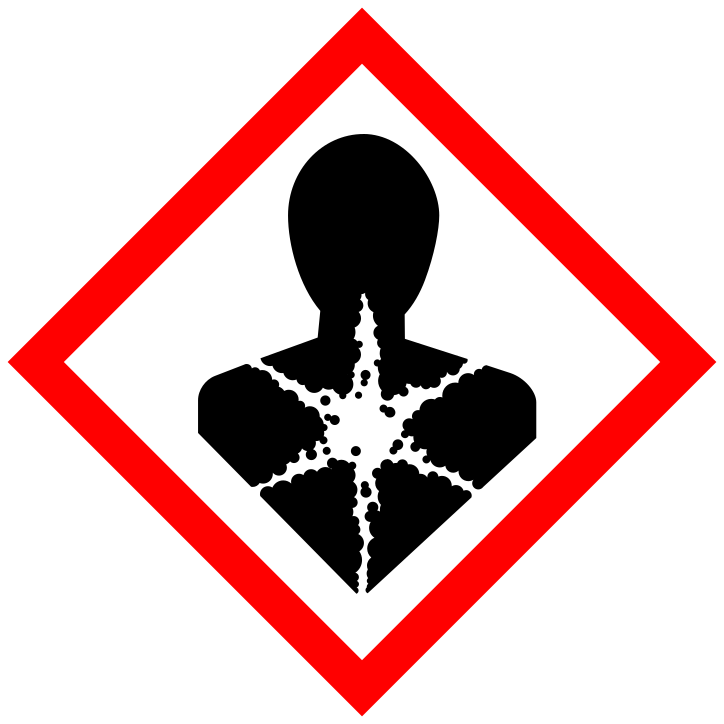
Danger
Distillates (petroleum)…
- May be fatal if swallowed and enters airways.
- If medical advice is needed, have product container or label at hand.
- Keep out of reach of children.
- Read carefully and follow all instructions.
- Dispose of contents/container to …
Supplier name, address and telephone number· Product identifier·Nominal quantity
Need this as an actual label? Open Distillates (petroleum)… in the GHS label constructor →
07 · Questions
Distillates (petroleum)… — frequently asked questions
What is the CAS number of Distillates (petroleum)…?
The CAS number of Distillates (petroleum)… is 101631-13-4. Its EC number is 309-938-8.
What does a Distillates (petroleum)… label have to show?
Under CLP Annex VI the label for Distillates (petroleum)… carries the pictogram Health hazard and the signal word is Danger.
Is Distillates (petroleum)… flammable?
CLP Annex VI assigns Distillates (petroleum)… no flammability hazard class. That is not a statement that it cannot burn: the harmonised list only records the hazards that were assessed for it.
Is Distillates (petroleum)… a carcinogen?
CLP Annex VI records no harmonised carcinogenicity classification for Distillates (petroleum)…. Annex VI is a list of agreed classifications, not a list of substances found safe, so this is an absence of a classification rather than a clean bill of health.
Nearby
Substances next to Distillates (petroleum)…
Keep going: substances starting with D, or search the whole database by name, CAS number, pictogram or signal word.