Substance profile
Distillates (petroleum), heavy catalytic cracked
Distillates (petroleum), heavy catalytic cracked is a substance with a harmonised classification under EU CLP.
01 · Identification
What Distillates (petroleum)… is
Distillates (petroleum), heavy catalytic cracked is a substance with a harmonised classification under EU CLP.
Under the GHS it carries the signal word Danger.
02 · Identifiers
Distillates (petroleum)… identifiers and molecular data
Distillates (petroleum)… CAS number and EC number
Other names for Distillates (petroleum)…
- Heavy Fuel oil
- [A complex combination of hydrocarbons produced by the distillation of products from a catalytic cracking process. It consists of hydrocarbons having carbon numbers predominantly in the range of C15 through C35 and boiling in the range of approximately 260 °C to 500 °C (500 °F to 932 °F). This stream is likely to contain 5 wt. % or more of 4- to 6-membered condensed ring aromatic hydrocarbons.]
03 · GHS classification
Distillates (petroleum)… hazard classification
Harmonised classification under CLP Annex VI. This is the legally binding classification in the EU; other jurisdictions may differ.
Distillates (petroleum)… pictograms and signal word
Distillates (petroleum)… hazard class and category
| Hazard class | Category | From code | Pictogram |
|---|---|---|---|
| Carcinogenicity GHS chapter 3.6 | Category 1A or 1B | H350 | GHS08 |
Where two values are shown with “or”, the hazard statement is shared by more than one category or by more than one class, and the code alone does not say which. H272, for example, belongs to oxidising liquids and to oxidising solids — the physical state decides. The binding answer for a specific entry is in the CLP Annex VI table itself.
Distillates (petroleum)… hazard statements (H-codes)
| Code | Hazard statement |
|---|---|
| H350 | May cause cancer <state route of exposure if it is conclusively proven that no other routes of exposure cause the hazard>. |
This page lists only the codes assigned to Distillates (petroleum)…. The full reference lives on the hazard statements hub, the precautionary statements hub and the GHS pictograms hub.
Safety Data Sheet
Getting an SDS for Distillates (petroleum)…
A Safety Data Sheet is written for a product, not for a substance: the supplier of the grade you actually buy issues it, so two suppliers of Distillates (petroleum… issue two different sheets. That is why there is no single authoritative SDS for a substance to download — what there is, is the job of collecting the sheets for the products you hold and keeping them current as suppliers revise them.
04 · Precautionary statements
Distillates (petroleum)… precautionary statements
CLP Annex VI assigns 4 precautionary statements to Distillates (petroleum)…. They are grouped the way a label groups them: what to do before handling, what to do when something has already happened, how to store it and how to dispose of it.
Prevention
What to do before and during handling so the hazard never happens.
Response
What to do once exposure, spillage or fire has already happened.
Reading the notation. … is a blank the supplier fills in — not a truncated sentence.· [square brackets] mark a part printed only when it applies.
05 · Names in the regulation
Distillates (petroleum)… name in 23 EU languages
CLP Annex VI Part 3 is published in every language edition of the regulation, and the identification column is written out in each of them. Nothing below is translated by us: each line is the name as that edition prints it. Under Art. 18(2) the substance name from Annex VI is a lawful product identifier, so this is the wording to put on a label going to that market — and where the cell lists several designations, any one of them qualifies.
| Language | Name in CLP Annex VI Part 3 |
|---|---|
| Bulgarian български | Дестилати (нефт), тежки от каталитичен крекинг Тежко горивно масло |
| Spanish español | Destilados (petróleo), fracción pesada craqueada catalíticamente fuelóleo pesado |
| Czech čeština | destiláty (ropné), těžké, katalyticky krakované těžký topný olej |
| Danish dansk | destillater (råolie), tunge katalytisk krakkede fuelolie |
| German Deutsch | Destillate (Erdöl), schwere katalytisch gecrackte Schweröl |
| Estonian eesti | destillaadid (nafta), rasked katalüütiliselt krakitud raske kütteõli |
| Greek ελληνικά | Αποστάγματα (πετρελαίου) βαρέα καταλυτικά πυρολυμένα Βαρύ μαζούτ |
| English English | Distillates (petroleum), heavy catalytic cracked Heavy Fuel oil |
| French français | Distillats lourds (pétrole), craquage catalytique fioul lourd [Combinaison complexe d'hydrocarbures obtenue par distillation des produits résultant d'un craquage catalytique. Se compose d'hydrocarbures comportant majoritairement entre 15 et 35 atomes de carbone (C 20 -C 35 ) et dont l'intervalle d'ébullition est compris approximativement entre 260 et 500 o C (entre 500 et 932 o F).] Peut contenir 5 % ou plus, en poids, d'hydrocarbures aromatiques comportant 4 à 6 cycles accolés.] |
| Croatian hrvatski | destilati (nafta), teški katalitički krekirani teško loživo ulje |
| Italian italiano | distillati (petrolio), frazioni pesanti di cracking catalitico olio combustibile denso |
| Latvian latviešu | Destilāti (naftas), smagie katalītiskā krekinga Smagā degvieleļļa[Ogļūdeņražu savienojumu komplekss, kas iegūts, destilējot katalītiskā krekinga produktus. Sastāv no ogļūdeņražiem ar oglekļa atomu skaitu galvenokārt no C 15 līdz C 35 , aptuvenā viršanas temperatūra no 260 o C līdz 500 o C (500 o F līdz 932 o F).] Šī frakcija varētu saturēt 5 vai vairāk masas procentus aromātisko ogļūdeņražu ar kondensētiem 4 līdz 6 locekļu cikliem.] |
| Lithuanian lietuvių | Distiliatai (nafta), sunkieji, kataliziškai krekinguoti sunkusis mazutas |
| Hungarian magyar | Párlatok (ásványolaj), nehéz katalitikusan krakkolt Nehéz gázolaj |
| Maltese Malti | Distillati (żejt mhux maħdum), krekkjati katalitiċi tqal Żejt kombustibbli Tqil[Taħlita kumplessa ta' idrokarburi prodotta mid-distillazzjoni ta' prodotti minn proċess ta' krekkjar katalitiku. Tikkonsisti b'mod predominanti f'idrokarburi b'numri tal-karbonju b'mod predominanti fil-medda ta' C 15 sa C 35 u b'punt ta' togħlija fil-medda ta' bejn wieħed u ieħor 260 o C sa 500 o C (500 o F sa 932 o F).] Dan il-fluss aktarx lijkun fih 5 wt. % jew iktar tal-idrokarburi aromatiċi b'ċirku kondensat b'4 sa 6 membri.] |
| Dutch Nederlands | destillaten (aardolie), zwaar katalytisch gekraakt stookolie[een complexe verzameling koolwaterstoffen, verkregen door destillatie van producten van een katalytisch kraakproces. Bestaat uit koolwaterstoffen, overwegend C 15 tot en met C 35 , met een kooktraject van ongeveer 260 o C tot 500 o C (500 o F tot 932 o F).] Deze stroom bevat waarschijnlijk 5 of meer gewichtsprocenten aromatische koolwaterstoffen met vier- tot zesvoudig gecondenseerde ringen.] |
| Polish polski | Destylaty ciężkie z krakingu katalitycznego (ropa naftowa) Olej opałowy ciężki |
| Portuguese português | destilados (petróleo), pesados de cracking catalítico fuelóleo pesado |
| Romanian română | Distilate grele (petrol), cracare catalitică Păcură grea |
| Slovak slovenčina | destiláty (ropné), ťažké, hydrokrakované ťažký vykurovací olej |
| Slovenian slovenščina | destilati (nafta), težki, katalitično krekirani težko kurilno olje |
| Finnish suomi | Tisleet (maaöljy), raskaat katalyyttisesti krakatut Raskas polttoöljy |
| Swedish svenska | Destillat (petroleum), tunga katalytiskt krackade Tung eldningsolja |
All 23 language editions of Annex VI carry this entry. Irish is the twenty-fourth official EU language and has no line here for a different reason: no consolidated CLP text has ever been published in Irish, so there is no Irish edition of Annex VI to quote a name from. Source: consolidated CLP, CELEX 02008R1272, language editions. © European Union, https://eur-lex.europa.eu — only the electronic Official Journal of the European Union is authentic.
06 · Label elements
Distillates (petroleum)… GHS label elements
Everything CLP Annex VI fixes for Distillates (petroleum)…, laid out the way it appears on a label. The greyed lines are the parts only the supplier can fill in.
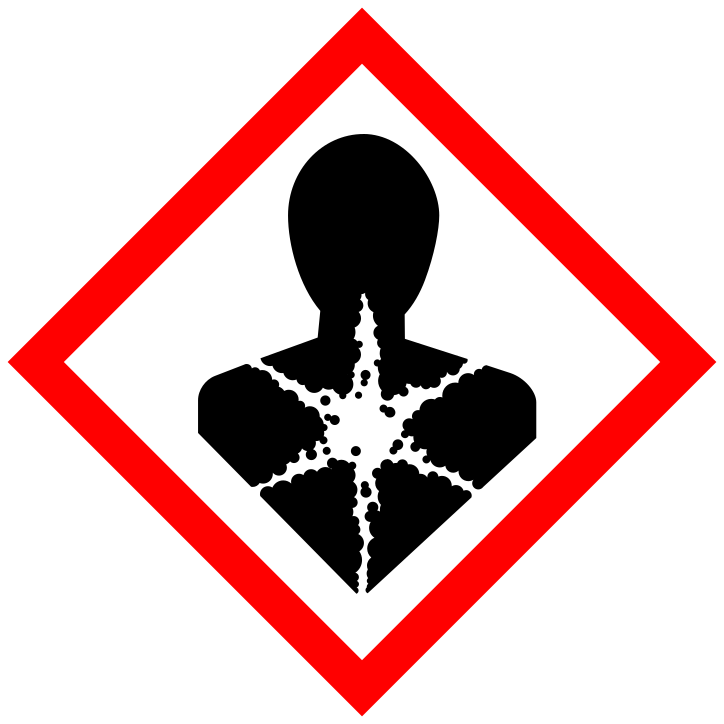
Danger
Distillates (petroleum)…
- May cause cancer <state route of exposure if it is conclusively proven that no other routes of exposure cause the hazard>.
- Obtain special instructions before use.
- Wear protective gloves/protective clothing/eye protection/face protection/hearing protection/…
- IF exposed or concerned:
- Get medical advice/attention.
Supplier name, address and telephone number· Product identifier·Nominal quantity
Need this as an actual label? Open Distillates (petroleum)… in the GHS label constructor →
07 · Questions
Distillates (petroleum)… — frequently asked questions
What is the CAS number of Distillates (petroleum)…?
The CAS number of Distillates (petroleum)… is 64741-61-3. Its EC number is 265-063-0.
What does a Distillates (petroleum)… label have to show?
Under CLP Annex VI the label for Distillates (petroleum)… carries the pictogram Health hazard and the signal word is Danger.
Is Distillates (petroleum)… flammable?
CLP Annex VI assigns Distillates (petroleum)… no flammability hazard class. That is not a statement that it cannot burn: the harmonised list only records the hazards that were assessed for it.
Is Distillates (petroleum)… a carcinogen?
Yes. CLP Annex VI classifies Distillates (petroleum)… as a category 1A or 1B carcinogen and assigns it H350: may cause cancer.
Nearby
Substances next to Distillates (petroleum)…
Keep going: substances starting with D, or search the whole database by name, CAS number, pictogram or signal word.