Substance profile
Distillates (petroleum), light arom.
Distillates (petroleum), light arom. is a substance with a harmonised classification under EU CLP.
01 · Identification
What Distillates (petroleum)… is
Distillates (petroleum), light arom. is a substance with a harmonised classification under EU CLP.
Under the GHS it carries the signal word Danger.
02 · Identifiers
Distillates (petroleum)… identifiers and molecular data
Distillates (petroleum)… CAS number and EC number
Other names for Distillates (petroleum)…
- Low boiling point thermally cracked naphtha
- [The complex combination of hydrocarbons from the distillation of the products from the thermal cracking of ethane and propane. This lower boiling fraction consists predominantly of C5-7 aromatic hydrocarbons with some unsaturated aliphatic hydrocarbons having a carbon number predominantly of C5. This stream may contain benzene.]
03 · GHS classification
Distillates (petroleum)… hazard classification
Harmonised classification under CLP Annex VI. This is the legally binding classification in the EU; other jurisdictions may differ.
Distillates (petroleum)… pictograms and signal word
Distillates (petroleum)… hazard class and category
| Hazard class | Category | From code | Pictogram |
|---|---|---|---|
| Germ cell mutagenicity GHS chapter 3.5 | Category 1A or 1B | H340 | GHS08 |
| Carcinogenicity GHS chapter 3.6 | Category 1A or 1B | H350 | GHS08 |
| Aspiration hazard GHS chapter 3.10 | Category 1 | H304 | GHS08 |
Where two values are shown with “or”, the hazard statement is shared by more than one category or by more than one class, and the code alone does not say which. H272, for example, belongs to oxidising liquids and to oxidising solids — the physical state decides. The binding answer for a specific entry is in the CLP Annex VI table itself.
Distillates (petroleum)… hazard statements (H-codes)
| Code | Hazard statement |
|---|---|
| H350 | May cause cancer <state route of exposure if it is conclusively proven that no other routes of exposure cause the hazard>. |
| H340 | May cause genetic defects <state route of exposure if it is conclusively proven that no other routes of exposure cause the hazard>. |
| H304 | May be fatal if swallowed and enters airways. |
This page lists only the codes assigned to Distillates (petroleum)…. The full reference lives on the hazard statements hub, the precautionary statements hub and the GHS pictograms hub.
Safety Data Sheet
Getting an SDS for Distillates (petroleum)…
A Safety Data Sheet is written for a product, not for a substance: the supplier of the grade you actually buy issues it, so two suppliers of Distillates (petroleum… issue two different sheets. That is why there is no single authoritative SDS for a substance to download — what there is, is the job of collecting the sheets for the products you hold and keeping them current as suppliers revise them.
04 · Precautionary statements
Distillates (petroleum)… precautionary statements
CLP Annex VI assigns 4 precautionary statements to Distillates (petroleum)…. They are grouped the way a label groups them: what to do before handling, what to do when something has already happened, how to store it and how to dispose of it.
Prevention
What to do before and during handling so the hazard never happens.
Response
What to do once exposure, spillage or fire has already happened.
Reading the notation. … is a blank the supplier fills in — not a truncated sentence.· [square brackets] mark a part printed only when it applies.
05 · Names in the regulation
Distillates (petroleum)… name in 23 EU languages
CLP Annex VI Part 3 is published in every language edition of the regulation, and the identification column is written out in each of them. Nothing below is translated by us: each line is the name as that edition prints it. Under Art. 18(2) the substance name from Annex VI is a lawful product identifier, so this is the wording to put on a label going to that market — and where the cell lists several designations, any one of them qualifies.
| Language | Name in CLP Annex VI Part 3 |
|---|---|
| Bulgarian български | Дестилати (нефтени), леки ароматни Нафта от термичен крекинг с ниска температура на кипене |
| Spanish español | Destilados (petróleo), fracción aromática ligera nafta craqueada térmicamente de bajo punto de ebullición |
| Czech čeština | destiláty (ropné), lehké aromatické nízkovroucí tepelně krakovaná benzínová frakce |
| Danish dansk | destillater (råolie), lette aromatiske lavtkogende termisk krakket nafta |
| German Deutsch | Destillate (Erdöl), leicht, aromatisch Naphtha, thermisch gecrackt, niedrigsiedend |
| Estonian eesti | destillaadid (nafta), aromaatne kergkeev fraktsioon kergkeev termiliselt krakitud toorbensiin |
| Greek ελληνικά | Αποστάγματα (πετρελαίου), ελαφρό κλάσμα αρωματικών ενώσεων Νάφθα χαμηλού σημείου ζέσεως από θερμική πυρόλυση |
| English English | Distillates (petroleum), light arom. Low boiling point thermally cracked naphtha |
| French français | Distillats aromatiques légers (pétrole) naphta de craquage thermique à bas point d'ébullition |
| Croatian hrvatski | destilati (nafta), laki aromatski niskovrijući toplinski krekiran benzin |
| Italian italiano | distillati (petrolio), aromatici leggeri nafta di cracking termico con basso punto di ebollizione |
| Latvian latviešu | Destilāti (naftas), vieglā arom. frakcija Termiskā krekinga jēlbenzīns ar zemu viršanas punktu |
| Lithuanian lietuvių | Distiliatai (nafta), lengvieji aromatiniai Žematemperatūris terminio krekingo pirminis benzinas |
| Hungarian magyar | Desztillátumok (ásványolaj), könnyű arom. Alacsony forráspontú termikusan krakkolt benzin |
| Maltese Malti | Distillati (żejt mhux maħdum), arom. ħfief Nafta krekkjata termalment b’punt tat-togħlija baxx |
| Dutch Nederlands | destillaten (aardolie), lichte aromatische fractie thermisch gekraakte nafta met laag kookpunt |
| Polish polski | Destylaty (ropa naftowa), węglowodory aromatyczne, lekkie Niskowrząca benzyna z krakingu termicznego |
| Portuguese português | destilados (petróleo), fração aromática leve fração de baixo ponto de ebulição de nafta sujeita a cracking térmico |
| Romanian română | Distilate (petrol), hidrocarburi aromatice ușoare Benzină nafta de cracare termică cu temperaturi de fierbere scăzute |
| Slovak slovenčina | destiláty (ropné), ľahké frakcie, s vysokým obsahom aromatických uhľovodíkov tepelne krakovaný ťažký benzín s nízkou teplotou varu |
| Slovenian slovenščina | destilati (nafta), lahki arom. termično krekirana nafta z nizkim vreliščem |
| Finnish suomi | Tisleet (maaöljy), kevyet aromaattiset Matalalla kiehuva lämpökrakattu teollisuusbensiini |
| Swedish svenska | Destillat (petroleum), lätta aromatiska Lågkokande termiskt krackad nafta |
All 23 language editions of Annex VI carry this entry. Irish is the twenty-fourth official EU language and has no line here for a different reason: no consolidated CLP text has ever been published in Irish, so there is no Irish edition of Annex VI to quote a name from. Source: consolidated CLP, CELEX 02008R1272, language editions. © European Union, https://eur-lex.europa.eu — only the electronic Official Journal of the European Union is authentic.
06 · Label elements
Distillates (petroleum)… GHS label elements
Everything CLP Annex VI fixes for Distillates (petroleum)…, laid out the way it appears on a label. The greyed lines are the parts only the supplier can fill in.
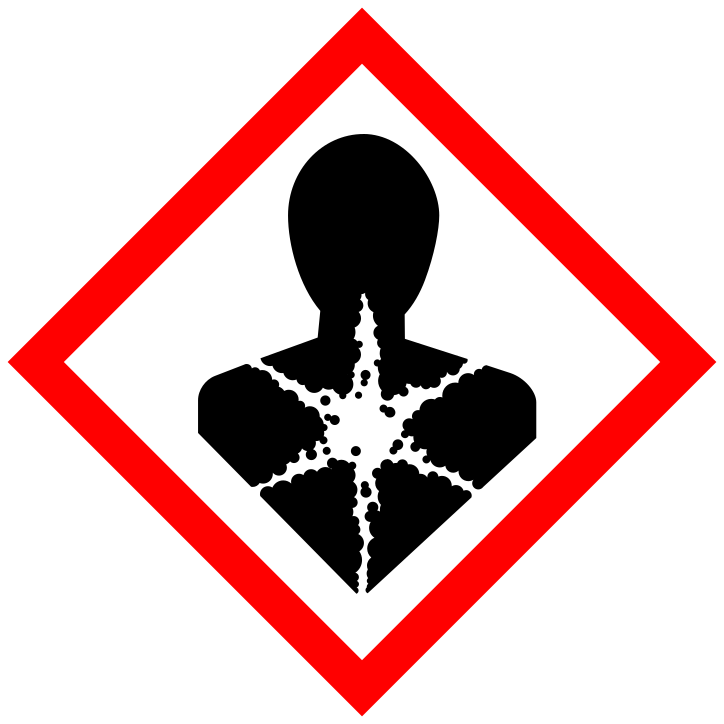
Danger
Distillates (petroleum)…
- May cause cancer <state route of exposure if it is conclusively proven that no other routes of exposure cause the hazard>.
- May cause genetic defects <state route of exposure if it is conclusively proven that no other routes of exposure cause the hazard>.
- May be fatal if swallowed and enters airways.
- Obtain special instructions before use.
- Wear protective gloves/protective clothing/eye protection/face protection/hearing protection/…
- IF exposed or concerned:
- Get medical advice/attention.
Supplier name, address and telephone number· Product identifier·Nominal quantity
Need this as an actual label? Open Distillates (petroleum)… in the GHS label constructor →
07 · Questions
Distillates (petroleum)… — frequently asked questions
What is the CAS number of Distillates (petroleum)…?
The CAS number of Distillates (petroleum)… is 67891-80-9. Its EC number is 267-565-5.
What does a Distillates (petroleum)… label have to show?
Under CLP Annex VI the label for Distillates (petroleum)… carries the pictogram Health hazard and the signal word is Danger.
Is Distillates (petroleum)… flammable?
CLP Annex VI assigns Distillates (petroleum)… no flammability hazard class. That is not a statement that it cannot burn: the harmonised list only records the hazards that were assessed for it.
Is Distillates (petroleum)… a carcinogen?
Yes. CLP Annex VI classifies Distillates (petroleum)… as a category 1A or 1B carcinogen and assigns it H350: may cause cancer.
Nearby
Substances next to Distillates (petroleum)…
Keep going: substances starting with D, or search the whole database by name, CAS number, pictogram or signal word.