Substance profile
Distillates (petroleum), solvent-dewaxed light paraffinic
Distillates (petroleum), solvent-dewaxed light paraffinic is a substance with a harmonised classification under EU CLP.
01 · Identification
What Distillates (petroleum)… is
Distillates (petroleum), solvent-dewaxed light paraffinic is a substance with a harmonised classification under EU CLP.
Under the GHS it carries the signal word Danger.
02 · Identifiers
Distillates (petroleum)… identifiers and molecular data
Distillates (petroleum)… CAS number and EC number
Other names for Distillates (petroleum)…
- Baseoil - unspecified
- [A complex comination of hydrocarbons obtained by removal of normal paraffins from a petroleum fraction by solvent crystallization. It consists predominantly of hydrocarbons having carbon numbers predominantly in the range of C15 through C30 and produces a finished oil with a viscosity of less than 100 SUS at 100 °F (19cSt at 40 °C).]
03 · GHS classification
Distillates (petroleum)… hazard classification
Harmonised classification under CLP Annex VI. This is the legally binding classification in the EU; other jurisdictions may differ.
Distillates (petroleum)… pictograms and signal word
Distillates (petroleum)… hazard class and category
| Hazard class | Category | From code | Pictogram |
|---|---|---|---|
| Carcinogenicity GHS chapter 3.6 | Category 1A or 1B | H350 | GHS08 |
Where two values are shown with “or”, the hazard statement is shared by more than one category or by more than one class, and the code alone does not say which. H272, for example, belongs to oxidising liquids and to oxidising solids — the physical state decides. The binding answer for a specific entry is in the CLP Annex VI table itself.
Distillates (petroleum)… hazard statements (H-codes)
| Code | Hazard statement |
|---|---|
| H350 | May cause cancer <state route of exposure if it is conclusively proven that no other routes of exposure cause the hazard>. |
This page lists only the codes assigned to Distillates (petroleum)…. The full reference lives on the hazard statements hub, the precautionary statements hub and the GHS pictograms hub.
Safety Data Sheet
Getting an SDS for Distillates (petroleum)…
A Safety Data Sheet is written for a product, not for a substance: the supplier of the grade you actually buy issues it, so two suppliers of Distillates (petroleum… issue two different sheets. That is why there is no single authoritative SDS for a substance to download — what there is, is the job of collecting the sheets for the products you hold and keeping them current as suppliers revise them.
04 · Precautionary statements
Distillates (petroleum)… precautionary statements
CLP Annex VI assigns 4 precautionary statements to Distillates (petroleum)…. They are grouped the way a label groups them: what to do before handling, what to do when something has already happened, how to store it and how to dispose of it.
Prevention
What to do before and during handling so the hazard never happens.
Response
What to do once exposure, spillage or fire has already happened.
Reading the notation. … is a blank the supplier fills in — not a truncated sentence.· [square brackets] mark a part printed only when it applies.
05 · Names in the regulation
Distillates (petroleum)… name in 23 EU languages
CLP Annex VI Part 3 is published in every language edition of the regulation, and the identification column is written out in each of them. Nothing below is translated by us: each line is the name as that edition prints it. Under Art. 18(2) the substance name from Annex VI is a lawful product identifier, so this is the wording to put on a label going to that market — and where the cell lists several designations, any one of them qualifies.
| Language | Name in CLP Annex VI Part 3 |
|---|---|
| Bulgarian български | Дестилати (нефтени), депарафинирани с разтворител, леки парафинови Базово масло — неспецифицирано |
| Spanish español | Destilados (petróleo), fracción parafínica ligera desparafinada con disolventes aceite de base, sin especificar |
| Czech čeština | destiláty (ropné), rozpouštědlově odparafinované lehké parafinické základový olej – nespecifikovaný [Složitá směs uhlovodíků vznikající odstraněním normálních parafinů z ropné frakce rozpouštědlovou krystalizací. Je složena převážně z uhlovodíků s počtem uhlíkových atomů převážně v rozmezí C 15 až C 30 a poskytuje finální olej s viskozitou menší než 19 mm 2 .s -1 při 40 o C. |
| Danish dansk | destillater (råolie), solventafvoksede lette paraffin- uspecificeret baseolie |
| German Deutsch | Destillate (Erdöl), lösungsmittelentwachste leichte paraffinhaltige Basisöl — nicht spezifiziert |
| Estonian eesti | destillaadid (nafta), lahustiga deparafiinitud kerged parafiinsed baasõli – määratlemata |
| Greek ελληνικά | Αποστάγματα (πετρελαίου), ελαφρά παραφινικά αποκηρωμένα με διαλύτη Βασικό ορυκτέλαιο — μη προσδιοριζόμενο |
| English English | Distillates (petroleum), solvent-dewaxed light paraffinic Baseoil — unspecified |
| French français | Distillats paraffiniques légers (pétrole), déparaffinés au solvant huile de base — non spécifiée[combinaison complexe d'hydrocarbures obtenue en éliminant les paraffines normales d'une fraction pétrolière par cristallisation au solvant. Se compose principalement d'hydrocarbures comportant majoritairement entre 15 et 30 atomes de carbone (C 15 -C 30 ), et donne une huile-produit fini de viscosité inférieure à 19 cSt à 40 o C (100 SUS à 100 o F). |
| Croatian hrvatski | destilati (nafta), otapalom deparafinirani laki parafinski bazno ulje – nespecificirano |
| Italian italiano | distillati (petrolio), paraffinici leggeri decerati con solvente olio base — non specificato |
| Latvian latviešu | Destilāti (naftas), vieglie parafīnu, ar šķīdinātāju attīrīti no vaskiem Pamateļļa — nav precizēta |
| Lithuanian lietuvių | Distiliatai (nafta), tirpikliu deparafinuoti lengvieji parafininiai pagrindinė alyva – detaliau nenurodyta |
| Hungarian magyar | Párlatok (ásványolaj), oldószerrel viasztalanított könnyű paraffinos Alapolaj – nem meghatározott[Összetett szénhidrogénkeverék, melynek előállításához oldószeres kristályosítással kivonják a normál paraffinokat az ásványolaj-frakcióból. Főként C 15 -C 30 szénatomszámú szénhidrogénekből áll, és végtermék olajként viszkozitása nem éri el a 100 SUS értéket 100 o F-on (19 cSt 40 o C-on). |
| Maltese Malti | Distillati (taż-żejt mhux maħdum), paraffiniċi ħfief deparaffinati bis-solvent Żejt bażi — mhux speċifikat[Taħlita kumplessa ta' idrokarburi miksuba bit-tneħħija ta' paraffini normali minn frazzjoni taż-żejt mhux maħdum bi kristallizzazzjoni ta' solvent. Tikkonsisti l-aktar f'idrokarburi b'numri tal-karbonju fil-biċċa l-kbira fil-medda ta' C 15 sa C 30 u tipproduċi żejt lest b'viskożità ta' inqas minn 100 SUS f'100 o F (19cSt f' 40 o C). |
| Dutch Nederlands | destillaten (aardolie), met oplosmiddel van was ontdane lichte paraffinische basisolie — niet gespecifieerd[een complexe verzameling koolwaterstoffen die wordt verkregen door verwijdering van normale paraffinen uit een aardoliefractie door oplosmiddelkristallisatie. Bestaat voornamelijk uit koolwaterstoffen, overwegend C 15 tot en met C 30 , en vormt een voltooide olie met een viscositeit die kleiner is dan 100 SUS bij 100 o F (19 cSt bij 40 o C). |
| Polish polski | Destylaty lekkie parafinowe z odparafinowania rozpuszczalnikowego (ropa naftowa) Olej bazowy – niespecyfikowany |
| Portuguese português | destilados (petróleo), parafínicos leves, desparafinados com solventes óleo-base — não-especificado |
| Romanian română | Distilate parafinice ușoare (petrol), deparafinare cu solvenți Ulei de bază — fără specificații |
| Slovak slovenčina | destiláty (ropné), odvoskované rozpúšťadlom, ľahké vyššie alkánové frakcie základový olej – nešpecifikovaný |
| Slovenian slovenščina | destilati (nafta), razvoščeni s topilom, lahki parafinski bazno olje – nespecificirano |
| Finnish suomi | Tisleet (maaöljy), vahat poistettu liuottimella kevyet parafiiniset Perusöljy – täsmentämätön |
| Swedish svenska | Destillat (petroleum), lösningsmedelsavvaxade lätta paraffiniska Basolja – ospecificerad |
All 23 language editions of Annex VI carry this entry. Irish is the twenty-fourth official EU language and has no line here for a different reason: no consolidated CLP text has ever been published in Irish, so there is no Irish edition of Annex VI to quote a name from. Source: consolidated CLP, CELEX 02008R1272, language editions. © European Union, https://eur-lex.europa.eu — only the electronic Official Journal of the European Union is authentic.
06 · Label elements
Distillates (petroleum)… GHS label elements
Everything CLP Annex VI fixes for Distillates (petroleum)…, laid out the way it appears on a label. The greyed lines are the parts only the supplier can fill in.
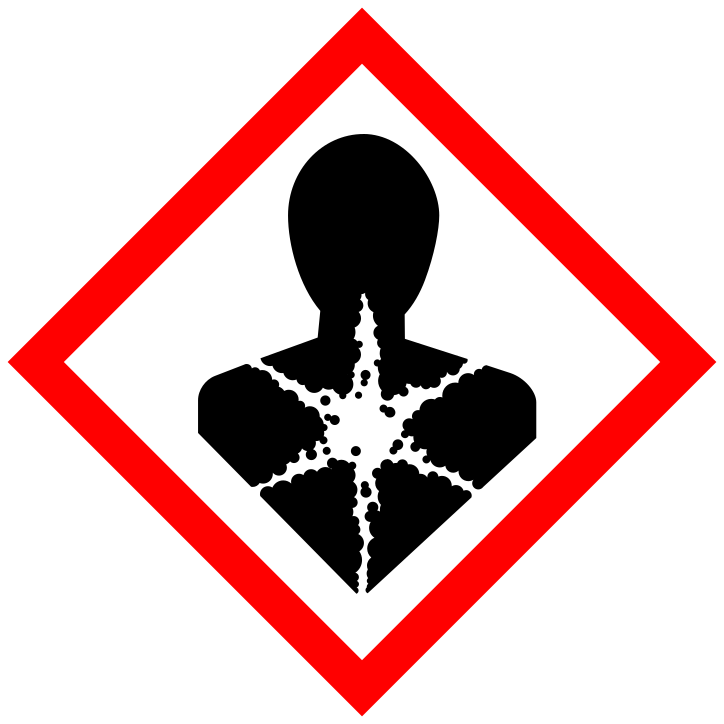
Danger
Distillates (petroleum)…
- May cause cancer <state route of exposure if it is conclusively proven that no other routes of exposure cause the hazard>.
- Obtain special instructions before use.
- Wear protective gloves/protective clothing/eye protection/face protection/hearing protection/…
- IF exposed or concerned:
- Get medical advice/attention.
Supplier name, address and telephone number· Product identifier·Nominal quantity
Need this as an actual label? Open Distillates (petroleum)… in the GHS label constructor →
07 · Questions
Distillates (petroleum)… — frequently asked questions
What is the CAS number of Distillates (petroleum)…?
The CAS number of Distillates (petroleum)… is 64742-56-9. Its EC number is 265-159-2.
What does a Distillates (petroleum)… label have to show?
Under CLP Annex VI the label for Distillates (petroleum)… carries the pictogram Health hazard and the signal word is Danger.
Is Distillates (petroleum)… flammable?
CLP Annex VI assigns Distillates (petroleum)… no flammability hazard class. That is not a statement that it cannot burn: the harmonised list only records the hazards that were assessed for it.
Is Distillates (petroleum)… a carcinogen?
Yes. CLP Annex VI classifies Distillates (petroleum)… as a category 1A or 1B carcinogen and assigns it H350: may cause cancer.
Nearby
Substances next to Distillates (petroleum)…
Keep going: substances starting with D, or search the whole database by name, CAS number, pictogram or signal word.