Substance profile
Distillates (petroleum), steam-cracked
Distillates (petroleum), steam-cracked is a substance with a harmonised classification under EU CLP.
01 · Identification
What Distillates (petroleum)… is
Distillates (petroleum), steam-cracked is a substance with a harmonised classification under EU CLP.
Under the GHS it carries the signal word Danger.
02 · Identifiers
Distillates (petroleum)… identifiers and molecular data
Distillates (petroleum)… CAS number and EC number
Other names for Distillates (petroleum)…
- Cracked kerosine
- [A complex combination of hydrocarbons obtained by the distillation of the products from a steam cracking process. It consists predominantly of unsaturated hydrocarbons having carbon numbers predominantly in the range of C7 through C16 and boiling in the range of approximately 90 °C to 290 °C (190 °F to 554 °F).]
03 · GHS classification
Distillates (petroleum)… hazard classification
Harmonised classification under CLP Annex VI. This is the legally binding classification in the EU; other jurisdictions may differ.
Distillates (petroleum)… pictograms and signal word
Distillates (petroleum)… hazard class and category
| Hazard class | Category | From code | Pictogram |
|---|---|---|---|
| Aspiration hazard GHS chapter 3.10 | Category 1 | H304 | GHS08 |
Distillates (petroleum)… hazard statements (H-codes)
| Code | Hazard statement |
|---|---|
| H304 | May be fatal if swallowed and enters airways. |
This page lists only the codes assigned to Distillates (petroleum)…. The full reference lives on the hazard statements hub, the precautionary statements hub and the GHS pictograms hub.
Safety Data Sheet
Getting an SDS for Distillates (petroleum)…
A Safety Data Sheet is written for a product, not for a substance: the supplier of the grade you actually buy issues it, so two suppliers of Distillates (petroleum… issue two different sheets. That is why there is no single authoritative SDS for a substance to download — what there is, is the job of collecting the sheets for the products you hold and keeping them current as suppliers revise them.
04 · Precautionary statements
Distillates (petroleum)… precautionary statements
CLP Annex VI assigns 4 precautionary statements to Distillates (petroleum)…. They are grouped the way a label groups them: what to do before handling, what to do when something has already happened, how to store it and how to dispose of it.
General
Statements that belong on the label whoever handles the product.
Disposal
What has to happen to the contents and the empty container.
Reading the notation. … is a blank the supplier fills in — not a truncated sentence.· [square brackets] mark a part printed only when it applies.
05 · Names in the regulation
Distillates (petroleum)… name in 23 EU languages
CLP Annex VI Part 3 is published in every language edition of the regulation, and the identification column is written out in each of them. Nothing below is translated by us: each line is the name as that edition prints it. Under Art. 18(2) the substance name from Annex VI is a lawful product identifier, so this is the wording to put on a label going to that market — and where the cell lists several designations, any one of them qualifies.
| Language | Name in CLP Annex VI Part 3 |
|---|---|
| Bulgarian български | Дестилати (нефтени), от паров крекинг Крекиран керосин |
| Spanish español | Destiladoss (petróleo), craqueados a vapor queroseno craqueado |
| Czech čeština | destiláty (ropné), pyrolýzní krakový petrolej |
| Danish dansk | destillater (råolie), dampkrakkede krakket petroleum |
| German Deutsch | Destillate (Erdöl), steamcracked gecracktes Kerosin |
| Estonian eesti | destillaadid (nafta), aurkrakitud krakitud petrooleum[Paljude süsivesinike segu, mis tekib aurkrakkimise saaduste destillatsioonil. Koosneb valdavalt küllastumata süsivesinikest, mille süsinikuarv on valdavalt vahemikus C 7–16 ja keemistemperatuur on vahemikus ligikaudu 90–290 o C (190–554 o F). |
| Greek ελληνικά | Αποστάγματα (πετρελαίου), ατμοπυρολυμένα Πυρολυμένη κηροζίνη |
| English English | Distillates (petroleum), steam-cracked Cracked kerosine |
| French français | Distillats (pétrole), vapocraquage kérosène de craquage |
| Croatian hrvatski | destilati (nafta), parom krekirani krekirani kerozin |
| Italian italiano | distillati (petrolio), crackizzati con vapor d'acqua cherosene da cracking |
| Latvian latviešu | Destilāti (naftas), tvaika krekinga Krekinga petroleja |
| Lithuanian lietuvių | Distiliatai (nafta), garų krekingo žibalo krekingas |
| Hungarian magyar | Párlatok (ásványolaj), gőzzel krakkolt Krakkolt kerozin[Szénhidrogének összetett keveréke, melyet gőzkrakkolási eljárás termékeinek desztillációjával nyernek. Főként C 7 -C 16 szénatomszámú telítetlen szénhidrogénekből áll, hozzávetőleges forráspont-tartománya: 90 o C-290 o C (190 o F-554 o F). |
| Maltese Malti | Distillati (żejt mhux maħdum), krekkjati bil-fwar Kerosin krekkjat[Taħlita kumplessa ta' idrokarburi miksuba mid-distillazzjoni tal-prodotti minn proċess ta' krekkjar bil-fwar. Tikkonsisti b'mod predominanti f'idrokarburi mhux saturati b'numri tal-karbonju b'mod predominanti fil-medda ta' C 7 sa C 16 u b'punt ta' togħlija fil-medda ta' bejn wieħed u ieħor 90 o C sa 290 o C (190 o F sa 554 o F). |
| Dutch Nederlands | destillaten (aardolie), stoomgekraakt gekraakte kerosine[een complexe verzameling koolwaterstoffen, verkregen door destillatie van de producten van een stoomkraakproces. Bestaat voornamelijk uit onverzadigde koolwaterstoffen, overwegend C 7 tot en met C 16 , met een kooktraject van ongeveer 90 o C tot 290 o C (190 o F tot 554 o F). |
| Polish polski | Destylaty (ropa naftowa), produkty z krakingu parowego Frakcja naftowa z krakowania |
| Portuguese português | destilados (petróleo), de steam cracking petróleo de iluminação sujeito a cracking |
| Romanian română | Distilate (petrol), cracare cu abur Kerosen de cracare |
| Slovak slovenčina | destiláty (ropné), z parného krakovania krakovaný petrolej[Komplexná zmes uhľovodíkov získavaná destiláciou produktov z procesu parného krakovania. Pozostáva predovšetkým z nenasýtených uhľovodíkov s počtom atómov uhlíka prevažne v rozmedzí od C 7 do C 16 . Má teplotu varu v rozmedzí približne od 90 o C do 290 o C (od 190 o F do 554 o F). |
| Slovenian slovenščina | destilati (nafta), parno krekirani krekirani kerozin |
| Finnish suomi | Tisleet (maaöljy), höyrykrakatut Krakattu kerosiini |
| Swedish svenska | Destillat (petroleum), ångkrackade Krackad fotogen |
All 23 language editions of Annex VI carry this entry. Irish is the twenty-fourth official EU language and has no line here for a different reason: no consolidated CLP text has ever been published in Irish, so there is no Irish edition of Annex VI to quote a name from. Source: consolidated CLP, CELEX 02008R1272, language editions. © European Union, https://eur-lex.europa.eu — only the electronic Official Journal of the European Union is authentic.
06 · Label elements
Distillates (petroleum)… GHS label elements
Everything CLP Annex VI fixes for Distillates (petroleum)…, laid out the way it appears on a label. The greyed lines are the parts only the supplier can fill in.
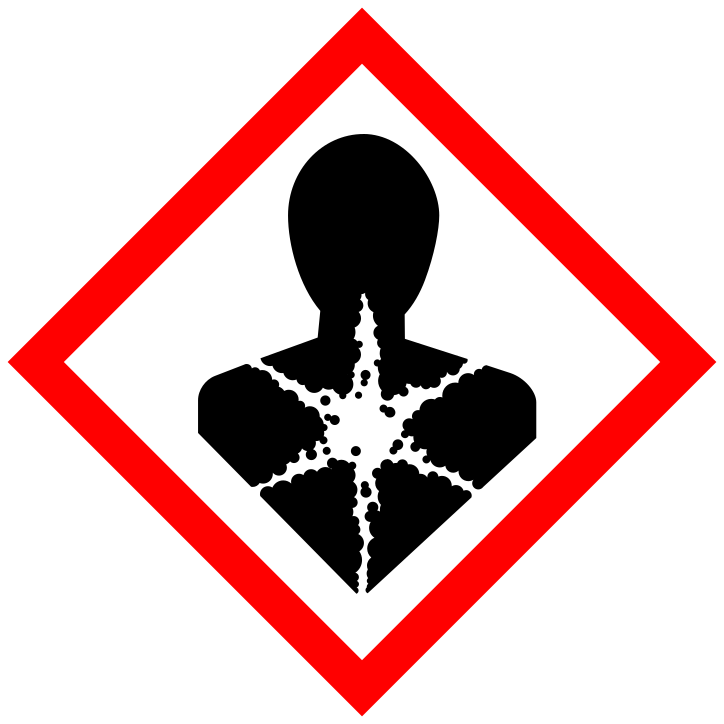
Danger
Distillates (petroleum)…
- May be fatal if swallowed and enters airways.
- If medical advice is needed, have product container or label at hand.
- Keep out of reach of children.
- Read carefully and follow all instructions.
- Dispose of contents/container to …
Supplier name, address and telephone number· Product identifier·Nominal quantity
Need this as an actual label? Open Distillates (petroleum)… in the GHS label constructor →
07 · Questions
Distillates (petroleum)… — frequently asked questions
What is the CAS number of Distillates (petroleum)…?
The CAS number of Distillates (petroleum)… is 64742-91-2. Its EC number is 265-194-3.
What does a Distillates (petroleum)… label have to show?
Under CLP Annex VI the label for Distillates (petroleum)… carries the pictogram Health hazard and the signal word is Danger.
Is Distillates (petroleum)… flammable?
CLP Annex VI assigns Distillates (petroleum)… no flammability hazard class. That is not a statement that it cannot burn: the harmonised list only records the hazards that were assessed for it.
Is Distillates (petroleum)… a carcinogen?
CLP Annex VI records no harmonised carcinogenicity classification for Distillates (petroleum)…. Annex VI is a list of agreed classifications, not a list of substances found safe, so this is an absence of a classification rather than a clean bill of health.
Nearby
Substances next to Distillates (petroleum)…
Keep going: substances starting with D, or search the whole database by name, CAS number, pictogram or signal word.