Substance profile
Extracts (petroleum), solvent-dewaxed heavy paraffinic distillate solvent, hydrodesulfurized
Extracts (petroleum), solvent-dewaxed heavy paraffinic distillate solvent, hydrodesulfurized is a substance with a harmonised classification under EU CLP.
01 · Identification
What Extracts (petroleum)… is
Extracts (petroleum), solvent-dewaxed heavy paraffinic distillate solvent, hydrodesulfurized is a substance with a harmonised classification under EU CLP.
Under the GHS it carries the signal word Danger.
02 · Identifiers
Extracts (petroleum)… identifiers and molecular data
Extracts (petroleum)… CAS number and EC number
Other names for Extracts (petroleum)…
- Distillate aromatic extract (treated)
- [A complex combination of hydrocarbons obtained from a solvent dewaxed petroleum stock by treating with hydrogen to convert organic sulfur to hydrogen sulfide which is removed. It consists predominantly of hydrocarbons having carbon numbers predominantly in the range of C15 through C50 and produces a finished oil with a viscosity of greater than 19cSt at 40 °C.]
03 · GHS classification
Extracts (petroleum)… hazard classification
Harmonised classification under CLP Annex VI. This is the legally binding classification in the EU; other jurisdictions may differ.
Extracts (petroleum)… pictograms and signal word
Extracts (petroleum)… hazard class and category
| Hazard class | Category | From code | Pictogram |
|---|---|---|---|
| Carcinogenicity GHS chapter 3.6 | Category 1A or 1B | H350 | GHS08 |
Where two values are shown with “or”, the hazard statement is shared by more than one category or by more than one class, and the code alone does not say which. H272, for example, belongs to oxidising liquids and to oxidising solids — the physical state decides. The binding answer for a specific entry is in the CLP Annex VI table itself.
Extracts (petroleum)… hazard statements (H-codes)
| Code | Hazard statement |
|---|---|
| H350 | May cause cancer <state route of exposure if it is conclusively proven that no other routes of exposure cause the hazard>. |
This page lists only the codes assigned to Extracts (petroleum)…. The full reference lives on the hazard statements hub, the precautionary statements hub and the GHS pictograms hub.
Safety Data Sheet
Getting an SDS for Extracts (petroleum)…
A Safety Data Sheet is written for a product, not for a substance: the supplier of the grade you actually buy issues it, so two suppliers of Extracts (petroleum)… issue two different sheets. That is why there is no single authoritative SDS for a substance to download — what there is, is the job of collecting the sheets for the products you hold and keeping them current as suppliers revise them.
04 · Precautionary statements
Extracts (petroleum)… precautionary statements
CLP Annex VI assigns 4 precautionary statements to Extracts (petroleum)…. They are grouped the way a label groups them: what to do before handling, what to do when something has already happened, how to store it and how to dispose of it.
Prevention
What to do before and during handling so the hazard never happens.
Response
What to do once exposure, spillage or fire has already happened.
Reading the notation. … is a blank the supplier fills in — not a truncated sentence.· [square brackets] mark a part printed only when it applies.
05 · Names in the regulation
Extracts (petroleum)… name in 23 EU languages
CLP Annex VI Part 3 is published in every language edition of the regulation, and the identification column is written out in each of them. Nothing below is translated by us: each line is the name as that edition prints it. Under Art. 18(2) the substance name from Annex VI is a lawful product identifier, so this is the wording to put on a label going to that market — and where the cell lists several designations, any one of them qualifies.
| Language | Name in CLP Annex VI Part 3 |
|---|---|
| Bulgarian български | Екстракти (нефт), депарафинирани с разтворител, разтворител на тежък парафинов дестилат, хидродесулфуриран Ароматен екстракт от дестилат (обработен) |
| Spanish español | Extractos (petróleo), con disolventes, destilado parafínico pesado desparafinado con disolventes, hidrodesulfurado extracto aromático destilado (tratado) |
| Czech čeština | extrakty (ropné), rozpouštědlové z rozpouštědlově odparafinovaného těžkého parafinického destilátu, hydrogenačně odsířené aromatický extrakt destilátu (dorafinovaný) |
| Danish dansk | ekstrakter (råolie), solventafvoksende tunge paraffindestillatsolvent-, hydroafsvovlede aromatisk ekstrakt af destillat (behandlet) |
| German Deutsch | Extrakte (Erdöl), durch Lösungsmittel entwachstes schweres paraffinhaltiges Destillat Lösungsmittel, hydrodesulfuriert Aromatenextrakt aus Destillat (behandelt) |
| Estonian eesti | ekstraktid (nafta), lahustiga ekstraheeritud (deparafiinitud) raske parafiinne destillaat, hüdroväävlitustatud destillaadi aromaatikat sisaldav ekstrakt (töödeldud) |
| Greek ελληνικά | Εκχυλίσματα (πετρελαίου), από αποκηρωμένο με διαλύτη βαρύ παραφινικό κλάσμα καθαρισμένο με διαλύτη, υδρογονοαποθειωμένο Απόσταγμα, αρωματικό εκχύλισμα (κατεργασμένο) |
| English English | Extracts (petroleum), solvent-dewaxed heavy paraffinic distillate solvent, hydrodesulfurized Distillate aromatic extract (treated) |
| French français | Extraits au solvant (pétrole), distillat paraffinique lourd déparaffiné au solvant, hydrodésulfurés extrait aromatique de distillat (traité)[combinaison complexe d'hydrocarbures obtenue par traitement à l'hydrogène d'une charge pétrolière déparaffinée au solvant afin de convertir le soufre organique en hydrogène sulfuré, qui est ensuite éliminé. Se compose principalement d'hydrocarbures comportant majoritairement entre 15 et 50 atomes de carbone (C 15 -C 50 ), et donne une huile-produit fini de viscosité supérieure à 19 cSt à 40 o C. |
| Croatian hrvatski | ekstrakti (nafta), otapalom deparafinirani, otapalom ekstrahirani teški parafinski destilat, hidrodesulfurizirani destilatni aromatski ekstrakt (obrađen) |
| Italian italiano | estratti (petrolio), solvente distillato paraffinico pesante decerato con solvente, idrodesolforato estratto aromatico distillato (trattato) |
| Latvian latviešu | Ekstrakti (naftas), ar šķīdinātāju no vaskiem attīrīta smaga parafīnu destilāta šķīdinātāja, hidrodesulfurizēti Destilāta aromātiskais ekstrakts (apstrādāts) |
| Lithuanian lietuvių | Ekstraktai (nafta), tirpikliais deparafinizuoto tamsaus parafinų distiliato tirpiklis, hidronusierintas distiliuotas aromatinis ekstraktas (apdorotas) |
| Hungarian magyar | Extraktumok (ásványolaj), oldószerrel viasztalanított paraffinos nehézpárlat oldószer, hidrogénnel kéntelenített Párlat, aromás extraktum (kezelt)[Oldószerrel viasztalanított ásványolaj párlatnak a szerves kénvegyületek kénhidrogénné alakítása és eltávolítása érdekében végzett hidrogénezésével előállított, összetett szénhidrogénkeverék. Főként C 15 -C 50 szénatomszámú szénhidrogénekből áll, és a végtermék olaj viszkozitása hozzávetőleg 19 cSt 40 o C-on. |
| Maltese Malti | Estratti (żejt mhux maħdum) solvent tad-distillat paraffiniku tqil bix-xama’ mneħħi bis-solvent, idrodesulfurizzati Estratt aromatiku ta' distillat (trattat)[Taħlita kumplessa ta' idrokarburi miksuba minn stokk ta' żejt mhux maħdum bix-xama' mneħħija b'solvent bit-trattament bl-idroġenu sabiex il-kubrit organiku jiġu konvertit f'kubrit tal-idroġenu li jitneħħa. Tikkonsisti b'mod predominanti f'idrokarburi b'numri tal-karbonju fil-biċċa l-kbira fil-medda ta’ C 15 sa C 50 u tipproduċi żejt lest b'viskożità akbar minn 19cSt f’40 o C. |
| Dutch Nederlands | extracten (aardolie), met oplosmiddel van was ontdane paraffinisch zwaar destillaat-oplosmiddel-, met waterstof ontzwaveld aromatisch extract van destillaat (bewerkt) |
| Polish polski | Ekstrakty rozpuszczalnikowe destylatów ciężkich parafinowych, odparafinowanych rozpuszczalnikowo, hydroodsiarczone (ropa naftowa) Ekstrakt aromatyczny (po obróbce) |
| Portuguese português | extratos (petróleo), com solventes, de destilados parafínicos pesados desparafinados com solventes, hidrodessulfurados extrato aromático de destilado (tratado) |
| Romanian română | Extracție cu solvenți, hidrodesulfurare (petrol), distilat parafinic greu deparafinat cu solvenți Extract aromatic din distilat (tratat) |
| Slovak slovenčina | extrakty (ropné), odvoskované rozpúšťadlom, z ťažkého vyššieho alkánového destilátu, extrahované rozpúšťadlom, hydrogenačne odsírené aromátový extrakt z destilátov (upravovaný) |
| Slovenian slovenščina | ekstrakti (nafta), s topilom ekstrahiran težki parafinski destilat, razvoščeni s topilom, razžvepljeni z vodikom ekstrakt aromatov iz destilata (obdelan) |
| Finnish suomi | Uutteet (maaöljy), vahat poistettu liuottimella raskas parafiininen tisleliuotin, rikki poistettu vedyllä Tislauksen aromaattinen uute (käsitelty) |
| Swedish svenska | Extrakt (petroleum), lösningsmedelsavvaxade tunga paraffindestillatlösningsmedels-, väteavsvavlade Destillat, aromatiskt extrakt (behandlat) |
All 23 language editions of Annex VI carry this entry. Irish is the twenty-fourth official EU language and has no line here for a different reason: no consolidated CLP text has ever been published in Irish, so there is no Irish edition of Annex VI to quote a name from. Source: consolidated CLP, CELEX 02008R1272, language editions. © European Union, https://eur-lex.europa.eu — only the electronic Official Journal of the European Union is authentic.
06 · Label elements
Extracts (petroleum)… GHS label elements
Everything CLP Annex VI fixes for Extracts (petroleum)…, laid out the way it appears on a label. The greyed lines are the parts only the supplier can fill in.
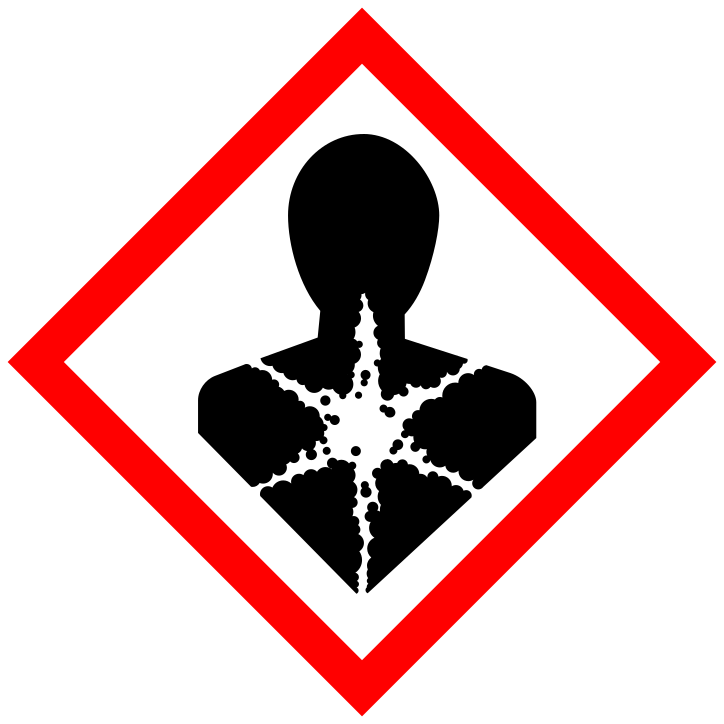
Danger
Extracts (petroleum)…
- May cause cancer <state route of exposure if it is conclusively proven that no other routes of exposure cause the hazard>.
- Obtain special instructions before use.
- Wear protective gloves/protective clothing/eye protection/face protection/hearing protection/…
- IF exposed or concerned:
- Get medical advice/attention.
Supplier name, address and telephone number· Product identifier·Nominal quantity
Need this as an actual label? Open Extracts (petroleum)… in the GHS label constructor →
07 · Transport
Extracts (petroleum)… UN number and transport classification
Transport classification is a separate system from the GHS classification above. It decides how a package is marked and how a load may be carried; it does not follow from the workplace label, and the workplace label does not follow from it. The entries below are linked by CAS number, never by name.
Extracts (petroleum)… under UN 1197 — shipping name, class and packing group
Europe · ADR 2025, Table A
| Proper shipping name (3.1.2) | Class | Classification code | PG | Labels (column 5) |
|---|---|---|---|---|
| EXTRACTS, LIQUID, for flavour or aroma (vapour pressure at 50 °C more than 110 kPa) | 3 | F1 | II | |
| EXTRACTS, LIQUID, for flavour or aroma (vapour pressure at 50 °C not more than 110 kPa) | 3 | F1 | II | |
| EXTRACTS, LIQUID, for flavour or aroma | 3 | F1 | III | |
| EXTRACTS, LIQUID, for flavour or aroma (having a flash-point below 23 °C and viscous according to 2.2.3.1.4) (vapour pressure at 50 °C more than 110 kPa) | 3 | F1 | III | |
| EXTRACTS, LIQUID, for flavour or aroma (having a flash-point below 23 °C and viscous according to 2.2.3.1.4) (vapour pressure at 50 °C not more than 110 kPa) | 3 | F1 | III | |

Source: ADR 2025, Table A of Chapter 3.2 · ECE/TRANS/352 Vol. I (UNECE). Class 3 is “Flammable liquids” (ADR 2.1.1.1).
United States · 49 CFR 172.101 Hazardous Materials Table
| Proper shipping name (column 2) | Class or division | PG | Labels (column 6) |
|---|---|---|---|
| Extracts, liquid, for flavor or aroma | 3 | II | |
| Extracts, liquid, for flavor or aroma | 3 | III | |
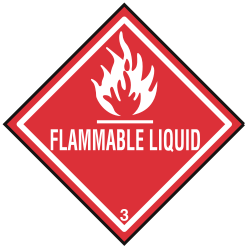
Source: 49 CFR 172.101 Hazardous Materials Table · eCFR, revision 2026-08-03. Class 3 is “Flammable and combustible liquid” (49 CFR 173.2).
08 · Questions
Extracts (petroleum)… — frequently asked questions
What is the CAS number of Extracts (petroleum)…?
The CAS number of Extracts (petroleum)… is 93763-11-2. Its EC number is 297-829-5.
What does a Extracts (petroleum)… label have to show?
Under CLP Annex VI the label for Extracts (petroleum)… carries the pictogram Health hazard and the signal word is Danger.
Is Extracts (petroleum)… flammable?
CLP Annex VI assigns Extracts (petroleum)… no flammability hazard class. That is not a statement that it cannot burn: the harmonised list only records the hazards that were assessed for it.
Is Extracts (petroleum)… a carcinogen?
Yes. CLP Annex VI classifies Extracts (petroleum)… as a category 1A or 1B carcinogen and assigns it H350: may cause cancer.
Nearby
Substances next to Extracts (petroleum)…
Keep going: substances starting with E, or search the whole database by name, CAS number, pictogram or signal word.