Substance profile
Hydrocarbons, C16-20, solvent-dewaxed hydrocracked paraffinic distn. residue
Hydrocarbons, C16-20, solvent-dewaxed hydrocracked paraffinic distn. residue is a substance with a harmonised classification under EU CLP.
01 · Identification
What Hydrocarbons, C16-20… is
Hydrocarbons, C16-20, solvent-dewaxed hydrocracked paraffinic distn. residue is a substance with a harmonised classification under EU CLP.
Under the GHS it carries the signal word Warning.
02 · Identifiers
Hydrocarbons, C16-20… identifiers and molecular data
Hydrocarbons, C16-20… CAS number and EC number
Other names for Hydrocarbons, C16-20…
- Cracked gasoil
- [A complex combination of hydrocarbons obtained by solvent dewaxing of a distillation residue from a hydrocracked paraffinic distillate. It consists predominantly of hydrocarbons having carbon numbers predominantly in the range of C16 through C20 and boiling in the range of approximately 360 °C to 500 °C (680 °F to 932 °F). It produces a finished oil having a viscosity of 4,5 cSt at approximately 100 °C (212 °F).]
03 · GHS classification
Hydrocarbons, C16-20… hazard classification
Harmonised classification under CLP Annex VI. This is the legally binding classification in the EU; other jurisdictions may differ.
Hydrocarbons, C16-20… pictograms and signal word
Hydrocarbons, C16-20… hazard class and category
| Hazard class | Category | From code | Pictogram |
|---|---|---|---|
| Carcinogenicity GHS chapter 3.6 | Category 2 | H351 | GHS08 |
Hydrocarbons, C16-20… hazard statements (H-codes)
| Code | Hazard statement |
|---|---|
| H351 | Suspected of causing cancer <state route of exposure if it is conclusively proven that no other routes of exposure cause the hazard>. |
This page lists only the codes assigned to Hydrocarbons, C16-20…. The full reference lives on the hazard statements hub, the precautionary statements hub and the GHS pictograms hub.
Safety Data Sheet
Getting an SDS for Hydrocarbons, C16-20…
A Safety Data Sheet is written for a product, not for a substance: the supplier of the grade you actually buy issues it, so two suppliers of Hydrocarbons, C16-20… issue two different sheets. That is why there is no single authoritative SDS for a substance to download — what there is, is the job of collecting the sheets for the products you hold and keeping them current as suppliers revise them.
04 · Precautionary statements
Hydrocarbons, C16-20… precautionary statements
CLP Annex VI assigns 4 precautionary statements to Hydrocarbons, C16-20…. They are grouped the way a label groups them: what to do before handling, what to do when something has already happened, how to store it and how to dispose of it.
Prevention
What to do before and during handling so the hazard never happens.
Response
What to do once exposure, spillage or fire has already happened.
Reading the notation. … is a blank the supplier fills in — not a truncated sentence.· [square brackets] mark a part printed only when it applies.
05 · Names in the regulation
Hydrocarbons, C16-20… name in 23 EU languages
CLP Annex VI Part 3 is published in every language edition of the regulation, and the identification column is written out in each of them. Nothing below is translated by us: each line is the name as that edition prints it. Under Art. 18(2) the substance name from Annex VI is a lawful product identifier, so this is the wording to put on a label going to that market — and where the cell lists several designations, any one of them qualifies.
| Language | Name in CLP Annex VI Part 3 |
|---|---|
| Bulgarian български | Въглеводороди, C 16-20 , депарафиниран с разтворител хидрокрекиран парафинов остатък от дестилация Крекиран газьол |
| Spanish español | Hidrocarburos, C 16-20 , residuo de destilación parafínico hidrocraqueado desparafinado con disolventes gasóleo craqueado |
| Czech čeština | uhlovodíky, C 16-20 , rozpouštědlově odparafinovaný hydrokrakovaný parafinický destilační zbytek krakový plynový olej |
| Danish dansk | carbonhydrider, C 16-20 , solvent-afvokset hydrokrakket paraffindestillationsrest krakket gasolie |
| German Deutsch | Kohlenwasserstoffe, C 16-20 , durch Lösungsmittel entwachst hydrogecrackt paraffinhaltig Destillationsrückstand gecracktes Gasöl |
| Estonian eesti | C 16-20 -süsivesinikud, lahustiga deparafiinitud hüdrokrakitud parafiinsed destillatsioonijäägid krakitud gaasiõli |
| Greek ελληνικά | Υδρογονάνθρακες, C 16-20 , αποκηρωμένο με διαλύτη υδρογονοπυρολυμένο παραφινικό υπόλειμμα απόσταξης Πυρολυμένο κλάσμα gasoil |
| English English | Hydrocarbons, C 16-20 , solvent-dewaxed hydrocracked paraffinic distn. residue Cracked gasoil |
| French français | Hydrocarbures en C 16-20 , résidu de distillation paraffinique, hydrocraquage et déparaffinage au solvant gazole de craquage[combinaison complexe d'hydrocarbures obtenue par déparaffinage au solvant d'un résidu de distillation issu d'un distillat paraffinique ayant subi un hydrocraquage. Se compose principalement d'hydrocarbures comportant majoritairement entre 16 et 20 atomes de carbone (C 16 -C 20 ) et dont l'intervalle d'ébullition est compris approximativement entre 360 et 500 o C (entre 680 et 932 o F).] Donne une huile-produit fini de viscosité égale à 4,5 cSt à environ 100 o C (212 o F).] |
| Croatian hrvatski | ugljikovodici, C 16-20 , deparafinirani otapalom, hidrokrekirani parafinski ostatak destilacije krekirano plinsko ulje |
| Italian italiano | idrocarburi, C 16-20 , residuo della distillazione di paraffine da idrocracking decerati con solvente gasolio da cracking |
| Latvian latviešu | Ogļūdeņraži, C 16-20 , hidrokrekinga parafīnu destilācijas atlikums, ar šķīdinātāju attīrīts no vaskiem Krekinga gāzeļļa |
| Lithuanian lietuvių | Angliavandeniliai, C 16-20 , tirpiklio deparafinizavimas hidrokrekingu parafinų distiliacijos likutis krekingo gazolis |
| Hungarian magyar | Szénhidrogének, C 16-20 , oldószerrel viaszmentesített, hidrokrakkolt paraffin deszt. maradék Krakkolt gázolaj |
| Maltese Malti | Idrokarburi, C 16-20 , residwu tad-distn. paraffiniku idrokrekkjat bix-xama' mneħħija b'solvent Diżil krekkjat [Taħlita kumplessa ta' idrokarburi miksuba bid-deparaffinazzjoni b'solvent tar-residwu tad-distillazzjoni minn distillat paraffiniku idrokrekkjat. Tikkonsisti b'mod predominanti f'idrokarburi b'numri tal-karbonju b'mod predominanti fil-medda ta' C 16 sa C 20 u b'punt ta' togħlija fil-medda ta' bejn wieħed u ieħor 360 o C sa 500 o C (680 o F sa 932 o F).] Tipproduċi żejt lest b'viskożità ta' 4,5 cSt f’madwar 100 o C (212 o F).] |
| Dutch Nederlands | koolwaterstoffen, C 16-20 -, met oplosmiddel van was ontdaan waterstofgekraakt paraffinisch destillatieresidu gekraakte gasolie |
| Polish polski | Węglowodory C 16-20 z od parafin owa ni a rozpuszczalnikowego pozostałości po destylacji frakcji parafinowej z hydrokrakingu Olej gazowy z krakowania |
| Portuguese português | hidrocarbonetos, C 16-20 , resíduo de destilação de produtos de hidrocracking de destilado parafínico, desparafinado com solventes gasóleo de cracking |
| Romanian română | Hidrocarburi, fracția C 16-20 , reziduu de la distilarea parafinelor, hidrocracare și deparafinare cu solvenți Motorină de cracare |
| Slovak slovenčina | C 16-20 -uhľovodíky, rozpúšťadlom odvoskovaný hydrokrakovaný alkánový destilačný zvyšok krakovaný plynový olej |
| Slovenian slovenščina | ogljikovodiki, C 16–20 , razvoščeni s topilom, hidrokrekirani parafinski dest. ostanki krekirano plinsko olje |
| Finnish suomi | Hiilivedyt, C 16 –20, vahaton vetykrakattu parafiininen tislausjäännös Krakattu kaasuöljy |
| Swedish svenska | Kolväten, C 16-20 , lösningsmedelsavvaxade hydrokrackade paraffindestillationsåterstoder Krackad gasolja |
All 23 language editions of Annex VI carry this entry. Irish is the twenty-fourth official EU language and has no line here for a different reason: no consolidated CLP text has ever been published in Irish, so there is no Irish edition of Annex VI to quote a name from. Source: consolidated CLP, CELEX 02008R1272, language editions. © European Union, https://eur-lex.europa.eu — only the electronic Official Journal of the European Union is authentic.
06 · Label elements
Hydrocarbons, C16-20… GHS label elements
Everything CLP Annex VI fixes for Hydrocarbons, C16-20…, laid out the way it appears on a label. The greyed lines are the parts only the supplier can fill in.
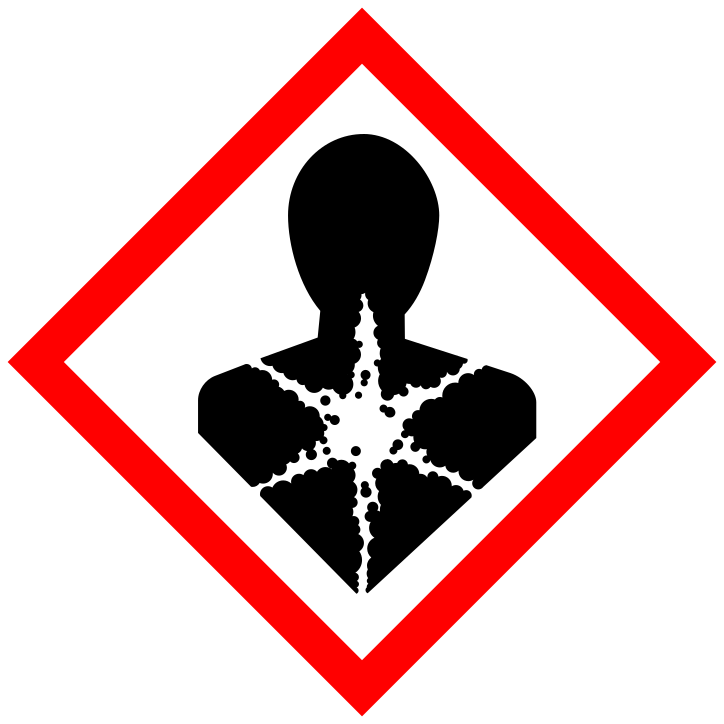
Warning
Hydrocarbons, C16-20…
- Suspected of causing cancer <state route of exposure if it is conclusively proven that no other routes of exposure cause the hazard>.
- Obtain special instructions before use.
- Wear protective gloves/protective clothing/eye protection/face protection/hearing protection/…
- IF exposed or concerned:
- Get medical advice/attention.
Supplier name, address and telephone number· Product identifier·Nominal quantity
Need this as an actual label? Open Hydrocarbons, C16-20… in the GHS label constructor →
07 · Transport
Hydrocarbons, C16-20… UN number and transport classification
Transport classification is a separate system from the GHS classification above. It decides how a package is marked and how a load may be carried; it does not follow from the workplace label, and the workplace label does not follow from it. The entries below are linked by CAS number, never by name.
Hydrocarbons, C16-20… under UN 3295 — shipping name, class and packing group
Europe · ADR 2025, Table A
| Proper shipping name (3.1.2) | Class | Classification code | PG | Labels (column 5) |
|---|---|---|---|---|
| HYDROCARBONS, LIQUID, N.O.S. | 3 | F1 | I | |
| HYDROCARBONS, LIQUID, N.O.S. (vapour pressure at 50 °C more than 110 kPa) | 3 | F1 | II | |
| HYDROCARBONS, LIQUID, N.O.S. (vapour pressure at 50 °C not more than 110 kPa) | 3 | F1 | II | |
| HYDROCARBONS, LIQUID, N.O.S. | 3 | F1 | III | |

Source: ADR 2025, Table A of Chapter 3.2 · ECE/TRANS/352 Vol. I (UNECE). Class 3 is “Flammable liquids” (ADR 2.1.1.1).
United States · 49 CFR 172.101 Hazardous Materials Table
| Proper shipping name (column 2) | Class or division | PG | Labels (column 6) |
|---|---|---|---|
| Hydrocarbons, liquid, n.o.s. | 3 | I | |
| Hydrocarbons, liquid, n.o.s. | 3 | II | |
| Hydrocarbons, liquid, n.o.s. | 3 | III | |
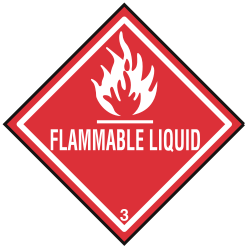
Source: 49 CFR 172.101 Hazardous Materials Table · eCFR, revision 2026-08-03. Class 3 is “Flammable and combustible liquid” (49 CFR 173.2).
08 · Questions
Hydrocarbons, C16-20… — frequently asked questions
What is the CAS number of Hydrocarbons, C16-20…?
The CAS number of Hydrocarbons, C16-20… is 97675-88-2. Its EC number is 307-662-2.
What does a Hydrocarbons, C16-20… label have to show?
Under CLP Annex VI the label for Hydrocarbons, C16-20… carries the pictogram Health hazard and the signal word is Warning.
Is Hydrocarbons, C16-20… flammable?
CLP Annex VI assigns Hydrocarbons, C16-20… no flammability hazard class. That is not a statement that it cannot burn: the harmonised list only records the hazards that were assessed for it.
Is Hydrocarbons, C16-20… a carcinogen?
CLP Annex VI assigns Hydrocarbons, C16-20… H351 — suspected of causing cancer. That is category 2: the evidence points that way but is not conclusive.
Nearby
Substances next to Hydrocarbons, C16-20…
Keep going: substances starting with H, or search the whole database by name, CAS number, pictogram or signal word.