Substance profile
Kerosene
Kerosene is a substance with a harmonised classification under EU CLP.
01 · Identification
What Kerosene is
Kerosene is a substance with a harmonised classification under EU CLP.
Under the GHS it carries the signal word Danger.
02 · Identifiers
Kerosene identifiers and molecular data
Kerosene CAS number and EC number
Other names for Kerosene
- paraffin oil
- jet fuel
- Fuel Oils
- Jp-1
- Kerosine
- Oils, Fuel: No. 1
- Range Oil
- Jet Fuels: Jp-5
- Kerosene, Heavy
- Af 100 (Pesticide)
- Avtur
- Avtur (Pesticide)
- Bayol 35
- Bitumen Cutter
- Shell 140
- Shellsol 2046
- Kerosine (petroleum)
- Straight run kerosine
- [A complex combination of hydrocarbons produced by the distillation of crude oil. It consists of hydrocarbons having carbon numbers predominantly in the range of C9 through C16 and boiling in the range of approximately 150 °C to 290 °C (320 °F to 554 °F).]
03 · GHS classification
Kerosene hazard classification
Harmonised classification under CLP Annex VI. This is the legally binding classification in the EU; other jurisdictions may differ.
Kerosene pictograms and signal word
Kerosene hazard class and category
| Hazard class | Category | From code | Pictogram |
|---|---|---|---|
| Aspiration hazard GHS chapter 3.10 | Category 1 | H304 | GHS08 |
Kerosene hazard statements (H-codes)
| Code | Hazard statement |
|---|---|
| H304 | May be fatal if swallowed and enters airways. |
This page lists only the codes assigned to Kerosene. The full reference lives on the hazard statements hub, the precautionary statements hub and the GHS pictograms hub.
Safety Data Sheet
Getting an SDS for Kerosene
Our own Kerosene safety data sheet walks through all sixteen sections of the published data. What it is not is the document an inspector asks for: an SDS is issued for a product by its supplier, so the sheet covering the grade actually standing in your store exists only in that supplier’s version. Collecting those and keeping them current as suppliers revise them is a separate job.
04 · Precautionary statements
Kerosene precautionary statements
CLP Annex VI assigns 4 precautionary statements to Kerosene. They are grouped the way a label groups them: what to do before handling, what to do when something has already happened, how to store it and how to dispose of it.
General
Statements that belong on the label whoever handles the product.
Disposal
What has to happen to the contents and the empty container.
Reading the notation. … is a blank the supplier fills in — not a truncated sentence.· [square brackets] mark a part printed only when it applies.
05 · Names in the regulation
Kerosene name in 23 EU languages
CLP Annex VI Part 3 is published in every language edition of the regulation, and the identification column is written out in each of them. Nothing below is translated by us: each line is the name as that edition prints it. Under Art. 18(2) the substance name from Annex VI is a lawful product identifier, so this is the wording to put on a label going to that market — and where the cell lists several designations, any one of them qualifies.
| Language | Name in CLP Annex VI Part 3 |
|---|---|
| Bulgarian български | Керосин (нефтен) Керосин от пряка дестилация |
| Spanish español | Queroseno (petróleo) queroseno de primera destilación |
| Czech čeština | petrolej (ropný) primární petrolej |
| Danish dansk | petroleum (råolie) straight-run, petroleum |
| German Deutsch | Kerosin (Erdöl) Straight-run Kerosin |
| Estonian eesti | petrooleum (nafta) otsedestillatsiooni petrooleum |
| Greek ελληνικά | Κηροζίνη (πετρελαίου) Κηροζίνη, απευθείας απόσταξης |
| English English | Kerosine (petroleum) Straight run kerosine |
| French français | Kérosène (pétrole) kérosène de distillation directe |
| Croatian hrvatski | kerozin (nafta) primarni kerozin |
| Italian italiano | cherosene (petrolio) cherosene di prima distillazione |
| Latvian latviešu | Petroleja (naftas) Tiešās destilācijas petroleja |
| Lithuanian lietuvių | Žibalas (naftos) pirminis žibalas |
| Hungarian magyar | Kerozin (ásványolaj), közvetlen lepárlású kerozin |
| Maltese Malti | Kerosin (żejt mhux maħdum) Kerosin ta’ straight-run |
| Dutch Nederlands | kerosine (aardolie) gedestilleerde kerosine |
| Polish polski | Frakcja naftowa (ropa naftowa) Frakcja naftowa z destylacji zachowawczej |
| Portuguese português | petróleo de iluminação (petróleo) petróleo de iluminação de destilação direta |
| Romanian română | Kerosen (petrol) Kerosen de distilare primară |
| Slovak slovenčina | petrolej (ropný) primárny petrolej |
| Slovenian slovenščina | kerozin (nafta) kerozin iz direktne destilacije |
| Finnish suomi | Kerosiini (maaöljy) Suoratislauskerosiini |
| Swedish svenska | Fotogen (petroleum) Direktdestillerad fotogen |
All 23 language editions of Annex VI carry this entry. Irish is the twenty-fourth official EU language and has no line here for a different reason: no consolidated CLP text has ever been published in Irish, so there is no Irish edition of Annex VI to quote a name from. Source: consolidated CLP, CELEX 02008R1272, language editions. © European Union, https://eur-lex.europa.eu — only the electronic Official Journal of the European Union is authentic.
06 · Label elements
Kerosene GHS label elements
Everything CLP Annex VI fixes for Kerosene, laid out the way it appears on a label. The greyed lines are the parts only the supplier can fill in.

Danger
Kerosene
- May be fatal if swallowed and enters airways.
- If medical advice is needed, have product container or label at hand.
- Keep out of reach of children.
- Read carefully and follow all instructions.
- Dispose of contents/container to …
Supplier name, address and telephone number· Product identifier·Nominal quantity
Need this as an actual label? Open Kerosene in the GHS label constructor →
07 · Handling and storage
Kerosene storage and handling
Kerosene reactive group
CAMEO Chemicals places Kerosene in the reactive group Hydrocarbons, Aliphatic Saturated. Compatibility with other chemicals is worked out from the group, not from the individual substance — which is why two substances you have never seen react can still be flagged as a pair that must be separated.
A reactive group is a CAMEO Chemicals (US NOAA) grouping, not a GHS hazard class: it has no code, no category and no legal force. It is what the storage compatibility matrix on this site computes from.
Planning storage for a mix of chemicals? Check Kerosene in the storage compatibility matrix →
08 · Transport
Kerosene UN number and transport classification
Transport classification is a separate system from the GHS classification above. It decides how a package is marked and how a load may be carried; it does not follow from the workplace label, and the workplace label does not follow from it. The entries below are linked by CAS number, never by name.
Kerosene under UN 1223 — shipping name, class and packing group
Europe · ADR 2025, Table A
| Proper shipping name (3.1.2) | Class | Classification code | PG | Labels (column 5) |
|---|---|---|---|---|
| KEROSENE | 3 | F1 | III | |

Source: ADR 2025, Table A of Chapter 3.2 · ECE/TRANS/352 Vol. I (UNECE). Class 3 is “Flammable liquids” (ADR 2.1.1.1).
United States · 49 CFR 172.101 Hazardous Materials Table
| Proper shipping name (column 2) | Class or division | PG | Labels (column 6) |
|---|---|---|---|
| Kerosene | 3 | III | |
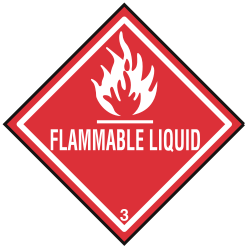
Source: 49 CFR 172.101 Hazardous Materials Table · eCFR, revision 2026-08-03. Class 3 is “Flammable and combustible liquid” (49 CFR 173.2).
09 · Questions
Kerosene — frequently asked questions
What is the CAS number of Kerosene?
The CAS number of Kerosene is 8008-20-6. Its EC number is 232-366-4.
What does a Kerosene label have to show?
Under CLP Annex VI the label for Kerosene carries the pictogram Health hazard and the signal word is Danger.
Is Kerosene flammable?
CLP Annex VI assigns Kerosene no flammability hazard class. That is not a statement that it cannot burn: the harmonised list only records the hazards that were assessed for it.
Is Kerosene a carcinogen?
CLP Annex VI records no harmonised carcinogenicity classification for Kerosene. Annex VI is a list of agreed classifications, not a list of substances found safe, so this is an absence of a classification rather than a clean bill of health.
Nearby
Substances next to Kerosene
Keep going: substances starting with K, or search the whole database by name, CAS number, pictogram or signal word.
Next