Substance profile
Natural gas condensates
Natural gas condensates is a substance with a harmonised classification under EU CLP.
01 · Identification
What Natural gas condensates is
Natural gas condensates is a substance with a harmonised classification under EU CLP.
Under the GHS it carries the signal word Danger.
02 · Identifiers
Natural gas condensates identifiers and molecular data
Natural gas condensates CAS number and EC number
Other names for Natural gas condensates
- Low boiling point naphtha - unspecified
- [A complex combination of hydrocarbons separated and/or condensed from natural gas during transportation and collected at the wellhead and/or from the production, gathering, transmission, and distribution pipelines in deeps, scrubbers, etc. It consists predominantly of hydrocarbons having carbon numbers predominantly in the range of C2 through C8.]
03 · GHS classification
Natural gas condensates hazard classification
Harmonised classification under CLP Annex VI. This is the legally binding classification in the EU; other jurisdictions may differ.
Natural gas condensates pictograms and signal word
Natural gas condensates hazard class and category
| Hazard class | Category | From code | Pictogram |
|---|---|---|---|
| Germ cell mutagenicity GHS chapter 3.5 | Category 1A or 1B | H340 | GHS08 |
| Carcinogenicity GHS chapter 3.6 | Category 1A or 1B | H350 | GHS08 |
| Aspiration hazard GHS chapter 3.10 | Category 1 | H304 | GHS08 |
Where two values are shown with “or”, the hazard statement is shared by more than one category or by more than one class, and the code alone does not say which. H272, for example, belongs to oxidising liquids and to oxidising solids — the physical state decides. The binding answer for a specific entry is in the CLP Annex VI table itself.
Natural gas condensates hazard statements (H-codes)
| Code | Hazard statement |
|---|---|
| H350 | May cause cancer <state route of exposure if it is conclusively proven that no other routes of exposure cause the hazard>. |
| H340 | May cause genetic defects <state route of exposure if it is conclusively proven that no other routes of exposure cause the hazard>. |
| H304 | May be fatal if swallowed and enters airways. |
This page lists only the codes assigned to Natural gas condensates. The full reference lives on the hazard statements hub, the precautionary statements hub and the GHS pictograms hub.
Safety Data Sheet
Getting an SDS for Natural gas condensates
A Safety Data Sheet is written for a product, not for a substance: the supplier of the grade you actually buy issues it, so two suppliers of Natural gas condensate… issue two different sheets. That is why there is no single authoritative SDS for a substance to download — what there is, is the job of collecting the sheets for the products you hold and keeping them current as suppliers revise them.
04 · Precautionary statements
Natural gas condensates precautionary statements
CLP Annex VI assigns 4 precautionary statements to Natural gas condensates. They are grouped the way a label groups them: what to do before handling, what to do when something has already happened, how to store it and how to dispose of it.
Prevention
What to do before and during handling so the hazard never happens.
Response
What to do once exposure, spillage or fire has already happened.
Reading the notation. … is a blank the supplier fills in — not a truncated sentence.· [square brackets] mark a part printed only when it applies.
05 · Names in the regulation
Natural gas condensates name in 23 EU languages
CLP Annex VI Part 3 is published in every language edition of the regulation, and the identification column is written out in each of them. Nothing below is translated by us: each line is the name as that edition prints it. Under Art. 18(2) the substance name from Annex VI is a lawful product identifier, so this is the wording to put on a label going to that market — and where the cell lists several designations, any one of them qualifies.
| Language | Name in CLP Annex VI Part 3 |
|---|---|
| Bulgarian български | Кондензати от природен газ Нафта с ниска температура на кипене — неспецифицирана |
| Spanish español | Condensados de gas natural nafta de bajo punto de ebullición, sin especificar |
| Czech čeština | kondenzáty zemního plynu nízkovroucí benzínová frakce – nespecifikovaná |
| Danish dansk | naturgaskondensater lavtkogende uspecificeret naphtha |
| German Deutsch | Erdgaskondensate Naphtha, niedrigsiedend, nicht spezifiziert |
| Estonian eesti | maagaasikondensaadid kergkeev toorbensiin – määratlemata |
| Greek ελληνικά | Συμπυκνώματα φυσικού αερίου Νάφθα χαμηλού σημείου ζέσεως — μη προσδιοριζόμενη |
| English English | Natural gas condensates Low boiling point naphtha -unspecified |
| French français | Condensats de gaz naturel naphta à bas point d'ébullition — non spécifié |
| Croatian hrvatski | kondenzati prirodnog plina niskovrijući benzin – nespecificiran |
| Italian italiano | gas naturale, condensati nafta con basso punto di ebollizione — non specificata |
| Latvian latviešu | Dabasgāzes kondensāti Jēlbenzīns ar zemu viršanas punktu — nav precizēts |
| Lithuanian lietuvių | Gamtinių dujų kondensatai Žematemperatūris pirminis benzinas – neapibrėžtasSudėtingas mišinys angliavandenilių, atskirtų ir/arba kondensuotų iš gamtinių dujų jas transportuojant ir surinktų gręžinio angoje ir/arba gamybos, surinkimo, perdavimo ir paskirstymo vamzdynuose, įdubose, skruberiuose ir t. t. Jį sudaro daugiausia angliavandeniliai, turintys anglies atomų skaičių daugiausia nuo C 2 iki C 8 .] |
| Hungarian magyar | Földgáz kondenzátumok Alacsony forráspontú benzin – nem meghatározott |
| Maltese Malti | Kondensati tal-gass naturali Nafta b’punt tat-togħlija baxx -mhux speċifikat |
| Dutch Nederlands | aardgascondensaten nafta met laag kookpunt — niet gespecificeerd |
| Polish polski | Kondensaty gazu ziemnego Niskowrząca benzyna – niespecyfikowana[Złożona mieszanina węglowodorów wydzielona lub skondensowana z gazu ziemnego podczas transportu i zebrana na głowicy lub z produkcji, zbierania, przesyłania i dystrybucji przewodami rurowymi w dennikach, skruberach itd.] Składa się przede wszystkim z węglowodorów o liczbie atomów węgla głównie w zakresie od C 2 do C 8 .] |
| Portuguese português | condensados de gás natural nafta de baixo ponto de ebulição — não-especificada |
| Romanian română | Gaz natural, condensate Benzină nafta cu temperaturi de fierbere scăzute – fără specificații |
| Slovak slovenčina | kondenzáty zo zemného plynu ťažký benzín s nízkou teplotou varu – nešpecifikovaný |
| Slovenian slovenščina | kondenzati zemeljskega plina nafta z nizkim vreliščem – nespecificirana |
| Finnish suomi | Luonnonkaasukondensaatit Matalalla kiehuva teollisuusbensiini – täsmentämätön |
| Swedish svenska | Naturgaskondensat Lågkokande nafta – ospecificerad |
All 23 language editions of Annex VI carry this entry. Irish is the twenty-fourth official EU language and has no line here for a different reason: no consolidated CLP text has ever been published in Irish, so there is no Irish edition of Annex VI to quote a name from. Source: consolidated CLP, CELEX 02008R1272, language editions. © European Union, https://eur-lex.europa.eu — only the electronic Official Journal of the European Union is authentic.
06 · Label elements
Natural gas condensates GHS label elements
Everything CLP Annex VI fixes for Natural gas condensates, laid out the way it appears on a label. The greyed lines are the parts only the supplier can fill in.
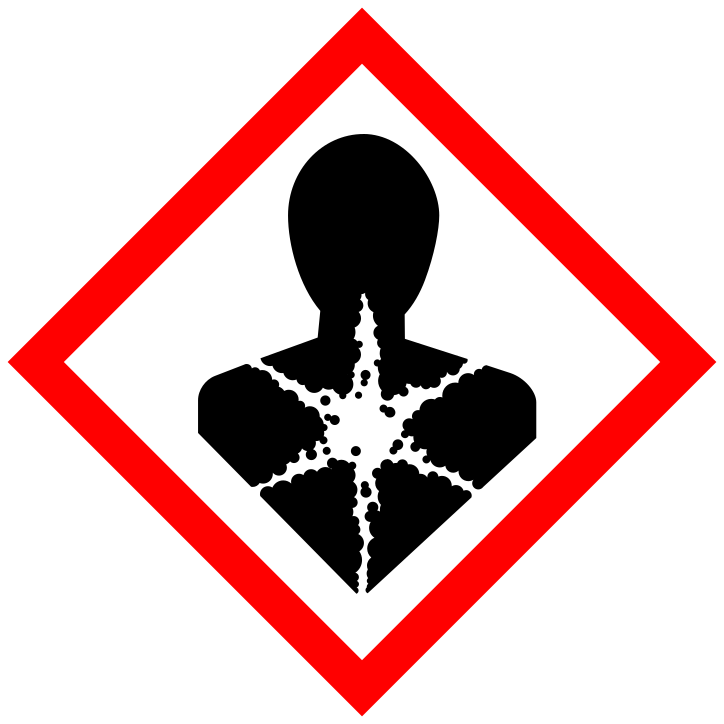
Danger
Natural gas condensates
- May cause cancer <state route of exposure if it is conclusively proven that no other routes of exposure cause the hazard>.
- May cause genetic defects <state route of exposure if it is conclusively proven that no other routes of exposure cause the hazard>.
- May be fatal if swallowed and enters airways.
- Obtain special instructions before use.
- Wear protective gloves/protective clothing/eye protection/face protection/hearing protection/…
- IF exposed or concerned:
- Get medical advice/attention.
Supplier name, address and telephone number· Product identifier·Nominal quantity
Need this as an actual label? Open Natural gas condensates in the GHS label constructor →
07 · Questions
Natural gas condensates — frequently asked questions
What is the CAS number of Natural gas condensates?
The CAS number of Natural gas condensates is 68919-39-1. Its EC number is 272-896-3.
What does a Natural gas condensates label have to show?
Under CLP Annex VI the label for Natural gas condensates carries the pictogram Health hazard and the signal word is Danger.
Is Natural gas condensates flammable?
CLP Annex VI assigns Natural gas condensates no flammability hazard class. That is not a statement that it cannot burn: the harmonised list only records the hazards that were assessed for it.
Is Natural gas condensates a carcinogen?
Yes. CLP Annex VI classifies Natural gas condensates as a category 1A or 1B carcinogen and assigns it H350: may cause cancer.
Nearby
Substances next to Natural gas condensates
Keep going: substances starting with N, or search the whole database by name, CAS number, pictogram or signal word.