Substance profile
Silicon carbide fibres (with diameter < 3 μm, length > 5 μm and aspect ratio ≥ 3:1)
Silicon carbide fibres (with diameter < 3 μm, length > 5 μm and aspect ratio ≥ 3:1) is exceedingly hard, green to bluish-black, iridescent, sharp crystals.
01 · Identification
What Silicon carbide fibres (with… is
Silicon carbide fibres (with diameter < 3 μm, length > 5 μm and aspect ratio ≥ 3:1) is exceedingly hard, green to bluish-black, iridescent, sharp crystals. Its molecular formula is CSi and its molecular weight is 40.096 g/mol. It is practically insoluble in water.
Under the GHS it carries the signal word Danger.
02 · Identifiers
Silicon carbide fibres (with… identifiers and molecular data
Silicon carbide fibres (with… CAS number and EC number
Silicon carbide fibres (with… molecular formula and molecular weight
03 · GHS classification
Silicon carbide fibres (with… hazard classification
Harmonised classification under CLP Annex VI. This is the legally binding classification in the EU; other jurisdictions may differ.
Silicon carbide fibres (with… pictograms and signal word
Silicon carbide fibres (with… hazard statements (H-codes)
| Code | Hazard statement |
|---|---|
| H350i | May cause cancer by inhalation. |
This page lists only the codes assigned to Silicon carbide fibres…. The full reference lives on the hazard statements hub, the precautionary statements hub and the GHS pictograms hub.
Safety Data Sheet
Getting an SDS for Silicon carbide fibres…
A Safety Data Sheet is written for a product, not for a substance: the supplier of the grade you actually buy issues it, so two suppliers of Silicon carbide… issue two different sheets. That is why there is no single authoritative SDS for a substance to download — what there is, is the job of collecting the sheets for the products you hold and keeping them current as suppliers revise them.
04 · Precautionary statements
Silicon carbide fibres (with… precautionary statements
CLP Annex VI assigns 4 precautionary statements to Silicon carbide fibres…. They are grouped the way a label groups them: what to do before handling, what to do when something has already happened, how to store it and how to dispose of it.
General
Statements that belong on the label whoever handles the product.
Disposal
What has to happen to the contents and the empty container.
Reading the notation. … is a blank the supplier fills in — not a truncated sentence.· [square brackets] mark a part printed only when it applies.
05 · Names in the regulation
Silicon carbide fibres (with… name in 23 EU languages
CLP Annex VI Part 3 is published in every language edition of the regulation, and the identification column is written out in each of them. Nothing below is translated by us: each line is the name as that edition prints it. Under Art. 18(2) the substance name from Annex VI is a lawful product identifier, so this is the wording to put on a label going to that market — and where the cell lists several designations, any one of them qualifies.
| Language | Name in CLP Annex VI Part 3 |
|---|---|
| Bulgarian български | влакна от силициев карбид (с диаметър < 3 μm, дължина > 5 μm и съотношение между дължината и диаметъра ≥ 3: 1) |
| Spanish español | Fibras de carburo de silicio (con un diámetro < 3 μm, una longitud > 5 μm y una relación de aspecto ≥ 3:1) |
| Czech čeština | vlákna z karbidu křemíku (o průměru < 3 μm, délce > 5 μm a s poměrem stran ≥ 3:1) |
| Danish dansk | siliciumcarbidfibre (med en diameter på < 3 μm, en længde på > 5 μm og et højde/breddeforhold på ≥ 3:1) |
| German Deutsch | Siliciumcarbidfasern (mit Durchmesser < 3 μm, Länge > 5 μm und Seitenverhältnis ≥ 3:1) |
| Estonian eesti | Ränikarbiidkiud (läbimõõduga < 3 μm, pikkusega > 5 μm ning pikkuse ja läbimõõdu suhtega ≥ 3: 1) |
| Greek ελληνικά | ίνες καρβιδίου του πυριτίου (με διάμετρο < 3 μm, μήκος > 5 μm και λόγο διαστάσεων ≥ 3:1) |
| English English | silicon carbide fibres (with diameter < 3 μm, length > 5 μm and aspect ratio ≥ 3:1) |
| French français | fibres de carbure de silicium (diamètre < 3μm, longueur > 5μm et rapport de longueur ≥ 3:1) |
| Croatian hrvatski | vlakna silicijeva karbida (promjera < 3 μm, duljine > 5 μm i omjera širine i visine ≥ 3: 1) |
| Italian italiano | fibre di carburo di silicio (con diametro < 3 μm, lunghezza > 5 μm e rapporto dimensionale ≥ 3:1) |
| Latvian latviešu | silīcija karbīda šķiedras (diametrs < 3 μm, garums > 5 μm un izmēru attiecība ≥ 3:1) |
| Lithuanian lietuvių | silicio karbido plaušai (kurių skersmuo < 3 μm, ilgis > 5 μm, o proporcija ≥ 3: 1) |
| Hungarian magyar | szilíciumkarbid-szálak (< 3 μm átmérő, > 5 μm hossz és ≥ 3: 1 méretarány) |
| Maltese Malti | fibri tal-karbur tas-siliċju (b’dijametru < 3 μm, tul > 5 μm u proporzjon tal-aspett ≥ 3:1) |
| Dutch Nederlands | vezels bestaande uit siliciumcarbide (met diameter < 3 μm, lengte > 5 μm en dimensieverhouding ≥ 3:1) |
| Polish polski | włókna węglika krzemu (o średnicy < 3 μm, długości > 5 μm i wskaźniku kształtu ≥ 3: 1) |
| Portuguese português | fibras de carboneto de silício (diâmetro < 3 μm, comprimento > 5 μm e fator de forma ≥ 3:1) |
| Romanian română | fibre de carbură de siliciu (cu diametrul < 3 μm, lungimea > 5 μm și raportul de aspect ≥ 3:1) |
| Slovak slovenčina | vlákna karbidu kremičitého (s priemerom < 3 μm, dĺžkou > 5 μm a pomerom strán ≥ 3:1) |
| Slovenian slovenščina | silicijkarbidna vlakna (premera < 3 μm, dolžine > 5 μm in z razmerjem med širino in višino ≥ 3 : 1) |
| Finnish suomi | piikarbidikuidut (halkaisija < 3 μm, pituus > 5 μm ja sivusuhde ≥ 3:1) |
| Swedish svenska | kiselkarbidfibrer (med diameter < 3 μm, längd > 5 μm och profilförhållande ≥ 3:1) |
All 23 language editions of Annex VI carry this entry. Irish is the twenty-fourth official EU language and has no line here for a different reason: no consolidated CLP text has ever been published in Irish, so there is no Irish edition of Annex VI to quote a name from. Source: consolidated CLP, CELEX 02008R1272, language editions. © European Union, https://eur-lex.europa.eu — only the electronic Official Journal of the European Union is authentic.
06 · Label elements
Silicon carbide fibres (with… GHS label elements
Everything CLP Annex VI fixes for Silicon carbide fibres…, laid out the way it appears on a label. The greyed lines are the parts only the supplier can fill in.
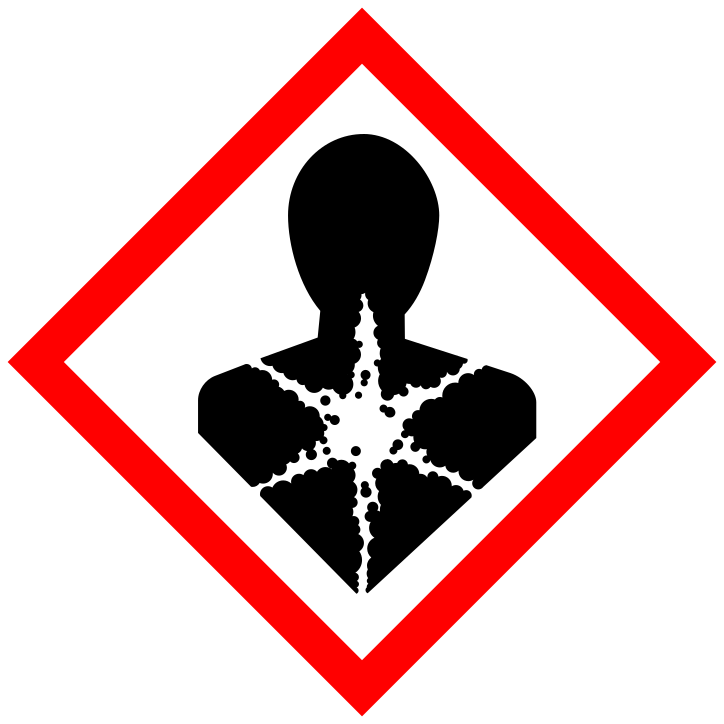
Danger
Silicon carbide fibres (with…
- May cause cancer by inhalation.
- If medical advice is needed, have product container or label at hand.
- Keep out of reach of children.
- Read carefully and follow all instructions.
- Dispose of contents/container to …
Supplier name, address and telephone number· Product identifier·Nominal quantity
Need this as an actual label? Open Silicon carbide fibres… in the GHS label constructor →
07 · Health hazards
Silicon carbide fibres (with… health hazards and exposure limits
Silicon carbide fibres (with… hazard summary
Production workers loading and unloading furnaces are exposed to carbon monoxide, sulfur dioxide, crystalline silica, and fibrous and nonfibrous silicon carbide particles. [Rom, p. 534-5] Workers in production and manufacturing, e.g., abrasive products industry, are exposed to varying quantities of fibers (or whiskers) that have dimensions similar to amphibole asbestos fibers. Nonfibrous particles have low to very low toxic effects on lung tissue. Silicon carbide fibers, on the other hand, can cause lung fibrosis, lung cancer, and possibly mesothelioma. Silicon carbide fibers should be counted and controlled in the same manner as asbestos fibers. [ACGIH] Occupational exposures associated with the Acheson process are carcinogenic to humans (Group 1). Fibrous silicon carbide is possibly carcinogenic to humans (Group 2B). Silicon carbide whiskers are probably carcinogenic to humans (Group 2A). [IARC Vol. 111] See the agent, Acheson process, occupational exposure.
Source: Haz-Map, Information on Hazardous Chemicals and Occupational Diseases
Silicon carbide fibres (with… carcinogenicity classification
An IARC group and a CLP classification answer different questions. IARC judges whether the evidence for cancer in humans is strong enough; CLP Annex VI is the legally binding EU classification. A substance can carry one and not the other.
Silicon carbide fibres (with… occupational exposure limits
| Limit | Value | Source |
|---|---|---|
| PEL | 15.0 [mg/m3](total dust), 5 mg/m3(respirable fraction) [fibrous dust] | Haz-Map, Information on Hazardous Chemicals and Occupational Diseases |
| PEL | 15 mg/m³ (total dust), 5 mg/m³ (respirable fraction) | Occupational Safety and Health Administration (OSHA) |
| PEL | TWA 15 mg/m3 (total) TWA 5 mg/m3 (resp) See Appendix G | The National Institute for Occupational Safety and Health (NIOSH) |
| REL | 10 mg/m³ (total dust), 5 mg/m³ (resp) | Occupational Safety and Health Administration (OSHA) |
| REL | TWA 10 mg/m3 (total) TWA 5 mg/m3 (resp) | The National Institute for Occupational Safety and Health (NIOSH) |
| IDLH | N.D. | The National Institute for Occupational Safety and Health (NIOSH) |
These are United States values. The European Union sets its own indicative and binding limits, and the figure that applies at a given workplace is the one in the local regulation — not the one shown here.
08 · Physical and chemical properties
Silicon carbide fibres (with… properties
Every value is shown with the conditions it was measured under and the source it came from. Where sources disagree, all values are listed rather than one being picked — the difference is usually a different form of the substance, not an error.
Silicon carbide fibres (with… boiling point
| Property | Value | Conditions | Source |
|---|---|---|---|
| Boiling point | Sublimes | sublimes | NIOSH |
| Sublimes (NIOSH, 2024) | sublimes | CAMEO | |
| sublimes | sublimes | OSHA |
Silicon carbide fibres (with… melting point
| Property | Value | Conditions | Source |
|---|---|---|---|
| Melting point | 2600 °C (4712 °F) | HSDB | |
| 2830 °C (5126 °F) | DOE PAC | ||
| 2700 °C (4892 °F) | sublimes | NIOSH |
Silicon carbide fibres (with… density
| Property | Value | Conditions | Source |
|---|---|---|---|
| Density | 3.23 g/cm³ | HSDB |
Silicon carbide fibres (with… solubility
| Property | Value | Conditions | Source |
|---|---|---|---|
| Solubility | INSOL IN COLD WATER, HOT WATER, & ACID; SOL IN FUSED POTASSIUM HYDROXIDE | HSDB | |
| INSOL IN ALCOHOL; SOL IN MOLTEN IRON | HSDB | ||
| Insoluble | NIOSH |
Silicon carbide fibres (with… vapor pressure
| Property | Value | Conditions | Source |
|---|---|---|---|
| Vapor pressure | 0 mmHg | approx | NIOSH |
Silicon carbide fibres (with… lower explosive limit (LEL)
| Property | Value | Conditions | Source |
|---|---|---|---|
| Lower explosive limit (LEL) | Noncombustible Solid | NIOSH |
Values compiled from PubChem Laboratory Chemical Safety Summary. Temperatures converted to Fahrenheit for reference.
09 · Fire and explosion
Silicon carbide fibres… fire and explosion behaviour
These are descriptions rather than measured values, so they are kept out of the table above and quoted here with the source that reported them.
Silicon carbide fibres (with… fire potential
NONCOMBUSTIBLE
Source: Hazardous Substances Data Bank (HSDB)
10 · Handling and storage
Silicon carbide fibres (with… storage and handling
Silicon carbide fibres (with… incompatible materials
Sublimes with decomposition at 4892 degrees F.
Source: Hazardous Substances Data Bank (HSDB)
Silicon carbide fibres (with… reactivity
SILICON CARBIDE is non-combustible. Generally unreactive. Soluble in molten alkalis (NaOH, KOH) and in molten iron.
Source: CAMEO Chemicals
Planning storage for a mix of chemicals? Check Silicon carbide fibres… in the storage compatibility matrix →
11 · Questions
Silicon carbide fibres (with… — frequently asked questions
What is the CAS number of Silicon carbide fibres (with…?
The CAS number of Silicon carbide fibres (with… is 409-21-2. Its EC number is 206-991-8.
What is the chemical formula of Silicon carbide fibres (with…?
The molecular formula of Silicon carbide fibres (with… is CSi and its molecular weight is 40.096 g/mol.
What does a Silicon carbide fibres (with… label have to show?
Under CLP Annex VI the label for Silicon carbide fibres (with… carries the pictogram Health hazard and the signal word is Danger.
Is Silicon carbide fibres (with… flammable?
CLP Annex VI assigns Silicon carbide fibres (with… no flammability hazard class. That is not a statement that it cannot burn: the harmonised list only records the hazards that were assessed for it.
Is Silicon carbide fibres (with… a carcinogen?
Yes. CLP Annex VI classifies Silicon carbide fibres (with… as a category 1A or 1B carcinogen and assigns it H350i: may cause cancer by inhalation. IARC places it in Group 2A: probably carcinogenic to humans.
What is the exposure limit for Silicon carbide fibres (with…?
The US occupational exposure limit reported for Silicon carbide fibres (with… is 15.0 [mg/m3](total dust), 5 mg/m3(respirable fraction) [fibrous dust] (Haz-Map, Information on Hazardous Chemicals and Occupational Diseases). Limits differ by country: the EU sets its own indicative and binding values, and the figure that applies at a given workplace is the one in the local regulation.
Nearby
Substances next to Silicon carbide fibres…
Keep going: substances starting with S, or search the whole database by name, CAS number, pictogram or signal word.