Physical hazard · Organic peroxides · Self-reactive substances and mixtures
H242 — Heating may cause a fire
Physical hazard statements describe what the substance itself can do — explode, ignite, react, corrode metal. 32 substances with a harmonised EU classification carry this code.
01 · Wording
What H242 says
Heating may cause a fire.
CLP Annex III · Physical hazards
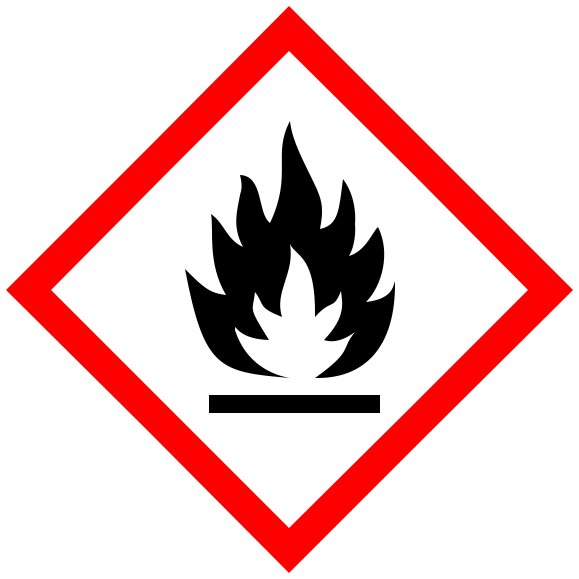
Organic peroxides · Self-reactive substances and mixtures GHS chapter 2.15
Categories Type C and D, Type E and F · pictogram GHS02 (flame) · signal word Danger or Warning
By category: Type C and D — GHS02, Danger; Type E and F — GHS02, Warning
Unchanged since 2009.
Present in every UN GHS edition from Rev.3 (2009) to Rev.11 (2025), with the same wording throughout.
Nine editions of the UN model text, 86 hazard statements, 19 of which ever moved. Read the full story in what changed in UN GHS Rev.11.
02 · Languages
H242 in the 24 official EU languages
A label put on the market in an EU country must carry the wording of that country's own language version of CLP — not a translation of the English one. These 24 lines are quoted from the consolidated regulation, Annex III, and are the text to print.
| Language | Official wording of H242 |
|---|---|
| BG български Bulgarian | Може да предизвика пожар при нагряване. |
| ES español Spanish | Peligro de incendio en caso de calentamiento. |
| CS čeština Czech | Zahřívání může způsobit požár. |
| DA dansk Danish | Brandfare ved opvarmning. |
| DE Deutsch German | Erwärmung kann Brand verursachen. |
| ET eesti Estonian | Kuumenemisel võib süttida. |
| EL ελληνικά Greek | Η θέρμανση μπορεί να προκαλέσει πυρκαγιά. |
| EN English English | Heating may cause a fire. |
| FR français French | Peut s'enflammer sous l'effet de la chaleur. |
| GA Gaeilge Irish | D'fhéadfadh téamh a bheith ina chúis le dóiteán. |
| HR hrvatski Croatian | Zagrijavanje može uzrokovati požar. |
| IT italiano Italian | Rischio d'incendio per riscaldamento. |
| LV latviešu Latvian | Sakaršana var izraisīt degšanu. |
| LT lietuvių Lithuanian | Kaitinant gali sukelti gaisrą. |
| HU magyar Hungarian | Hő hatására meggyulladhat. |
| MT Malti Maltese | It-tisħin jista' jikkawża nar. |
| NL Nederlands Dutch | Brandgevaar bij verwarming. |
| PL polski Polish | Ogrzanie może spowodować pożar. |
| PT português Portuguese | Risco de incêndio sob a acção do calor. |
| RO română Romanian | Pericol de incendiu în caz de încălzire. |
| SK slovenčina Slovak | Zahrievanie môže spôsobiť požiar. |
| SL slovenščina Slovenian | Segrevanje lahko povzroči požar. |
| FI suomi Finnish | Palovaarallinen kuumennettaessa. |
| SV svenska Swedish | Brandfarligt vid uppvärmning. |
Source: CELEX:02008R1272-20260501, Annex III. © European Union, https://eur-lex.europa.eu — only the electronic Official Journal of the European Union is authentic. Irish is one of the 24 official languages and its H and P texts are printed inside the multilingual Annex tables, but no consolidated CLP has ever been published in Irish — which is why an Irish-primary label cannot be built here.
03 · Legal status
Where H242 is current
GHS is a United Nations model text, revised every two years, and each jurisdiction adopts a revision on its own timetable. A code can be legally current in one system and deleted in another — that is normal, not an error.
| Jurisdiction | Basis | Status of H242 |
|---|---|---|
| EU CLP | Regulation (EC) 1272/2008 CLP Annex IV, Part 2 (consolidated) | Current |
| US OSHA HazCom | 29 CFR 1910.1200 Appendix C UN GHS Rev.7 (final rule of 20 May 2024) | Current |
| US HazCom 2012 | legacy · GHS Rev.3 UN GHS Rev.3, Annex 3 | Current |
| UN GHS | Rev.11 (2025) UN GHS Rev.11, Annex 3 | Current |
Currently in force under: EU CLP, US OSHA HazCom, US HazCom 2012, UN GHS. Sources: EU CLP · US OSHA HazCom · US HazCom 2012 · UN GHS
04 · Substances
Substances carrying H242
Every entry whose harmonised CLP Annex VI classification includes this hazard statement. Substances with a reference page here open on this site; the rest open on ghssymbols.com. Of these, 7 are group entries such as “salts of picric acid” or “beryllium compounds” — Annex VI gives them no CAS number, so they are listed by Index No and have no page of their own.
- 1,1-Dimethylpropyl 3,5,5-trimethylperoxyhexanoate CAS 68860-54-8
- 1,1,3,3-tetramethylbutylperoxypivalate CAS 22288-41-1
- 1,2,3,4-tetrahydro-1-naphthyl hydroperoxide CAS 771-29-9
- 1,3-di(prop-2,2-diyl)benzene bis(neodecanoylperoxide) CAS 117663-11-3
- 2,2'-dimethyl-2,2'-azodipropiononitrile CAS 78-67-1
- 2,5-Dibutoxy-4-(morpholin-4-yl)benzenediazonium… CAS 93672-52-7
- 3-Azidosulfonylbenzoic acid CAS 15980-11-7
- 3-hydroxy-1,1-dimethylbutyl 2-ethyl-2-methylheptanepero… Index No 617-016-00-4
- 4-dimethylaminobenzenediazonium 3-carboxy-4-hydroxybenz… Index No 611-022-00-0
- 4,4'-oxydi(benzenesulphonohydrazide) CAS 80-51-3
- ammonium bis(1-(3,5-dinitro-2-oxidophenylazo)-3-(N-phen… CAS 109125-51-1
- bis(α,α-dimethylbenzyl) peroxide CAS 80-43-3
- Di-tert-butyl peroxide CAS 110-05-4
- ethyl 3,3-bis(tert-pentylperoxy)butyrate CAS 67567-23-1
- Hexaneperoxoic acid, 6-(nonylamino)-6-oxo- CAS 104788-63-8
- Lauroyl peroxide CAS 105-74-8
- O,O-tert-butyl O-docosyl monoperoxyoxalate CAS 116753-76-5
- p-Menthane hydroperoxide CAS 80-47-7
- Peracetic Acid CAS 79-21-0
- Phthalimidoperoxycaproic acid CAS 128275-31-0
- R-2,3-epoxy-1-propanol CAS 57044-25-4
- reaction mass of esters of 5,5',6,6',7,7'-hexahydroxy-3… Index No 016-089-00-4
- reaction mass of: 1-methyl-1-(3-(1-methylethyl)phenyl)e… CAS 71566-50-2
- reaction mass of: 2,2'-bis(tert-pentylperoxy)-p-diisopr… CAS 32144-25-5
- reaction mass of: 2,2’-dimethyl-2,2’-azobutanenitrile… Index No 611-164-00-3
- reaction mass of: 4-(7-hydroxy-2,4,4-trimethyl-2-chroma… CAS 140698-96-0
- reaction mass of: 4,4',4''-[(2,4,6-trioxo-1,3,5(2H,4H,6… Index No 607-449-00-7
- reaction mass of: reaction product of… Index No 016-095-00-7
- reaction product of: borax, hydrogen peroxide, acetic… Index No 650-048-00-7
- Tert-butyl cumene peroxide CAS 3457-61-2
- toluene-4-sulphonohydrazide CAS 1576-35-8
- α,α-dimethylbenzyl hydroperoxide CAS 80-15-9
Nothing matches that filter.
All hazard statements
The full list of H-codes with the jurisdiction switch lives on the hazard statements hub. For what to do about the hazard, see precautionary statements (P-codes).
Wording quoted from the regulation named above. Substance counts come from harmonised classifications in CLP Annex VI — the statements on a real product also depend on the supplier's own classification. Always check the supplier safety data sheet.