Substance profile
Endosulfan
Endosulfan is brown crystals with a similar to terpene odor.
01 · Identification
What Endosulfan is
Endosulfan is brown crystals with a similar to terpene odor. Its molecular formula is C9H6Cl6O3S and its molecular weight is 406.9 g/mol. It melts at 106 °C.
Under the GHS it carries the signal word Danger.
02 · Identifiers
Endosulfan identifiers and molecular data
Endosulfan CAS number and EC number
Endosulfan molecular formula and molecular weight
Other names for Endosulfan
- endosulfan (ISO)
- 1,2,3,4,7,7-hexachloro-8,9,10-trinorborn-2-en-5,6-ylenedimethylene sulfite
- 1,4,5,6,7,7-hexachloro-8,9,10-trinorborn-5-en-2,3-ylenedimethylene sulfite
03 · GHS classification
Endosulfan hazard classification
Harmonised classification under CLP Annex VI. This is the legally binding classification in the EU; other jurisdictions may differ.
Endosulfan pictograms and signal word
Endosulfan hazard class and category
| Hazard class | Category | From code | Pictogram |
|---|---|---|---|
| Acute toxicity - oral GHS chapter 3.1 | Category 1 or 2 | H300 | GHS06 |
| Acute toxicity - dermal GHS chapter 3.1 | Category 4 | H312 | GHS07 |
| Acute toxicity - inhalation GHS chapter 3.1 | Category 1 or 2 | H330 | GHS06 |
| Hazardous to the aquatic environment - acute GHS chapter 4.1 | Category 1 | H400 | GHS09 |
| Hazardous to the aquatic environment - chronic GHS chapter 4.1 | Category 1 | H410 | GHS09 |
Where two values are shown with “or”, the hazard statement is shared by more than one category or by more than one class, and the code alone does not say which. H272, for example, belongs to oxidising liquids and to oxidising solids — the physical state decides. The binding answer for a specific entry is in the CLP Annex VI table itself.
Endosulfan hazard statements (H-codes)
| Code | Hazard statement |
|---|---|
| H330 | Fatal if inhaled. |
| H300 | Fatal if swallowed. |
| H312 | Harmful in contact with skin. |
| H400 | Very toxic to aquatic life. |
| H410 | Very toxic to aquatic life with long lasting effects. |
This page lists only the codes assigned to Endosulfan. The full reference lives on the hazard statements hub, the precautionary statements hub and the GHS pictograms hub.
Safety Data Sheet
Getting an SDS for Endosulfan
A Safety Data Sheet is written for a product, not for a substance: the supplier of the grade you actually buy issues it, so two suppliers of Endosulfan issue two different sheets. That is why there is no single authoritative SDS for a substance to download — what there is, is the job of collecting the sheets for the products you hold and keeping them current as suppliers revise them.
04 · Precautionary statements
Endosulfan precautionary statements
CLP Annex VI assigns 14 precautionary statements to Endosulfan. They are grouped the way a label groups them: what to do before handling, what to do when something has already happened, how to store it and how to dispose of it.
Prevention
What to do before and during handling so the hazard never happens.
Response
What to do once exposure, spillage or fire has already happened.
Disposal
What has to happen to the contents and the empty container.
Reading the notation. … is a blank the supplier fills in — not a truncated sentence.· [square brackets] mark a part printed only when it applies.
05 · Names in the regulation
Endosulfan name in 23 EU languages
CLP Annex VI Part 3 is published in every language edition of the regulation, and the identification column is written out in each of them. Nothing below is translated by us: each line is the name as that edition prints it. Under Art. 18(2) the substance name from Annex VI is a lawful product identifier, so this is the wording to put on a label going to that market — and where the cell lists several designations, any one of them qualifies.
| Language | Name in CLP Annex VI Part 3 |
|---|---|
| Bulgarian български | ендосулфан (ISO) 1,2,3,4,7,7-хексахлоро-8,9,10- тринорборн-2-ен-5,6-илендиметиленсулфит1,4,5,6,7,7-хексахлоро-8,9,10- тринорборн-5-ен-2,3-илендиметиленсулфит |
| Spanish español | Endosulfano (ISO) sulfito de 1,2,3,4,7,7-hexacloro-8,9,10-trinorborn-2-en-5,6-ilendimetilenosulfito de 1,4,5,6,7,7-hexacloro-8,9,10-trinorborn-5-en-2,3-ilendimetileno |
| Czech čeština | endosulfan (ISO) 1,2,3,4,7,7-hexachlorbicyklo[2.2.1]hept-2-en-5,6-dimethanol, cyklický sulfit1,4,5,6,7,7-hexachloro-8,9,10-trinorborn-5-en-2,3-ylenedimethylsulfit |
| Danish dansk | endosulfan (ISO) 1,2,3,4,7,7-hexachlor-8,9,10-trinorborn-2-en-5,6-ylendimethylsulfit1,2,3,4,7,7-hexachlor-8,9,10-trinorborn-5-en-2,3-ylendimethylsulfit |
| German Deutsch | Endosulfan (ISO) 1,2,3,4,7,7-Hexachlor-8,9,10-trinorborn-2-en-5,6-ylendimethylensulfit1,4,5,6,7,7-Hexachlor-8,9,10-trinorborn-5-en-2,3-ylendimethylensulfit |
| Estonian eesti | endosulfaan (ISO) 1,2,3,4,7,7-heksakloro-8,9,10-trinorborn-2-een-5,6-üleendimetüleensulfit1,4,5,6,7,7-heksakloro-8,9,10-trinorborn-5-een-2,3-üleendimetüleensulfit |
| Greek ελληνικά | endosulfan (ενδοσουλφάνη) (ISO) θειώδες 1,2,3,4,7,7-εξαχλωρο-8,9,10-τρινορβορν-2-εν-5,6-υλενοδιμεθυλένιοθειώδες 1,4,5,6,7,7-εξαχλωρο-8,9,10-τρινορβορν-5-εν-2,3-υλενοδιμεθυλένιο |
| English English | endosulfan (ISO) 1,2,3,4,7,7-hexachloro-8,9,10-trinorborn-2-en-5,6-ylenedimethylene sulfite1,4,5,6,7,7-hexachloro-8,9,10-trinorborn-5-en-2,3-ylenedimethylene sulfite |
| French français | endosulfan (ISO) sulfite de 1,2,3,4,7,7-hexachloro-8,9,10-trinorborn-2-én-5,6-ylènediméthylènesulfite de 1,4,5,6,7,7-hexachloro-8,9,10-trinorborn-5-én-2,3-ylènediméthylène |
| Croatian hrvatski | endosulfan (ISO) 1,2,3,4,7,7-heksaklor-8,9,10-trinorborn-2-en-5,6-ilendimetilen-sulfit1,4,5,6,7,7-heksaklor-8,9,10-trinorborn-5-en-2,3-ilendimetilen-sulfit |
| Italian italiano | endosulfan (ISO) solfito di 1,2,3,4,7,7-esacloro-8,9,10-trinorborn-2-en-5,6-ilendimetile solfito di 1,4,5,6,7,7-esacloro-8,9,10-trinorborn-5-en-2,3-ilendimetile |
| Latvian latviešu | endosulfāns (ISO) 1,2,3,4,7,7-heksahlor-8,9,10-trinorborn-2-ēn-5,6-ilēndimetilēnsulfīts1,4,5,6,7,7-heksahlor-8,9,10-trinorborn-5-ēn-2,3-ilēndimetilēnsulfīts |
| Lithuanian lietuvių | endosulfanas (ISO) 1,2,3,4,7,7-heksachlor-8,9,10-trinorborn-2-en-5,6-ilendimetileno sulfitas1,4,5,6,7,7-heksachlor-8,9,10-trinorborn-5-en-2,3-ilendimetileno sulfitas |
| Hungarian magyar | endoszulfán (ISO) 1,2,3,4,7,7-hexaklór-8,9,10-trinorborn-2-én-5,6-ilén-dimetilén-szulfit1,4,5,6,7,7-hexaklór-8,9,10-trinorborn-5-én-2,3-ilén-dimetilén-szulfit |
| Maltese Malti | endosulfan (ISO) sulfit ta’ 1,2,3,4,7,7-eżakloro-8,9,10-trinorborn-2-en-5,6-ilenedimetilensulfit ta’ 1,4,5,6,7,7-eżakloro-8,9,10-trinorborn-5-en-2,3-ilenedimetilen |
| Dutch Nederlands | endosulfan (ISO) 1,2,3,4,7,7-hexachloor-8,9,10-trinorborn-2-een-5,6-yleendimethylsulfiet(1,4,5,6,7,7-hexachloor-8,9,10-trinorborn-5-een-2,3-yleendimethyleen)sulfiet |
| Polish polski | endosulfan (ISO) siarczyn 1,4,5,6,7,7-heksachloro-8,9,10-trinorborn-5-en-2,3-ylenodimetylu) |
| Portuguese português | endossulfão (ISO) sulfito de 1,2,3,4,7,7-hexacloro-8,9,10-trinorborn-2-en-5,6-ilenodimetilenosulfito de 1,4,5,6,7,7-hexacloro-8,9,10-trinorborn-5-en-2,3-ilenodimetileno) |
| Romanian română | endosulfan (ISO) sulfit de 1,2,3,4,7,7- hexacloro-8,9,10-trinorborn-2-en-5,6-ilene dimetilensulfit de 1,4,5,6,7,7- hexacloro-8,9,10-trinorborn-5-en-2,3-ilene dimetilen |
| Slovak slovenčina | endosulfán (ISO) 6,7,8,9,10,10-hexachlór-5a,6,9,9atetrahydro- 6,9-metano-1 H ,4 H -2,4,3-benzodioxatiepín-3-oxid 1,4,5,6,7,7-hexachlór-8,9,10-trinorborn-5-én-2,3-ylénbismetylén-sulfit |
| Slovenian slovenščina | endosulfan (ISO) 1,2,3,4,7,7-heksakloro-8,9,10-trinorborn-2-en-5,6-ilendimetilen sulfit1,4,5,6,7,7-heksakloro-8,9,10-trinorborn-5-en-2,3-ilendimetilen sulfit |
| Finnish suomi | endosulfaani (ISO) 1,2,3,4,7,7-heksakloori-8,9,10-trinorborn-2-en-5,6-yleenidimetyylisulfiitti1,4,5,6,7,7-heksakloori-8,9,10-trinorborn-5-en-2,3-yleenidimetyylisulfiitti |
| Swedish svenska | endosulfan (ISO) 1,2,3,4,7,7-hexaklor-8,9,10-trinorborn-2-en-5,6-ylendimetylensulfit1,4,5,6,7,7-hexaklor-8,9,10-trinorborn-5-en-2,3-ylendimetylensulfit |
All 23 language editions of Annex VI carry this entry. Irish is the twenty-fourth official EU language and has no line here for a different reason: no consolidated CLP text has ever been published in Irish, so there is no Irish edition of Annex VI to quote a name from. Source: consolidated CLP, CELEX 02008R1272, language editions. © European Union, https://eur-lex.europa.eu — only the electronic Official Journal of the European Union is authentic.
06 · Label elements
Endosulfan GHS label elements
Everything CLP Annex VI fixes for Endosulfan, laid out the way it appears on a label. The greyed lines are the parts only the supplier can fill in.
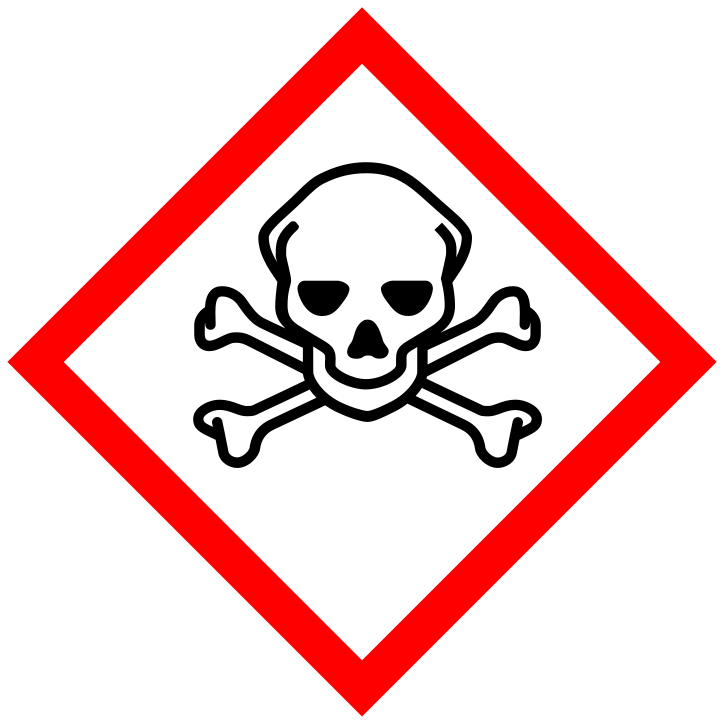
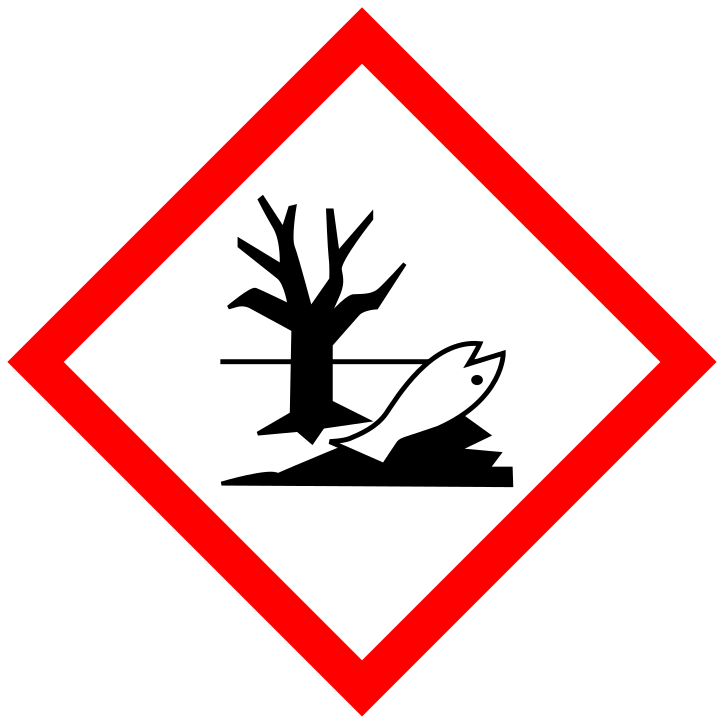
Danger
Endosulfan
- Fatal if inhaled.
- Fatal if swallowed.
- Harmful in contact with skin.
- Very toxic to aquatic life.
- Very toxic to aquatic life with long lasting effects.
- Do not breathe dust/fume/gas/mist/vapours/spray.
- Do not eat, drink or smoke when using this product.
- Use only outdoors or in a well-ventilated area.
- Avoid release to the environment.
- Wear protective gloves/protective clothing/eye protection/face protection/hearing protection/…
- IF SWALLOWED:
- IF ON SKIN:
- IF INHALED:
- Immediately call a POISON CENTER/doctor/…
- Call a POISON CENTER/doctor/… if you feel unwell.
- Rinse mouth.
- Wash with plenty of water/…
- Collect spillage.
- Dispose of contents/container to …
Supplier name, address and telephone number· Product identifier·Nominal quantity
Need this as an actual label? Open Endosulfan in the GHS label constructor →
07 · Health hazards
Endosulfan health hazards and exposure limits
Endosulfan hazard summary
Endosulfan is a pesticide. It is a cream- to brown-colored solid that may appear in the form of crystals or flakes. It has a smell like turpentine, but does not burn. It does not occur naturally in the environment. Endosulfan is used to control insects on food and non-food crops and also as a wood preservative.
Source: Agency for Toxic Substances and Disease Registry (ATSDR)
Endosulfan carcinogenicity classification
Studied by the US National Toxicology Program: TR-062: Bioassay of Endosulfan for Possible Carcinogenicity (CASRN 115-29-7) (1978 )
Cancer Classification: Not Likely to be Carcinogenic to Humans
Source: Hazardous Substances Data Bank (HSDB)
An IARC group and a CLP classification answer different questions. IARC judges whether the evidence for cancer in humans is strong enough; CLP Annex VI is the legally binding EU classification. A substance can carry one and not the other.
Endosulfan occupational exposure limits
| Limit | Value | Source |
|---|---|---|
| PEL | 0.1 mg/m³ (Construction and Maritime only) | Occupational Safety and Health Administration (OSHA) |
| PEL | none See Appendix G | The National Institute for Occupational Safety and Health (NIOSH) |
| REL | 0.1 mg/m³ | Occupational Safety and Health Administration (OSHA) |
| REL | TWA 0.1 mg/m3 [skin] | The National Institute for Occupational Safety and Health (NIOSH) |
| IDLH | N.D. | The National Institute for Occupational Safety and Health (NIOSH) |
These are United States values. The European Union sets its own indicative and binding limits, and the figure that applies at a given workplace is the one in the local regulation — not the one shown here.
08 · Physical and chemical properties
Endosulfan properties
Every value is shown with the conditions it was measured under and the source it came from. Where sources disagree, all values are listed rather than one being picked — the difference is usually a different form of the substance, not an error.
Endosulfan boiling point
| Property | Value | Conditions | Source |
|---|---|---|---|
| Boiling point | 106 °C (222.8 °F) | decomposes, at 0.7 mmHg (reduced pressure), with partial decomposition | HSDB |
| Decomposes | decomposes | NIOSH | |
| Decomposes (NIOSH, 2024) | decomposes | CAMEO |
Endosulfan melting point
| Property | Value | Conditions | Source |
|---|---|---|---|
| Melting point | 106 °C (222.8 °F) | pure | HSDB |
| 106.11 °C (223 °F) | NIOSH |
Endosulfan density
| Property | Value | Conditions | Source |
|---|---|---|---|
| Density | 1.74 g/cm³ | NIOSH | |
| 1.745 g/cm³ | at 20 °C | HSDB |
Endosulfan solubility
| Property | Value | Conditions | Source |
|---|---|---|---|
| Solubility | Solubility at 22 °C and a pH 7.2 in tap water; alpha-Endosulfan: 0.15 mg/l. | at 22 °C | HSDB |
| Solubility at 22 °C and a pH 7.2 in tap water; beta-Endosulfan: 0.06 mg/l. | at 22 °C | HSDB | |
| Sol in xylene, kerosene, chloroform, acetone, and alcohol | HSDB |
Endosulfan vapor pressure
| Property | Value | Conditions | Source |
|---|---|---|---|
| Vapor pressure | 0.0000062 mmHg | at 20 °C | HSDB |
| 0.00001 mmHg | at 25 °C | NIOSH |
Endosulfan lower explosive limit (LEL)
| Property | Value | Conditions | Source |
|---|---|---|---|
| Lower explosive limit (LEL) | Noncombustible Solid, but may be dissolved in flammable liquids. | NIOSH |
Endosulfan corrosivity
| Property | Value | Conditions | Source |
|---|---|---|---|
| Corrosivity | Corrosive to iron | HSDB |
Values compiled from PubChem Laboratory Chemical Safety Summary. Temperatures converted to Fahrenheit for reference.
09 · Fire and explosion
Endosulfan fire and explosion behaviour
These are descriptions rather than measured values, so they are kept out of the table above and quoted here with the source that reported them.
Endosulfan fire potential
Not combustible. Liquid formulations containing organic solvents may be flammable.
Source: Hazardous Substances Data Bank (HSDB)
10 · Handling and storage
Endosulfan storage and handling
Endosulfan safe storage
Provision to contain effluent from fire extinguishing. Separated from acids, bases, iron and food and feedstuffs. Dry. Well closed.
Source: ILO-WHO International Chemical Safety Cards (ICSCs)
Endosulfan storage conditions
Do not store in or around home. Do not store near heat, open flame, or hot surfaces.
Source: Hazardous Substances Data Bank (HSDB)
Endosulfan incompatible materials
Alkalis, acids, water [Note: Corrosive to iron. Hydrolyzes slowly on contact with water or decomposes in the presence of alkalis and acids to form sulfur dioxide].
Source: Hazardous Substances Data Bank (HSDB)
Endosulfan reactivity
ENDOSULFAN is an organochlorine, cyclodiene derivative. It is also a sulfite ester. Halogenated aliphatic or cyclic alkane compounds are moderately or very reactive. Halogenated organics generally become less reactive as more of their hydrogen atoms are replaced with halogen atoms. As endosulfan is rather highly substituted it may be resistant to reaction. However, materials in this group are incompatible with strong oxidizing and reducing agents. Also, they may be incompatible with many amines, nitrides, azo/diazo compounds, alkali metals, and epoxides. As an ester, it will hydrolyze to form sulfur dioxide and diol; reaction is more rapid under basic conditions.
Source: CAMEO Chemicals
Planning storage for a mix of chemicals? Check Endosulfan in the storage compatibility matrix →
11 · Questions
Endosulfan — frequently asked questions
What is the CAS number of Endosulfan?
The CAS number of Endosulfan is 115-29-7. Its EC number is 204-079-4.
What is the chemical formula of Endosulfan?
The molecular formula of Endosulfan is C9H6Cl6O3S and its molecular weight is 406.9 g/mol.
What does a Endosulfan label have to show?
Under CLP Annex VI the label for Endosulfan carries the pictograms Skull and crossbones and Environment and the signal word is Danger.
Is Endosulfan flammable?
CLP Annex VI assigns Endosulfan no flammability hazard class. That is not a statement that it cannot burn: the harmonised list only records the hazards that were assessed for it.
Is Endosulfan a carcinogen?
CLP Annex VI records no harmonised carcinogenicity classification for Endosulfan. Annex VI is a list of agreed classifications, not a list of substances found safe, so this is an absence of a classification rather than a clean bill of health.
What is the exposure limit for Endosulfan?
The US occupational exposure limit reported for Endosulfan is 0.1 mg/m³ (Construction and Maritime only) (Occupational Safety and Health Administration (OSHA)). Limits differ by country: the EU sets its own indicative and binding values, and the figure that applies at a given workplace is the one in the local regulation.
What is the melting point of Endosulfan?
The melting point of Endosulfan is 106 °C (223 °F), a figure on which HSDB, NIOSH and ICSC agree.
How should Endosulfan be stored?
Do not store in or around home. Do not store near heat, open flame, or hot surfaces. (Hazardous Substances Data Bank (HSDB))
Nearby
Substances next to Endosulfan
Keep going: substances starting with E, or search the whole database by name, CAS number, pictogram or signal word.