Substance profile
Gases (petroleum), depropanizer bottoms fractionation off
Gases (petroleum), depropanizer bottoms fractionation off is a substance with a harmonised classification under EU CLP.
01 · Identification
What Gases (petroleum), depropanize… is
Gases (petroleum), depropanizer bottoms fractionation off is a substance with a harmonised classification under EU CLP.
Under the GHS it carries the signal word Danger.
02 · Identifiers
Gases (petroleum), depropanize… identifiers and molecular data
Gases (petroleum), depropanize… CAS number and EC number
Other names for Gases (petroleum), depropanize…
- Petroleum gas
- [A complex combination of hydrocarbons obtained from the fractionation of depropanizer bottoms. It consists predominantly of butane, isobutane and butadiene.]
03 · GHS classification
Gases (petroleum), depropanize… hazard classification
Harmonised classification under CLP Annex VI. This is the legally binding classification in the EU; other jurisdictions may differ.
Gases (petroleum), depropanize… pictograms and signal word
Gases (petroleum), depropanize… hazard class and category
| Hazard class | Category | From code | Pictogram |
|---|---|---|---|
| Flammable gases GHS chapter 2.2 | Category 1A | H220 | GHS02 |
| Germ cell mutagenicity GHS chapter 3.5 | Category 1A or 1B | H340 | GHS08 |
| Carcinogenicity GHS chapter 3.6 | Category 1A or 1B | H350 | GHS08 |
Where two values are shown with “or”, the hazard statement is shared by more than one category or by more than one class, and the code alone does not say which. H272, for example, belongs to oxidising liquids and to oxidising solids — the physical state decides. The binding answer for a specific entry is in the CLP Annex VI table itself.
Gases (petroleum), depropanize… hazard statements (H-codes)
| Code | Hazard statement |
|---|---|
| H220 | Extremely flammable gas. |
| H350 | May cause cancer <state route of exposure if it is conclusively proven that no other routes of exposure cause the hazard>. |
| H340 | May cause genetic defects <state route of exposure if it is conclusively proven that no other routes of exposure cause the hazard>. |
This page lists only the codes assigned to Gases (petroleum)…. The full reference lives on the hazard statements hub, the precautionary statements hub and the GHS pictograms hub.
Safety Data Sheet
Getting an SDS for Gases (petroleum)…
A Safety Data Sheet is written for a product, not for a substance: the supplier of the grade you actually buy issues it, so two suppliers of Gases (petroleum)… issue two different sheets. That is why there is no single authoritative SDS for a substance to download — what there is, is the job of collecting the sheets for the products you hold and keeping them current as suppliers revise them.
04 · Precautionary statements
Gases (petroleum), depropanize… precautionary statements
CLP Annex VI assigns 7 precautionary statements to Gases (petroleum)…. They are grouped the way a label groups them: what to do before handling, what to do when something has already happened, how to store it and how to dispose of it.
Prevention
What to do before and during handling so the hazard never happens.
Response
What to do once exposure, spillage or fire has already happened.
Reading the notation. … is a blank the supplier fills in — not a truncated sentence.· [square brackets] mark a part printed only when it applies.
05 · Names in the regulation
Gases (petroleum), depropanize… name in 23 EU languages
CLP Annex VI Part 3 is published in every language edition of the regulation, and the identification column is written out in each of them. Nothing below is translated by us: each line is the name as that edition prints it. Under Art. 18(2) the substance name from Annex VI is a lawful product identifier, so this is the wording to put on a label going to that market — and where the cell lists several designations, any one of them qualifies.
| Language | Name in CLP Annex VI Part 3 |
|---|---|
| Bulgarian български | Газове (нефтени), фракциониране на дънни фракции от колоната за депропанизация нефтен газ |
| Spanish español | Gases (petróleo), del fraccionamiento de los residuos del fondo del despropanizador gas de petróleo |
| Czech čeština | plyny (ropné), výstup z frakcionace destilačních zbytků z depropanizéru ropný plyn |
| Danish dansk | gasser (råolie), depropanizer-bundfraktioner, fraktioneringsaftræks- kulbrintegasser |
| German Deutsch | Gase (Erdöl), Abgase aus Fraktionierung der Sumpfprodukte aus Propanabtrennung Gase aus der Erdölverarbeitung |
| Estonian eesti | gaasid (nafta), propaanieemaldi põhjajääkide fraktsioneerimise heitgaas naftagaas |
| Greek ελληνικά | Αέρια (πετρελαίου), εκλυόμενα από κλασμάτωση προϊόντων πυθμένα αποπροπανιωτήρα Πετρελαϊκό αέριο |
| English English | Gases (petroleum), depropanizer bottoms fractionation off Petroleum gas |
| French français | Gaz résiduels (pétrole), fractionnement des résidus du dépropaniseur gaz de pétrole |
| Croatian hrvatski | plinovi (nafta), ispušni plinovi iz frakcionacije produkata dna depropanizera naftni plin |
| Italian italiano | gas (petrolio), dal frazionamento di residui del depropanizzatore gas di petrolio |
| Latvian latviešu | Izdalgāzes (naftas), depropanizatora apakšējo frakciju frakcionēšanas Naftas pavadgāze |
| Lithuanian lietuvių | Dujos (nafta), depropanavimo įrenginio virintuvo likučiai Naftos dujos |
| Hungarian magyar | Gázok (nyersolaj), propánmentesítő fenéktermékek frakcionálási távozó terméke Ásványolaj gáz |
| Maltese Malti | Gassijiet (żejt mhux maħdum), effluwenti tal-gass tal-frazzjonazzjoni tal-qigħan tad-depropanizzatur Gass taż-żejt mhux maħdum |
| Dutch Nederlands | gassen (aardolie), depropanisatorbodemfracties fractioneringsuitstoot- petroleumgas |
| Polish polski | Gazy (ropa naftowa) z dna depropanizera pozostałość po destylacji frakcjonowanej Gaz z ropy naftowej |
| Portuguese português | gases (petróleo), de fracionamento de produtos de cauda de despropanizador gás de petróleo |
| Romanian română | Gaz rezidual (petrol), fracționare de reziduuri de la depropanizare Gaz petrolier |
| Slovak slovenčina | plyny (ropné), z frakcionácie zvyšku po oddeľovaní propánu plyn zo spracovania ropy |
| Slovenian slovenščina | plini (nafta), izhodni plini frakcionacije oborine iz depropanizatorja naftni plin |
| Finnish suomi | Kaasut (maaöljy), propaaninpoistoyksikön pohjat jakotislauspoisto Maaöljykaasu |
| Swedish svenska | Gaser (petroleum), propanavdrivarbottenfraktion, fraktioneringsavgaser Petroleumgas |
All 23 language editions of Annex VI carry this entry. Irish is the twenty-fourth official EU language and has no line here for a different reason: no consolidated CLP text has ever been published in Irish, so there is no Irish edition of Annex VI to quote a name from. Source: consolidated CLP, CELEX 02008R1272, language editions. © European Union, https://eur-lex.europa.eu — only the electronic Official Journal of the European Union is authentic.
06 · Label elements
Gases (petroleum), depropanize… GHS label elements
Everything CLP Annex VI fixes for Gases (petroleum)…, laid out the way it appears on a label. The greyed lines are the parts only the supplier can fill in.

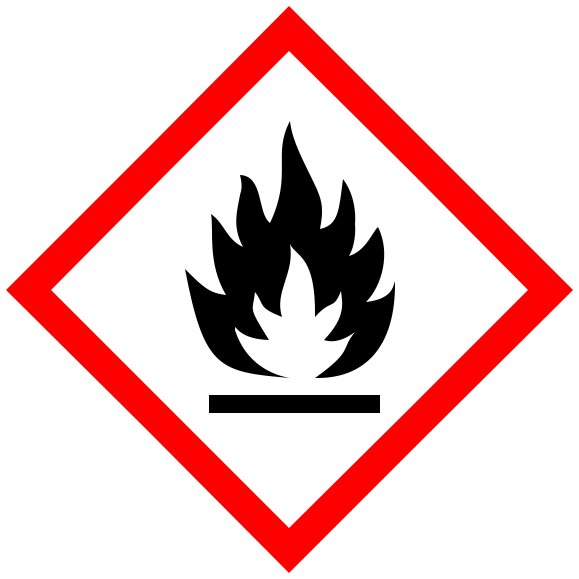
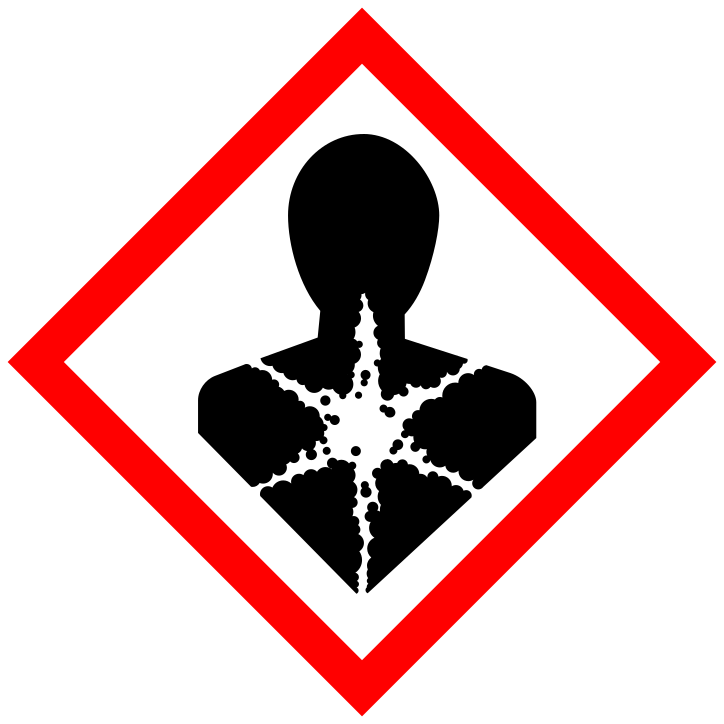
Danger
Gases (petroleum), depropanize…
- Extremely flammable gas.
- May cause cancer <state route of exposure if it is conclusively proven that no other routes of exposure cause the hazard>.
- May cause genetic defects <state route of exposure if it is conclusively proven that no other routes of exposure cause the hazard>.
- Obtain special instructions before use.
- Keep away from heat, hot surfaces, sparks, open flames and other ignition sources. No smoking.
- Keep container tightly closed.
- Wear protective gloves/protective clothing/eye protection/face protection/hearing protection/…
- IF exposed or concerned:
- Get medical advice/attention.
- Store in a well-ventilated place.
Supplier name, address and telephone number· Product identifier·Nominal quantity
Need this as an actual label? Open Gases (petroleum)… in the GHS label constructor →
07 · Questions
Gases (petroleum), depropanize… — frequently asked questions
What is the CAS number of Gases (petroleum), depropanize…?
The CAS number of Gases (petroleum), depropanize… is 68606-34-8. Its EC number is 271-742-2.
What does a Gases (petroleum), depropanize… label have to show?
Under CLP Annex VI the label for Gases (petroleum), depropanize… carries the pictograms Gas cylinder, Flame and Health hazard and the signal word is Danger.
Is Gases (petroleum), depropanize… flammable?
Yes. CLP Annex VI assigns Gases (petroleum), depropanize… H220 — extremely flammable gas.
Is Gases (petroleum), depropanize… a carcinogen?
Yes. CLP Annex VI classifies Gases (petroleum), depropanize… as a category 1A or 1B carcinogen and assigns it H350: may cause cancer.
How should Gases (petroleum), depropanize… be stored?
CLP Annex VI assigns Gases (petroleum), depropanize… the storage statement P403.
Nearby
Substances next to Gases (petroleum)…
Keep going: substances starting with G, or search the whole database by name, CAS number, pictogram or signal word.