Substance profile
Lead
Lead: soft silver-bluish white to gray metal.
01 · Identification
What Lead is
Lead: soft silver-bluish white to gray metal. Its molecular formula is Pb and its molecular weight is 207 g/mol. It boils at 1740 °C, melts at 328 °C, is practically insoluble in water.
Under the GHS it carries the signal word Danger. It is classed as hazardous Air Pollutants (HAPs).
02 · Identifiers
Lead identifiers and molecular data
Lead CAS number and EC number
Lead molecular formula and molecular weight
Other names for Lead
- lead metal
- C.I. 77575
- C.I. Pigment Metal 4
- Ks-4
- Lead Element
- Lead Flake
- Lead S 2
- Lead Sz
- Pb-S 100
- Plumbum
- Sso 1
- lead powder
- [particle diameter < 1 mm]
03 · GHS classification
Lead hazard classification
Harmonised classification under CLP Annex VI. This is the legally binding classification in the EU; other jurisdictions may differ.
Lead pictograms and signal word
Lead hazard class and category
| Hazard class | Category | From code | Pictogram |
|---|---|---|---|
| Reproductive toxicity GHS chapter 3.7 | Category Lactation | H362 | — |
| Hazardous to the aquatic environment - acute GHS chapter 4.1 | Category 1 | H400 | GHS09 |
| Hazardous to the aquatic environment - chronic GHS chapter 4.1 | Category 1 | H410 | GHS09 |
Lead hazard statements (H-codes)
| Code | Hazard statement |
|---|---|
| H360FD | May damage fertility. May damage the unborn child. |
| H362 | May cause harm to breast-fed children. |
| H400 | Very toxic to aquatic life. |
| H410 | Very toxic to aquatic life with long lasting effects. |
This page lists only the codes assigned to Lead. The full reference lives on the hazard statements hub, the precautionary statements hub and the GHS pictograms hub.
Safety Data Sheet
Getting an SDS for Lead
Our own Lead safety data sheet walks through all sixteen sections of the published data. What it is not is the document an inspector asks for: an SDS is issued for a product by its supplier, so the sheet covering the grade actually standing in your store exists only in that supplier’s version. Collecting those and keeping them current as suppliers revise them is a separate job.
04 · Precautionary statements
Lead precautionary statements
CLP Annex VI assigns 3 precautionary statements to Lead. They are grouped the way a label groups them: what to do before handling, what to do when something has already happened, how to store it and how to dispose of it.
Prevention
What to do before and during handling so the hazard never happens.
Disposal
What has to happen to the contents and the empty container.
Reading the notation. … is a blank the supplier fills in — not a truncated sentence.· [square brackets] mark a part printed only when it applies.
05 · Names in the regulation
Lead name in 23 EU languages
CLP Annex VI Part 3 is published in every language edition of the regulation, and the identification column is written out in each of them. Nothing below is translated by us: each line is the name as that edition prints it. Under Art. 18(2) the substance name from Annex VI is a lawful product identifier, so this is the wording to put on a label going to that market — and where the cell lists several designations, any one of them qualifies.
| Language | Name in CLP Annex VI Part 3 |
|---|---|
| Bulgarian български | олово в прахообразна форма |
| Spanish español | Polvo de plomo |
| Czech čeština | olověný prášek |
| Danish dansk | bly i pulverform |
| German Deutsch | Bleipulver |
| Estonian eesti | pliipulber |
| Greek ελληνικά | μόλυβδος σε σκόνη |
| English English | lead powder |
| French français | poudre de plomb |
| Croatian hrvatski | olovo u prahu |
| Italian italiano | polvere di piombo |
| Latvian latviešu | svina pulveris |
| Lithuanian lietuvių | švino milteliai |
| Hungarian magyar | ólom por formában |
| Maltese Malti | trab taċ-ċomb |
| Dutch Nederlands | loodpoeder |
| Polish polski | ołów w postaci proszku |
| Portuguese português | pó de chumbo |
| Romanian română | pulbere de plumb |
| Slovak slovenčina | olovený prášok |
| Slovenian slovenščina | svinčev prah |
| Finnish suomi | lyijyjauhe |
| Swedish svenska | bly i pulverform |
All 23 language editions of Annex VI carry this entry. Irish is the twenty-fourth official EU language and has no line here for a different reason: no consolidated CLP text has ever been published in Irish, so there is no Irish edition of Annex VI to quote a name from. Source: consolidated CLP, CELEX 02008R1272, language editions. © European Union, https://eur-lex.europa.eu — only the electronic Official Journal of the European Union is authentic.
06 · Label elements
Lead GHS label elements
Everything CLP Annex VI fixes for Lead, laid out the way it appears on a label. The greyed lines are the parts only the supplier can fill in.
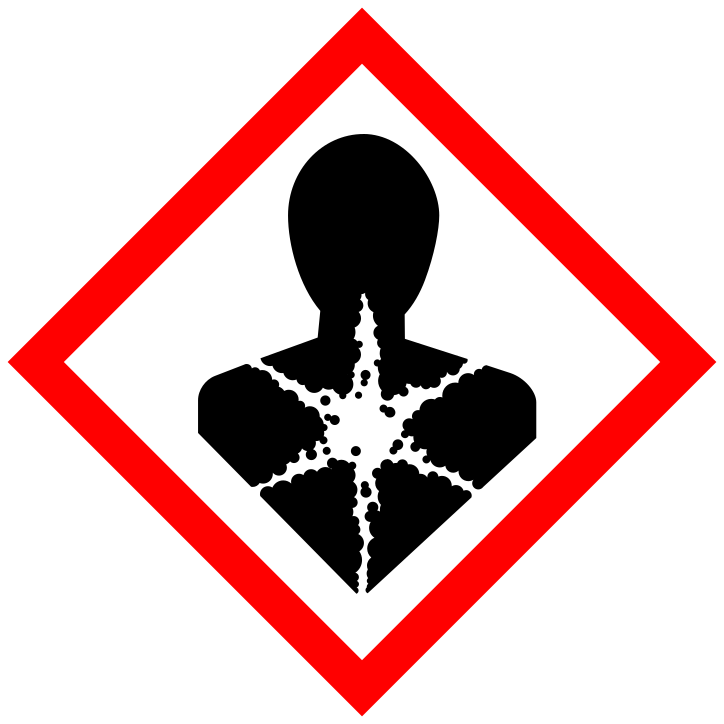
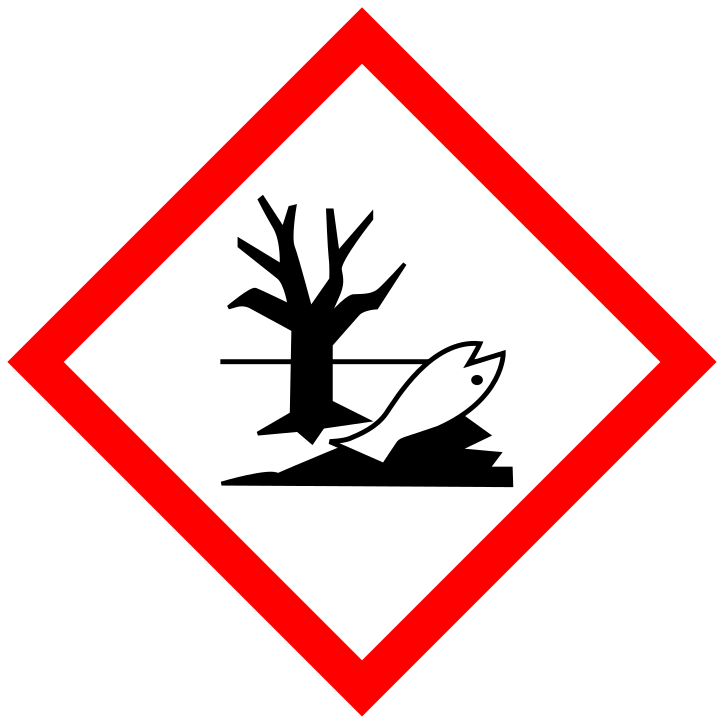
Danger
Lead
- May damage fertility. May damage the unborn child.
- May cause harm to breast-fed children.
- Very toxic to aquatic life.
- Very toxic to aquatic life with long lasting effects.
- Avoid release to the environment.
- Collect spillage.
- Dispose of contents/container to …
Supplier name, address and telephone number· Product identifier·Nominal quantity
Need this as an actual label? Open Lead in the GHS label constructor →
07 · Health hazards
Lead health hazards and exposure limits
Lead hazard summary
Lead is a naturally occurring bluish-gray metal found in small amounts in the earth's crust. Lead can be found in all parts of our environment. Much of it comes from human activities including burning fossil fuels, mining, and manufacturing. Lead has many different uses. It is used in the production of batteries, ammunition, metal products (solder and pipes), and devices to shield X-rays. Because of health concerns, lead from gasoline, paints and ceramic products, caulking, and pipe solder has been dramatically reduced in recent years.CDC uses a blood lead reference value (BLRV) of 3.5 micrograms per deciliter (μg/dL) to identify children with higher levels of lead in their blood compared to most children. This level is based on the 97.5th percentile of the blood lead values among U.S. children ages 1""5 years from the 2015""2016 and 2017""2018 National Health and Nutrition Examination Survey cycles. Children with blood lead levels at or above the BLRV represent those at the top 2.5% with the highest blood lead levels. To learn more about CDC's updated recommendations on children's blood lead levels, please visit:http://www.cdc.gov/nceh/lead/ACCLPP/blood_lead_levels.htm.
Source: Agency for Toxic Substances and Disease Registry (ATSDR)
Lead carcinogenicity classification
An IARC group and a CLP classification answer different questions. IARC judges whether the evidence for cancer in humans is strong enough; CLP Annex VI is the legally binding EU classification. A substance can carry one and not the other.
Lead occupational exposure limits
| Limit | Value | Source |
|---|---|---|
| PEL | 0.05 [mg/m3] | Haz-Map, Information on Hazardous Chemicals and Occupational Diseases |
| PEL | 0.05 mg/m³ [0.03 mg/m³ Action Level] | Occupational Safety and Health Administration (OSHA) |
| PEL | [1910.1025] TWA 0.050 mg/m3 See Appendix C [*Note: The PEL also applies to other lead compounds (as Pb) -- see Appendix C.] | The National Institute for Occupational Safety and Health (NIOSH) |
| REL | 0.05 mg/m³ | Occupational Safety and Health Administration (OSHA) |
| REL | TWA (8-hour) 0.050 mg/m3 See Appendix C [*Note: The REL also applies to other lead compounds (as Pb) -- see Appendix C.] | The National Institute for Occupational Safety and Health (NIOSH) |
| IDLH | 100 mg Pb/m3 (NIOSH, 2024) | CAMEO Chemicals |
| IDLH | 100.0 [mg/m3] | Haz-Map, Information on Hazardous Chemicals and Occupational Diseases |
| IDLH | Excerpts from Documentation for IDLHs: Basis for revised IDLH: No inhalation toxicity data are available on which to base an IDLH for lead compounds. | Haz-Map, Information on Hazardous Chemicals and Occupational Diseases |
These are United States values. The European Union sets its own indicative and binding limits, and the figure that applies at a given workplace is the one in the local regulation — not the one shown here.
08 · Physical and chemical properties
Lead properties
Every value is shown with the conditions it was measured under and the source it came from. Where sources disagree, all values are listed rather than one being picked — the difference is usually a different form of the substance, not an error.
Lead boiling point
| Property | Value | Conditions | Source |
|---|---|---|---|
| Boiling point | 1740 °C (3164 °F) | NIOSH | |
| 1740 °C (3164 °F) | at 760 mmHg | CAMEO |
Lead melting point
| Property | Value | Conditions | Source |
|---|---|---|---|
| Melting point | 327.22 °C (621 °F) | NIOSH | |
| 327.5 °C (621.5 °F) | CAMEO |
Lead density
| Property | Value | Conditions | Source |
|---|---|---|---|
| Density | 11.34 g/cm³ | NIOSH |
Lead solubility
| Property | Value | Conditions | Source |
|---|---|---|---|
| Solubility | Insoluble | NIOSH | |
| Insoluble (NTP, 1992) | CAMEO | ||
| Solubility in water, g/l: (practically insoluble) | ICSC |
Lead vapor pressure
| Property | Value | Conditions | Source |
|---|---|---|---|
| Vapor pressure | 0 mmHg | approx | NIOSH |
| 1.77 mmHg | CAMEO |
Lead lower explosive limit (LEL)
| Property | Value | Conditions | Source |
|---|---|---|---|
| Lower explosive limit (LEL) | Noncombustible Solid in bulk form. | NIOSH |
Values compiled from PubChem Laboratory Chemical Safety Summary. Temperatures converted to Fahrenheit for reference.
09 · Handling and storage
Lead storage and handling
Lead reactive group
CAMEO Chemicals places Lead in the reactive group Metals, Less Reactive. Compatibility with other chemicals is worked out from the group, not from the individual substance — which is why two substances you have never seen react can still be flagged as a pair that must be separated.
A reactive group is a CAMEO Chemicals (US NOAA) grouping, not a GHS hazard class: it has no code, no category and no legal force. It is what the storage compatibility matrix on this site computes from.
Lead safe storage
Store only in original container. Separated from food and feedstuffs and incompatible materials. See Chemical Dangers. Store in an area without drain or sewer access.
Source: ILO-WHO International Chemical Safety Cards (ICSCs)
Lead incompatible materials
Strong oxidizers, hydrogen peroxide, acids
Source: The National Institute for Occupational Safety and Health (NIOSH)
Lead reactivity
In the presence of carbon, the combination of chlorine trifluoride with aluminum, copper, lead, magnesium, silver, tin, or zinc results in a violent reaction [Mellor 2, Supp. 1: 1956]. A solution of sodium azide in copper pipe with lead joints formed copper and lead azide, both are detonating compounds [Klotz 1973]. Sodium acetylide becomes pyrophoric when mixed with metals like lead. Mixtures of trioxane with 60% hydrogen peroxide in contact with metallic lead when heated detonated. Lead containing rubber ignited in a nitric acid atmosphere. Lead is incompatible with strong oxidants such as: ammonium nitrate, chlorine trifluoride, hydrogen peroxide, etc.
Source: CAMEO Chemicals
Planning storage for a mix of chemicals? Check Lead in the storage compatibility matrix →
10 · Questions
Lead — frequently asked questions
What is the CAS number of Lead?
The CAS number of Lead is 7439-92-1. Its EC number is 231-100-4.
What is the chemical formula of Lead?
The molecular formula of Lead is Pb and its molecular weight is 207 g/mol.
What does a Lead label have to show?
Under CLP Annex VI the label for Lead carries the pictograms Health hazard and Environment and the signal word is Danger.
Is Lead flammable?
CLP Annex VI assigns Lead no flammability hazard class. That is not a statement that it cannot burn: the harmonised list only records the hazards that were assessed for it.
Is Lead a carcinogen?
CLP Annex VI records no harmonised carcinogenicity classification for Lead. Annex VI is a list of agreed classifications, not a list of substances found safe, so this is an absence of a classification rather than a clean bill of health. IARC places it in Group 2B: possibly carcinogenic to humans.
What is the exposure limit for Lead?
The US occupational exposure limit reported for Lead is 0.05 [mg/m3] (Haz-Map, Information on Hazardous Chemicals and Occupational Diseases). Limits differ by country: the EU sets its own indicative and binding values, and the figure that applies at a given workplace is the one in the local regulation.
What is the boiling point of Lead?
The boiling point of Lead is 1740 °C (3164 °F), a figure on which NIOSH, NTP via CAMEO and ICSC agree.
What is the melting point of Lead?
The melting point of Lead is 328 °C (622 °F), a figure on which NIOSH, NTP via CAMEO and ICSC agree.
Nearby
Substances next to Lead
Keep going: substances starting with L, or search the whole database by name, CAS number, pictogram or signal word.
Next