Substance profile
Light oil (coal), semi-coking process
Light oil (coal), semi-coking process is a substance with a harmonised classification under EU CLP.
01 · Identification
What Light oil (coal), semi-coking… is
Light oil (coal), semi-coking process is a substance with a harmonised classification under EU CLP.
Under the GHS it carries the signal word Danger.
02 · Identifiers
Light oil (coal), semi-coking… identifiers and molecular data
Light oil (coal), semi-coking… CAS number and EC number
Other names for Light oil (coal), semi-coking…
- Fresh oil
- [The volatile organic liquid condensed from the gas evolved in the low-temperature (less than 700°C (1292°F)) destructive distillation of coal. Composed primarily of C6-10 hydrocarbons.]
03 · GHS classification
Light oil (coal), semi-coking… hazard classification
Harmonised classification under CLP Annex VI. This is the legally binding classification in the EU; other jurisdictions may differ.
Light oil (coal), semi-coking… pictograms and signal word
Light oil (coal), semi-coking… hazard class and category
| Hazard class | Category | From code | Pictogram |
|---|---|---|---|
| Germ cell mutagenicity GHS chapter 3.5 | Category 1A or 1B | H340 | GHS08 |
| Carcinogenicity GHS chapter 3.6 | Category 1A or 1B | H350 | GHS08 |
Where two values are shown with “or”, the hazard statement is shared by more than one category or by more than one class, and the code alone does not say which. H272, for example, belongs to oxidising liquids and to oxidising solids — the physical state decides. The binding answer for a specific entry is in the CLP Annex VI table itself.
Light oil (coal), semi-coking… hazard statements (H-codes)
| Code | Hazard statement |
|---|---|
| H350 | May cause cancer <state route of exposure if it is conclusively proven that no other routes of exposure cause the hazard>. |
| H340 | May cause genetic defects <state route of exposure if it is conclusively proven that no other routes of exposure cause the hazard>. |
This page lists only the codes assigned to Light oil (coal)…. The full reference lives on the hazard statements hub, the precautionary statements hub and the GHS pictograms hub.
Safety Data Sheet
Getting an SDS for Light oil (coal)…
A Safety Data Sheet is written for a product, not for a substance: the supplier of the grade you actually buy issues it, so two suppliers of Light oil (coal)… issue two different sheets. That is why there is no single authoritative SDS for a substance to download — what there is, is the job of collecting the sheets for the products you hold and keeping them current as suppliers revise them.
04 · Precautionary statements
Light oil (coal), semi-coking… precautionary statements
CLP Annex VI assigns 4 precautionary statements to Light oil (coal)…. They are grouped the way a label groups them: what to do before handling, what to do when something has already happened, how to store it and how to dispose of it.
Prevention
What to do before and during handling so the hazard never happens.
Response
What to do once exposure, spillage or fire has already happened.
Reading the notation. … is a blank the supplier fills in — not a truncated sentence.· [square brackets] mark a part printed only when it applies.
05 · Names in the regulation
Light oil (coal), semi-coking… name in 23 EU languages
CLP Annex VI Part 3 is published in every language edition of the regulation, and the identification column is written out in each of them. Nothing below is translated by us: each line is the name as that edition prints it. Under Art. 18(2) the substance name from Annex VI is a lawful product identifier, so this is the wording to put on a label going to that market — and where the cell lists several designations, any one of them qualifies.
| Language | Name in CLP Annex VI Part 3 |
|---|---|
| Bulgarian български | Леко масло (въглищно), процес на полукоксуване свежо масло |
| Spanish español | Aceite ligero (hulla), proceso de semi-coquización aceite fresco[líquido orgánico volátil condensado del gas desprendido en la destilación destructiva de hulla a baja temperatura (menos de 700 o C (1 292 o F))compuesto principalmente de hidrocarburos de C 6-10 |
| Czech čeština | lehký olej (černouhelný), polokoksovací proces primární olej |
| Danish dansk | letolie (kul), halvforkoksningsproces- frisk olie |
| German Deutsch | Leichtöl (Kohle), Halbverkokungsverfahren Frischöl |
| Estonian eesti | kergõli (kivisüsi) poolkoksistamisprotsessist värske õli |
| Greek ελληνικά | Ελαφρό έλαιο (γαιάνθρακα), διεργασίας ημιοπτανθρακοποίησης Πρόσφατο έλαιο |
| English English | Light oil (coal), semi-coking process Fresh oil |
| French français | Huile légère (charbon), semi-cokéfaction huile fraîche |
| Croatian hrvatski | lako ulje (ugljen), semi-koking proces svježe ulje |
| Italian italiano | olio leggero (carbone), processo semi-coking olio fresco |
| Latvian latviešu | Vieglā eļļa (ogļu), puskoksēšanas Svaigā eļļa |
| Lithuanian lietuvių | Lengvoji alyva (akmens anglys), pusinio koksavimo procesas Žalia alyva |
| Hungarian magyar | Könnyűolaj (szén), félkokszolási folyamat, Nyers olajpárlat |
| Maltese Malti | Żejt ħafif (faħam), proċess ta’ semi-kokkjar Żejt frisk |
| Dutch Nederlands | lichte olie (kool), semi-verkooksingsproces verse olie |
| Polish polski | Olej lekki z procesu półkoksowania (węgiel) Olej świeży |
| Portuguese português | óleo leve (carvão), processo de semicoqueificação óleo fresco |
| Romanian română | Ulei ușor (cărbune), proces de semicocsificare Ulei proaspăt |
| Slovak slovenčina | ľahký olej (uhoľný), z nízkoteplotnej karbonizácie ľahký olej |
| Slovenian slovenščina | lahko olje (premog), pol-koksni postopek sveže olje |
| Finnish suomi | Kevytöljy (kivihiili), osakoksausprosessi Tuoreöljy |
| Swedish svenska | Lättolja (kol), halvförkoksningsprocess Färskolja |
All 23 language editions of Annex VI carry this entry. Irish is the twenty-fourth official EU language and has no line here for a different reason: no consolidated CLP text has ever been published in Irish, so there is no Irish edition of Annex VI to quote a name from. Source: consolidated CLP, CELEX 02008R1272, language editions. © European Union, https://eur-lex.europa.eu — only the electronic Official Journal of the European Union is authentic.
06 · Label elements
Light oil (coal), semi-coking… GHS label elements
Everything CLP Annex VI fixes for Light oil (coal)…, laid out the way it appears on a label. The greyed lines are the parts only the supplier can fill in.
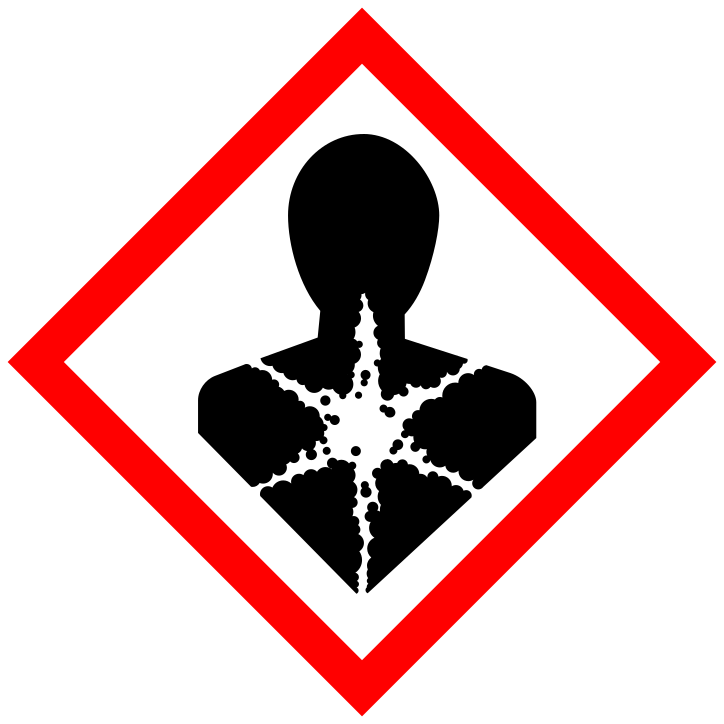
Danger
Light oil (coal), semi-coking…
- May cause cancer <state route of exposure if it is conclusively proven that no other routes of exposure cause the hazard>.
- May cause genetic defects <state route of exposure if it is conclusively proven that no other routes of exposure cause the hazard>.
- Obtain special instructions before use.
- Wear protective gloves/protective clothing/eye protection/face protection/hearing protection/…
- IF exposed or concerned:
- Get medical advice/attention.
Supplier name, address and telephone number· Product identifier·Nominal quantity
Need this as an actual label? Open Light oil (coal)… in the GHS label constructor →
07 · Questions
Light oil (coal), semi-coking… — frequently asked questions
What is the CAS number of Light oil (coal), semi-coking…?
The CAS number of Light oil (coal), semi-coking… is 90641-11-5. Its EC number is 292-635-7.
What does a Light oil (coal), semi-coking… label have to show?
Under CLP Annex VI the label for Light oil (coal), semi-coking… carries the pictogram Health hazard and the signal word is Danger.
Is Light oil (coal), semi-coking… flammable?
CLP Annex VI assigns Light oil (coal), semi-coking… no flammability hazard class. That is not a statement that it cannot burn: the harmonised list only records the hazards that were assessed for it.
Is Light oil (coal), semi-coking… a carcinogen?
Yes. CLP Annex VI classifies Light oil (coal), semi-coking… as a category 1A or 1B carcinogen and assigns it H350: may cause cancer.
Nearby
Substances next to Light oil (coal)…
Keep going: substances starting with L, or search the whole database by name, CAS number, pictogram or signal word.