Substance profile
Methyl isobutyl ketone
Methyl isobutyl ketone is a liquid with a pleasant odor.
01 · Identification
What Methyl isobutyl ketone is
Methyl isobutyl ketone is a liquid with a pleasant odor. Its molecular formula is C6H12O and its molecular weight is 100.16 g/mol. It boils at 117 °C, melts at -84.7 °C.
Under the GHS it carries the signal word Danger. It is classed as hazardous Air Pollutants (HAPs).
02 · Identifiers
Methyl isobutyl ketone identifiers and molecular data
Methyl isobutyl ketone CAS number and EC number
Methyl isobutyl ketone molecular formula and molecular weight
Other names for Methyl isobutyl ketone
- MIBK
- Hexone
- Isobutyl Methyl Ketone
- Isopropyl Acetone
- Isopropylacetone
- Ketone, Isobutyl Methyl
- Methyl 2-Methylpropyl Ketone
- 4-Methyl 2-Pentanone
- Methyl Iso-Butyl Ketone
- 4-Methyl-2-Oxopentane
- 4-Methyl-2-Pentanone
- 2-Methyl-4-Pentanone
- 2-Methylpropyl Methyl Ketone
- Shell Mibk
- 4-methylpentan-2-one
- isobutyl methyl ketone
03 · GHS classification
Methyl isobutyl ketone hazard classification
Harmonised classification under CLP Annex VI. This is the legally binding classification in the EU; other jurisdictions may differ.
Methyl isobutyl ketone pictograms and signal word
Methyl isobutyl ketone hazard class and category
| Hazard class | Category | From code | Pictogram |
|---|---|---|---|
| Flammable liquids GHS chapter 2.6 | Category 2 | H225 | GHS02 |
| Acute toxicity - inhalation GHS chapter 3.1 | Category 4 | H332 | GHS07 |
| Serious eye damage/eye irritation GHS chapter 3.3 | Category 2A | H319 | GHS07 |
| Carcinogenicity GHS chapter 3.6 | Category 2 | H351 | GHS08 |
| Specific target organ toxicity - single exposure GHS chapter 3.8 | Category 3 narcotic | H336 | GHS07 |
Methyl isobutyl ketone hazard statements (H-codes)
| Code | Hazard statement |
|---|---|
| H225 | Highly flammable liquid and vapour. |
| H351 | Suspected of causing cancer <state route of exposure if it is conclusively proven that no other routes of exposure cause the hazard>. |
| H332 | Harmful if inhaled. |
| H336 | May cause drowsiness or dizziness. |
| H319 | Causes serious eye irritation. |
Methyl isobutyl ketone supplemental EU statements (EUH)
| Code | Statement |
|---|---|
| EUH066 | Repeated exposure may cause skin dryness or cracking. |
This page lists only the codes assigned to Methyl isobutyl ketone. The full reference lives on the hazard statements hub, the precautionary statements hub and the GHS pictograms hub.
Safety Data Sheet
Getting an SDS for Methyl isobutyl ketone
Our own Methyl isobutyl ketone safety data sheet walks through all sixteen sections of the published data. What it is not is the document an inspector asks for: an SDS is issued for a product by its supplier, so the sheet covering the grade actually standing in your store exists only in that supplier’s version. Collecting those and keeping them current as suppliers revise them is a separate job.
04 · Precautionary statements
Methyl isobutyl ketone precautionary statements
CLP Annex VI assigns 17 precautionary statements to Methyl isobutyl ketone. They are grouped the way a label groups them: what to do before handling, what to do when something has already happened, how to store it and how to dispose of it.
Prevention
What to do before and during handling so the hazard never happens.
Response
What to do once exposure, spillage or fire has already happened.
Reading the notation. … is a blank the supplier fills in — not a truncated sentence.· [square brackets] mark a part printed only when it applies.
05 · Names in the regulation
Methyl isobutyl ketone name in 23 EU languages
CLP Annex VI Part 3 is published in every language edition of the regulation, and the identification column is written out in each of them. Nothing below is translated by us: each line is the name as that edition prints it. Under Art. 18(2) the substance name from Annex VI is a lawful product identifier, so this is the wording to put on a label going to that market — and where the cell lists several designations, any one of them qualifies.
| Language | Name in CLP Annex VI Part 3 |
|---|---|
| Bulgarian български | 4-метилпентан-2-он изобутилметилкетон |
| Spanish español | 4-Metilpentan-2-ona isobutilmetilcetona |
| Czech čeština | 4-methylpentan-2-on isobutyl(methyl)keton |
| Danish dansk | 4-methylpentan-2-on isobutylmethylketon |
| German Deutsch | 4-Methylpentan-2-on Isobutylmethylketon |
| Estonian eesti | 4-metüülpentaan-2-oon isobutüülmetüülketoon |
| Greek ελληνικά | 4-μεθυλοπενταν-2-όνη ισοβουτυλομεθυλοκετόνη |
| English English | 4-methylpentan-2-one isobutyl methyl ketone |
| French français | 4-méthylpentan-2-one isobutylméthylcétone |
| Croatian hrvatski | 4-metilpentan-2-on izobutil-metil-keton |
| Italian italiano | 4-metilpentan-2-one isobutile metile chetone |
| Latvian latviešu | 4-metilpentān-2-ons izobutilmetilketons |
| Lithuanian lietuvių | 4-metilpentan-2-onas izobutilmetilketonas |
| Hungarian magyar | 4-metilpentán-2-on izobutil-metil-keton |
| Maltese Malti | 4-metilpentan-2-ol keton tal-metil tal-isobutil |
| Dutch Nederlands | 4-methylpentaan-2-on isobutylmethylketone |
| Polish polski | 4-metylopentan-2-on keton izobutylowo-metylowy |
| Portuguese português | 4-metilpentan-2-ona isobutilmetilcetona |
| Romanian română | 4-metilpentan-2-onă izobutilmetilcetonă |
| Slovak slovenčina | 4-metylpentán-2-ón, izobutyl metylketón |
| Slovenian slovenščina | 4-metilpentan-2-on izobutil metil keton |
| Finnish suomi | 4-metyylipentan-2-oni isobutyylimetyyliketoni |
| Swedish svenska | 4-metylpentan-2-on isobutylmetylketon |
All 23 language editions of Annex VI carry this entry. Irish is the twenty-fourth official EU language and has no line here for a different reason: no consolidated CLP text has ever been published in Irish, so there is no Irish edition of Annex VI to quote a name from. Source: consolidated CLP, CELEX 02008R1272, language editions. © European Union, https://eur-lex.europa.eu — only the electronic Official Journal of the European Union is authentic.
06 · Label elements
Methyl isobutyl ketone GHS label elements
Everything CLP Annex VI fixes for Methyl isobutyl ketone, laid out the way it appears on a label. The greyed lines are the parts only the supplier can fill in.
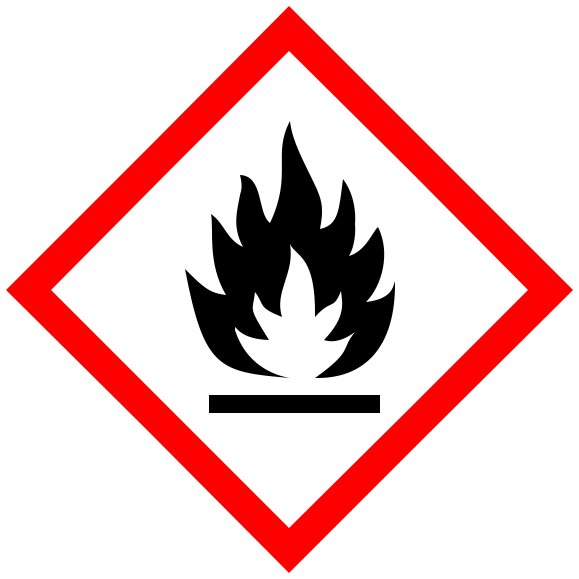
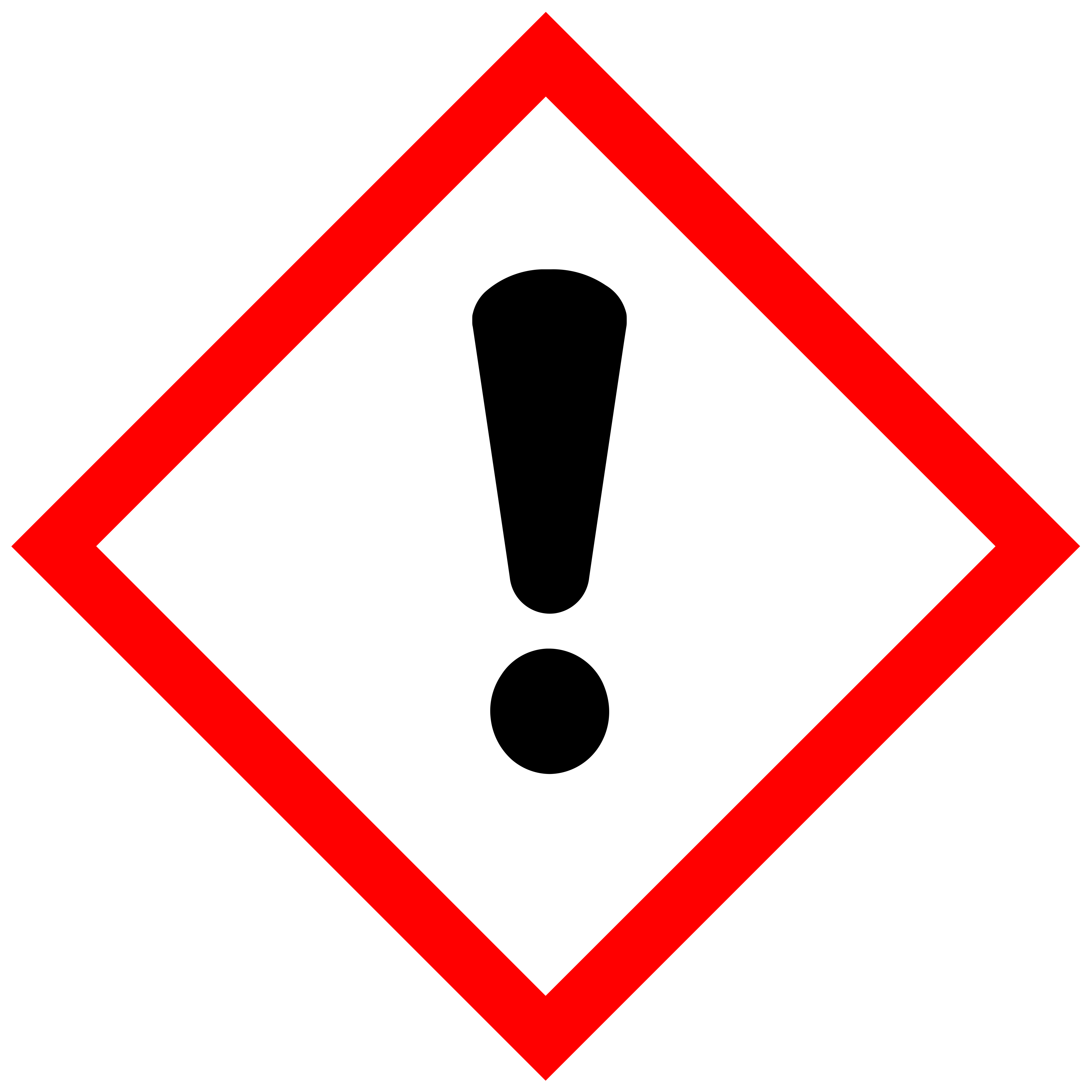
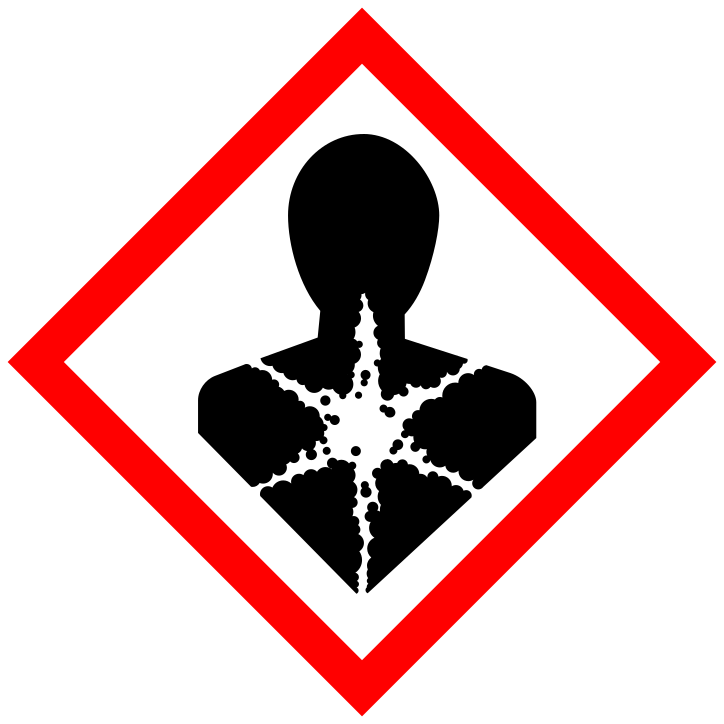
Danger
Methyl isobutyl ketone
- Highly flammable liquid and vapour.
- Suspected of causing cancer <state route of exposure if it is conclusively proven that no other routes of exposure cause the hazard>.
- Harmful if inhaled.
- May cause drowsiness or dizziness.
- Causes serious eye irritation.
- Repeated exposure may cause skin dryness or cracking.
- Obtain special instructions before use.
- Keep away from heat, hot surfaces, sparks, open flames and other ignition sources. No smoking.
- Keep container tightly closed.
- Use explosion-proof [electrical/ventilating/lighting/…] equipment.
- Use only non-sparking tools.
- Do not breathe dust/fume/gas/mist/vapours/spray.
- Wash … thoroughly after handling.
- Use only outdoors or in a well-ventilated area.
- Wear protective gloves/protective clothing/eye protection/face protection/hearing protection/…
- IF INHALED:
- IF IN EYES:
- IF exposed or concerned:
- Call a POISON CENTER/doctor/… if you feel unwell.
- Get medical advice/attention.
- If eye irritation persists:
- Remove contact lenses, if present and easy to do. Continue rinsing.
- Store in a well-ventilated place.
Supplier name, address and telephone number· Product identifier·Nominal quantity
Need this as an actual label? Open Methyl isobutyl ketone in the GHS label constructor →
07 · Health hazards
Methyl isobutyl ketone health hazards and exposure limits
Methyl isobutyl ketone hazard summary
Methyl isobutyl ketone is used as a solvent for gums, resins, paints, varnishes, lacquers, and nitrocellulose. Acute (short-term) exposure to methyl isobutyl ketone may irritate the eyes and mucous membranes, and cause weakness, headache, nausea, lightheadedness, vomiting, dizziness, incoordination, narcosis in humans. Chronic (long-term) occupational exposure to methyl isobutyl ketone has been observed to cause nausea, headache, burning in the eyes, weakness, insomnia, intestinal pain, and slight enlargement of the liver in humans. Lethargy and kidney and liver effects have been observed in rats and mice chronically exposed by gavage (experimentally placing the chemical in the stomach), ingestion, and inhalation. EPA has classified methyl isobutyl ketone as a Group D, not classifiable as to human carcinogenicity.
Source: EPA Hazardous Air Pollutants
Methyl isobutyl ketone carcinogenicity classification
Under the conditions of these 2-year dermal studies, there was no evidence of carcinogenic activity of bis(2-chloroethoxy)methane in male or female F344/N rats administered 75, 150, or 300 mg/kg. There was no evidence of carcinogenic activity of bis(2-chloroethoxy)methane in male B6C3F1 mice administered 150, 300, or 600 mg/kg or in female B6C3F1 mice administered 100, 200, or 400 mg/kg.
Source: US National Toxicology Program · TR-538: Toxicology and Carcinogenesis Studies of Methyl Isobutyl Ketone (CASRN 108-10-1) in F344/N Rats and B6C3F1 Mice (Inhalation Studies) (2007 )
Cancer in humans: No data were available to the Working Group. Cancer in experimental animals: There is sufficient evidence in experimental animals for the carcinogenicity of methyl isobutyl ketone. Overall evaluation: Methyl isobutyl ketone is possibly carcinogenic to humans (Group 2B).
Source: Hazardous Substances Data Bank (HSDB)
An IARC group and a CLP classification answer different questions. IARC judges whether the evidence for cancer in humans is strong enough; CLP Annex VI is the legally binding EU classification. A substance can carry one and not the other.
Methyl isobutyl ketone occupational exposure limits
| Limit | Value | Source |
|---|---|---|
| PEL | 100.0 [ppm] | Haz-Map, Information on Hazardous Chemicals and Occupational Diseases |
| PEL | 100 ppm (410 mg/m³) | Occupational Safety and Health Administration (OSHA) |
| PEL | TWA 100 ppm (410 mg/m3) See Appendix G | The National Institute for Occupational Safety and Health (NIOSH) |
| REL | 50 ppm (205 mg/m³) | Occupational Safety and Health Administration (OSHA) |
| REL | 75 ppm (300 mg/m³) | Occupational Safety and Health Administration (OSHA) |
| REL | TWA 50 ppm (205 mg/m3) ST 75 ppm (300 mg/m3) | The National Institute for Occupational Safety and Health (NIOSH) |
| IDLH | 500 ppm (NIOSH, 2024) | CAMEO Chemicals |
| IDLH | 500.0 [ppm] | Haz-Map, Information on Hazardous Chemicals and Occupational Diseases |
| IDLH | 500 ppm | Hazardous Substances Data Bank (HSDB) |
These are United States values. The European Union sets its own indicative and binding limits, and the figure that applies at a given workplace is the one in the local regulation — not the one shown here.
08 · Physical and chemical properties
Methyl isobutyl ketone properties
Every value is shown with the conditions it was measured under and the source it came from. Where sources disagree, all values are listed rather than one being picked — the difference is usually a different form of the substance, not an error.
Methyl isobutyl ketone boiling point
| Property | Value | Conditions | Source |
|---|---|---|---|
| Boiling point | 115.7 °C (240.3 °F) | HSDB | |
| 116.67 °C (242 °F) | NIOSH |
Methyl isobutyl ketone melting point
| Property | Value | Conditions | Source |
|---|---|---|---|
| Melting point | -85 °C (-121 °F) | HSDB | |
| -84.44 °C (-120 °F) | NIOSH | ||
| -84.72 °C (-120.5 °F) | CAMEO |
Methyl isobutyl ketone density
| Property | Value | Conditions | Source |
|---|---|---|---|
| Density | 0.8042 g/cm³ | at 20 °C | HSDB |
| 0.7965 g/cm³ | at 25 °C | HSDB | |
| Bulk density: 6.68 lb/gal at 20 °C | at 20 °C | HSDB |
Methyl isobutyl ketone solubility
| Property | Value | Conditions | Source |
|---|---|---|---|
| Solubility | Slightly soluble in water | HSDB | |
| In water, 19,000 mg/L at 25 °C | at 25 °C | HSDB |
Methyl isobutyl ketone vapor pressure
| Property | Value | Conditions | Source |
|---|---|---|---|
| Vapor pressure | 16 mmHg | NIOSH | |
| 5 mmHg | at 19.72 °C | CAMEO | |
| 19.9 mmHg | at 25 °C | HSDB |
Methyl isobutyl ketone flash point
| Property | Value | Conditions | Source |
|---|---|---|---|
| Flash point | 17.78 °C (64 °F) | HSDB | |
| 22.78 °C (73 °F) | CAMEO |
Methyl isobutyl ketone autoignition temperature
| Property | Value | Conditions | Source |
|---|---|---|---|
| Autoignition temperature | 456.67 °C (854 °F) | CAMEO | |
| 460 °C (860 °F) | ICSC | ||
| 448.89 °C (840 °F) | HSDB |
Methyl isobutyl ketone lower explosive limit (LEL)
| Property | Value | Conditions | Source |
|---|---|---|---|
| Lower explosive limit (LEL) | 1.4 % by volume | CAMEO |
Methyl isobutyl ketone upper explosive limit (UEL)
| Property | Value | Conditions | Source |
|---|---|---|---|
| Upper explosive limit (UEL) | 7.5 % by volume | CAMEO |
Methyl isobutyl ketone vapor density
| Property | Value | Conditions | Source |
|---|---|---|---|
| Vapor density | 3.45 (air = 1) | HSDB |
Methyl isobutyl ketone odor threshold
| Property | Value | Conditions | Source |
|---|---|---|---|
| Odor threshold | 0.10 ppm | HSDB | |
| Air: 0.68 ul/L; water: 1.3 mg/L | HSDB | ||
| Odor detection limit in air: 9.70x10⁻⁶ g/L (gas). | HSDB |
Methyl isobutyl ketone critical temperature and pressure
| Property | Value | Conditions | Source |
|---|---|---|---|
| Critical temperature and pressure | 302.25 °C (576.1 °F) | HSDB |
Values compiled from PubChem Laboratory Chemical Safety Summary. Temperatures converted to Fahrenheit for reference.
09 · Fire and explosion
Methyl isobutyl ketone fire and explosion behaviour
These are descriptions rather than measured values, so they are kept out of the table above and quoted here with the source that reported them.
Methyl isobutyl ketone fire potential
Flammable liquid.
Source: Hazardous Substances Data Bank (HSDB)
Solubility
Water/air, blood/air, oil (olive oil)/air, oil/water, and oil/blood partition (or solubility) coefficients of methyl isobutyl ketone were measured by vial-equilibration in combination with gas chromatography. Partition coefficients for methyl isobutyl ketone: water/air: 79; blood/air: 90; oil/air: 926. The blood/air partition coefficients for ketones are almost in the same range as the water/air, irrespective of the oil/air partition coefficients.
Source: HSDB
10 · Handling and storage
Methyl isobutyl ketone storage and handling
Methyl isobutyl ketone reactive group
CAMEO Chemicals places Methyl isobutyl ketone in the reactive group Ketones. Compatibility with other chemicals is worked out from the group, not from the individual substance — which is why two substances you have never seen react can still be flagged as a pair that must be separated.
A reactive group is a CAMEO Chemicals (US NOAA) grouping, not a GHS hazard class: it has no code, no category and no legal force. It is what the storage compatibility matrix on this site computes from.
Methyl isobutyl ketone peroxide formation
B: Compounds that form peroxides on concentration (distillation/evaporation)
Source: Lab and Research Safety, University of Minnesota
Methyl isobutyl ketone safe storage
Fireproof. Separated from strong oxidants. Well closed.
Source: ILO-WHO International Chemical Safety Cards (ICSCs)
Methyl isobutyl ketone storage conditions
Keep container tightly closed in a dry and well-ventilated place. Containers which are opened must be carefully resealed and kept upright to prevent leakage. Store at Room Temperature.
Source: Hazardous Substances Data Bank (HSDB)
Methyl isobutyl ketone incompatible materials
Incompatible with strong oxidizers and can react vigorously with reducing agents.
Source: Hazardous Substances Data Bank (HSDB)
Methyl isobutyl ketone reactivity
METHYL ISOBUTYL KETONE is incompatible with caustic soda and other strong alkalis, hydrochloric acid, sulfuric acid and other strong inorganic acids, amines and oxidizing agents such as hydrogen peroxide, nitric acid, perchloric acid and chromium trioxide. It reacts violently with potassium tert-butoxide. It reacts vigorously with reducing materials. (NTP, 1992).
Source: CAMEO Chemicals
Planning storage for a mix of chemicals? Check Methyl isobutyl ketone in the storage compatibility matrix →
11 · Questions
Methyl isobutyl ketone — frequently asked questions
What is the CAS number of Methyl isobutyl ketone?
The CAS number of Methyl isobutyl ketone is 108-10-1. Its EC number is 203-550-1.
What is the chemical formula of Methyl isobutyl ketone?
The molecular formula of Methyl isobutyl ketone is C6H12O and its molecular weight is 100.16 g/mol.
What does a Methyl isobutyl ketone label have to show?
Under CLP Annex VI the label for Methyl isobutyl ketone carries the pictograms Flame, Exclamation mark and Health hazard and the signal word is Danger.
Is Methyl isobutyl ketone flammable?
Yes. CLP Annex VI assigns Methyl isobutyl ketone H225 — highly flammable liquid and vapour. Its flash point is 17.8 °C (64 °F), a figure on which HSDB and NIOSH agree.
Is Methyl isobutyl ketone a carcinogen?
CLP Annex VI assigns Methyl isobutyl ketone H351 — suspected of causing cancer. That is category 2: the evidence points that way but is not conclusive. IARC places it in Group 2B: possibly carcinogenic to humans.
What is the exposure limit for Methyl isobutyl ketone?
The US occupational exposure limit reported for Methyl isobutyl ketone is 100.0 [ppm] (Haz-Map, Information on Hazardous Chemicals and Occupational Diseases). Limits differ by country: the EU sets its own indicative and binding values, and the figure that applies at a given workplace is the one in the local regulation.
What is the boiling point of Methyl isobutyl ketone?
The boiling point of Methyl isobutyl ketone is 117 °C (242 °F), a figure on which HSDB, NIOSH and OSHA agree.
What is the melting point of Methyl isobutyl ketone?
The melting point of Methyl isobutyl ketone is -84.7 °C (-120 °F), a figure on which HSDB, NIOSH and NTP via CAMEO agree.
How should Methyl isobutyl ketone be stored?
CLP Annex VI assigns Methyl isobutyl ketone the storage statement P403. Keep container tightly closed in a dry and well-ventilated place. Containers which are opened must be carefully resealed and kept upright to prevent leakage. Store at Room Temperature. (Hazardous Substances Data Bank (HSDB))
Nearby
Substances next to Methyl isobutyl ketone
Keep going: substances starting with M, or search the whole database by name, CAS number, pictogram or signal word.
Next