Health hazard · Specific target organ toxicity - single exposure
H336 — May cause drowsiness or dizziness
Health hazard statements describe what the substance does to a person exposed to it. 47 substances with a harmonised EU classification carry this code.
01 · Wording
What H336 says
May cause drowsiness or dizziness.
CLP Annex III · Health hazards
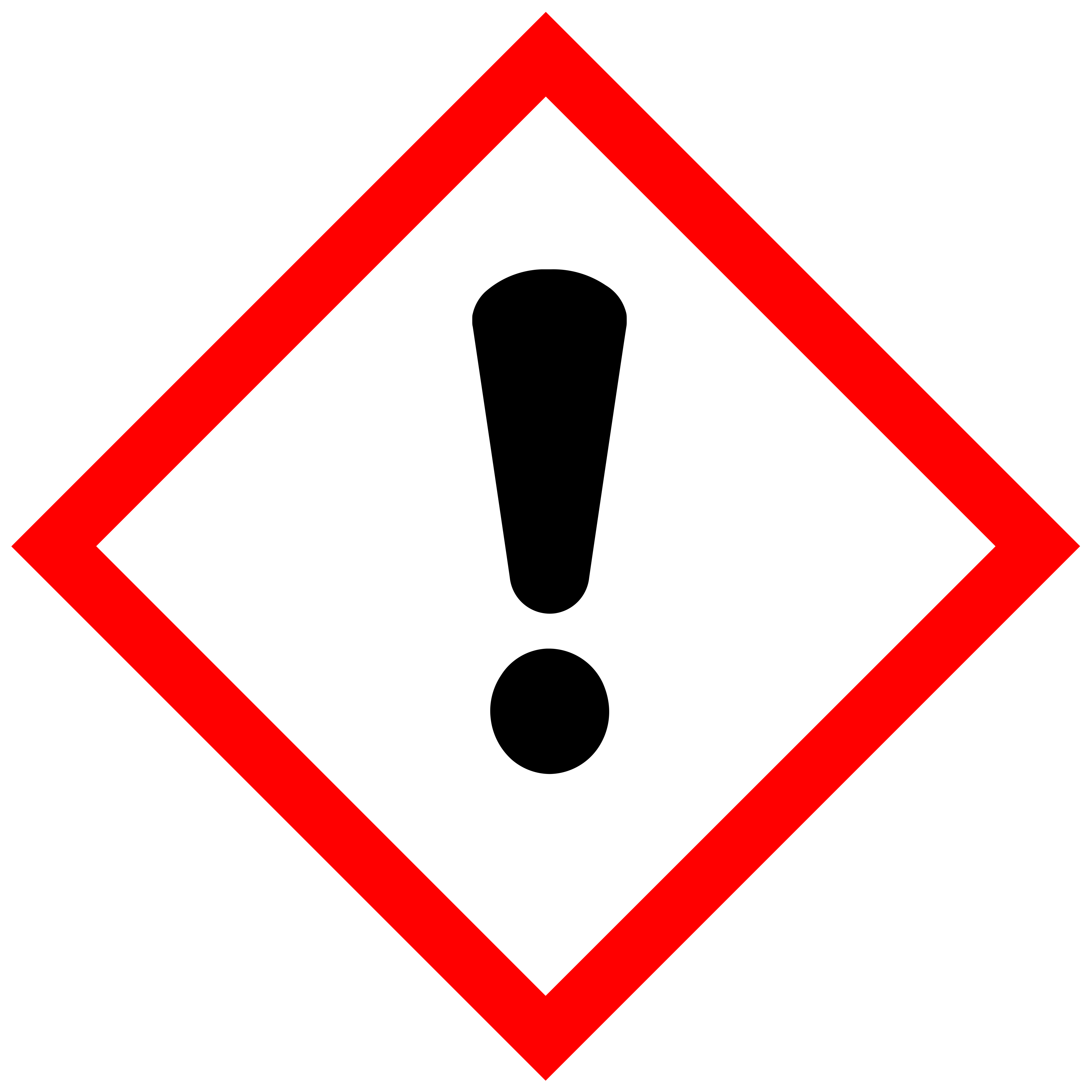
Specific target organ toxicity - single exposure GHS chapter 3.8
Category 3 narcotic · pictogram GHS07 (exclamation mark) · signal word Warning
Unchanged since 2009.
Present in every UN GHS edition from Rev.3 (2009) to Rev.11 (2025), with the same wording throughout.
Nine editions of the UN model text, 86 hazard statements, 19 of which ever moved. Read the full story in what changed in UN GHS Rev.11.
02 · Languages
H336 in the 24 official EU languages
A label put on the market in an EU country must carry the wording of that country's own language version of CLP — not a translation of the English one. These 24 lines are quoted from the consolidated regulation, Annex III, and are the text to print.
| Language | Official wording of H336 |
|---|---|
| BG български Bulgarian | Може да предизвика сънливост или световъртеж. |
| ES español Spanish | Puede provocar somnolencia o vértigo. |
| CS čeština Czech | Může způsobit ospalost nebo závratě. |
| DA dansk Danish | Kan forårsage sløvhed eller svimmelhed. |
| DE Deutsch German | Kann Schläfrigkeit und Benommenheit verursachen. |
| ET eesti Estonian | Võib põhjustada unisust või peapööritust. |
| EL ελληνικά Greek | Μπορεί να προκαλέσει υπνηλία ή ζάλη. |
| EN English English | May cause drowsiness or dizziness. |
| FR français French | Peut provoquer somnolence ou vertiges. |
| GA Gaeilge Irish | D'fhéadfadh sé a bheith ina chúis le codlatacht nó le meadhrán. |
| HR hrvatski Croatian | Može izazvati pospanost ili vrtoglavicu. |
| IT italiano Italian | Può provocare sonnolenza o vertigini. |
| LV latviešu Latvian | Var izraisīt miegainību vai reiboņus. |
| LT lietuvių Lithuanian | Gali sukelti mieguistumą arba galvos svaigimą. |
| HU magyar Hungarian | Álmosságot vagy szédülést okozhat. |
| MT Malti Maltese | Jista’ jikkawża ħedla jew sturdament. |
| NL Nederlands Dutch | Kan slaperigheid of duizeligheid veroorzaken. |
| PL polski Polish | Może wywoływać uczucie senności lub zawroty głowy. |
| PT português Portuguese | Pode provocar sonolência ou vertigens. |
| RO română Romanian | Poate provoca somnolență sau amețeală. |
| SK slovenčina Slovak | Môže spôsobiť ospalosť alebo závraty. |
| SL slovenščina Slovenian | Lahko povzroči zaspanost ali omotico. |
| FI suomi Finnish | Saattaa aiheuttaa uneliaisuutta ja huimausta. |
| SV svenska Swedish | Kan göra att man blir dåsig eller omtöcknad. |
Source: CELEX:02008R1272-20260501, Annex III. © European Union, https://eur-lex.europa.eu — only the electronic Official Journal of the European Union is authentic. Irish is one of the 24 official languages and its H and P texts are printed inside the multilingual Annex tables, but no consolidated CLP has ever been published in Irish — which is why an Irish-primary label cannot be built here.
03 · Legal status
Where H336 is current
GHS is a United Nations model text, revised every two years, and each jurisdiction adopts a revision on its own timetable. A code can be legally current in one system and deleted in another — that is normal, not an error.
| Jurisdiction | Basis | Status of H336 |
|---|---|---|
| EU CLP | Regulation (EC) 1272/2008 CLP Annex IV, Part 2 (consolidated) | Current |
| US OSHA HazCom | 29 CFR 1910.1200 Appendix C UN GHS Rev.7 (final rule of 20 May 2024) | Current |
| US HazCom 2012 | legacy · GHS Rev.3 UN GHS Rev.3, Annex 3 | Current |
| UN GHS | Rev.11 (2025) UN GHS Rev.11, Annex 3 | Current |
Currently in force under: EU CLP, US OSHA HazCom, US HazCom 2012, UN GHS. Sources: EU CLP · US OSHA HazCom · US HazCom 2012 · UN GHS
04 · Substances
Substances carrying H336
Every entry whose harmonised CLP Annex VI classification includes this hazard statement. Substances with a reference page here open on this site; the rest open on ghssymbols.com.
- (2-methylpropyl)lithium CAS 920-36-5
- (RS)-4-[1-(2,3-dimethylphenyl)ethyl]-1H-imidazole CAS 86347-14-0
- 1-Bromopropane CAS 106-94-5
- 1-ethoxypropan-2-ol CAS 1569-02-4
- 1-Methoxy-2-propanol CAS 107-98-2
- 1,4-Dimethylcyclohexane CAS 589-90-2
- 2-Butanone oxime CAS 96-29-7
- 2-methoxy-2-methylbutane CAS 994-05-8
- 2-methyl-3-(trimethoxysilyl)propyl-2-propenoate… CAS 125804-20-8
- 2-methylpropan-1-ol CAS 78-83-1
- 2,4,4-Trimethyl-1-pentene CAS 25167-70-8
- acetone CAS 67-64-1
- Acetone, oxime CAS 127-06-0
- Ammonium Bromide CAS 12124-97-9
- butan-1-ol CAS 71-36-3
- butan-2-ol [1] (S)-butan-2-ol [2] (R)-butan-2-ol [3]… CAS 78-92-2
- Butyl Acetate CAS 123-86-4
- Chloralose CAS 15879-93-3
- Cyclohexane CAS 110-82-7
- Dicamba CAS 1918-00-9
- diethyl ether CAS 60-29-7
- diisopropyl ether [1] dipropyl ether [2] CAS 108-20-3
- Dimethyl Disulfide CAS 624-92-0
- ethyl acetate CAS 141-78-6
- Ethylene CAS 74-85-1
- ethylene oxide CAS 75-21-8
- Fenpropidin CAS 67306-00-7
- heptane CAS 142-82-5
- hexan-2-one CAS 591-78-6
- hexane CAS 110-54-3
- hexane (containing < 5 % n-hexane (203-777-6)) CAS 107-83-5
- Isopentane CAS 78-78-4
- isopropyl alcohol CAS 67-63-0
- Methyl 2,5-dichlorobenzoate CAS 2905-69-3
- Methyl Acetate CAS 79-20-9
- methyl ethyl ketone CAS 78-93-3
- methyl isobutyl ketone CAS 108-10-1
- Methylcyclohexane CAS 108-87-2
- octane CAS 111-65-9
- pentan-3-one CAS 96-22-0
- Pentane CAS 109-66-0
- propan-1-ol CAS 71-23-8
- propyl acetate [1] isopropyl acetate [2] CAS 109-60-4
- propyl formate [1] isopropyl formate [2] CAS 110-74-7
- thiacloprid (ISO) CAS 111988-49-9
- toluene CAS 108-88-3
- trichloroethylene CAS 79-01-6
Nothing matches that filter.
All hazard statements
The full list of H-codes with the jurisdiction switch lives on the hazard statements hub. For what to do about the hazard, see precautionary statements (P-codes).
Wording quoted from the regulation named above. Substance counts come from harmonised classifications in CLP Annex VI — the statements on a real product also depend on the supplier's own classification. Always check the supplier safety data sheet.