Substance profile
Tail gas (petroleum), thermal cracked hydrocarbon fractionation stabilizer, petroleum coking
Tail gas (petroleum), thermal cracked hydrocarbon fractionation stabilizer, petroleum coking is a substance with a harmonised classification under EU CLP.
01 · Identification
What Tail gas (petroleum), thermal… is
Tail gas (petroleum), thermal cracked hydrocarbon fractionation stabilizer, petroleum coking is a substance with a harmonised classification under EU CLP.
Under the GHS it carries the signal word Danger.
02 · Identifiers
Tail gas (petroleum), thermal… identifiers and molecular data
Tail gas (petroleum), thermal… CAS number and EC number
Other names for Tail gas (petroleum), thermal…
- Petroleum gas
- [A complex combination of hydrocarbons obtained from the fractionation stabilization of thermal cracked hydrocarbons from petroleum coking process. It consists of hydrocarbons having carbon numbers predominantly in the range of C1 through C6.]
03 · GHS classification
Tail gas (petroleum), thermal… hazard classification
Harmonised classification under CLP Annex VI. This is the legally binding classification in the EU; other jurisdictions may differ.
Tail gas (petroleum), thermal… pictograms and signal word
Tail gas (petroleum), thermal… hazard class and category
| Hazard class | Category | From code | Pictogram |
|---|---|---|---|
| Flammable gases GHS chapter 2.2 | Category 1A | H220 | GHS02 |
| Germ cell mutagenicity GHS chapter 3.5 | Category 1A or 1B | H340 | GHS08 |
| Carcinogenicity GHS chapter 3.6 | Category 1A or 1B | H350 | GHS08 |
Where two values are shown with “or”, the hazard statement is shared by more than one category or by more than one class, and the code alone does not say which. H272, for example, belongs to oxidising liquids and to oxidising solids — the physical state decides. The binding answer for a specific entry is in the CLP Annex VI table itself.
Tail gas (petroleum), thermal… hazard statements (H-codes)
| Code | Hazard statement |
|---|---|
| H220 | Extremely flammable gas. |
| H350 | May cause cancer <state route of exposure if it is conclusively proven that no other routes of exposure cause the hazard>. |
| H340 | May cause genetic defects <state route of exposure if it is conclusively proven that no other routes of exposure cause the hazard>. |
This page lists only the codes assigned to Tail gas (petroleum)…. The full reference lives on the hazard statements hub, the precautionary statements hub and the GHS pictograms hub.
Safety Data Sheet
Getting an SDS for Tail gas (petroleum)…
A Safety Data Sheet is written for a product, not for a substance: the supplier of the grade you actually buy issues it, so two suppliers of Tail gas (petroleum)… issue two different sheets. That is why there is no single authoritative SDS for a substance to download — what there is, is the job of collecting the sheets for the products you hold and keeping them current as suppliers revise them.
04 · Precautionary statements
Tail gas (petroleum), thermal… precautionary statements
CLP Annex VI assigns 7 precautionary statements to Tail gas (petroleum)…. They are grouped the way a label groups them: what to do before handling, what to do when something has already happened, how to store it and how to dispose of it.
Prevention
What to do before and during handling so the hazard never happens.
Response
What to do once exposure, spillage or fire has already happened.
Reading the notation. … is a blank the supplier fills in — not a truncated sentence.· [square brackets] mark a part printed only when it applies.
05 · Names in the regulation
Tail gas (petroleum), thermal… name in 23 EU languages
CLP Annex VI Part 3 is published in every language edition of the regulation, and the identification column is written out in each of them. Nothing below is translated by us: each line is the name as that edition prints it. Under Art. 18(2) the substance name from Annex VI is a lawful product identifier, so this is the wording to put on a label going to that market — and where the cell lists several designations, any one of them qualifies.
| Language | Name in CLP Annex VI Part 3 |
|---|---|
| Bulgarian български | Остатъчен газ (нефтен), от колона за стабилизация чрез фракциониране на термично крекирани въглеводороди, коксуване на нефт нефтен газ |
| Spanish español | Gas de cola (petróleo), estabilizador para el fraccionamiento de hidrocarburos craqueados térmicamente, coquización de petróleo gas de petróleo |
| Czech čeština | zbytkový plyn (ropný), stabilizační kolona tepelně krakovaných uhlovodíků, koksování ropy ropný plyn |
| Danish dansk | slutgas (råolie), termisk krakket carbonhydrid fraktioneringsstabilizer, råolieforkoksnings- kulbrintegasser |
| German Deutsch | Restgas (Erdöl), Fraktionierung und Stabilisierung thermisch gecrackter Kohlenwasserstoffe aus Coking-Verfahren Gase aus der Erdölverarbeitung |
| Estonian eesti | jääkgaas (nafta), termiliselt krakitud süsivesinike stabilisaatorist, nafta koksistamine naftagaas |
| Greek ελληνικά | Αέριο ουράς (πετρελαίου), σταθεροποιητή κλασμάτωσης θερμικά πυρολυμένων υδρογονανθράκων, από παραγωγή κοκ πετρελαίου Πετρελαϊκό αέριο |
| English English | Tail gas (petroleum), thermal cracked hydrocarbon fractionation stabilizer, petroleum coking Petroleum gas |
| French français | Gaz de queue (pétrole), stabilisateur de fractionnement d'hydrocarbures de craquage thermique, cokéfaction pétrolière gaz de pétrole |
| Croatian hrvatski | otpadni plin (nafta), frakcionacijski stabilizator toplinski krekiranih ugljikovodika, koksiranje nafte naftni plin |
| Italian italiano | gas di coda (petrolio), da stabilizzazione per frazionamento di idrocarburi crackizzati termicamente, coking del petrolio gas di petrolio |
| Latvian latviešu | Atliekgāze (naftas), termiskajā krekingā iegūtu ogļūdeņražu frakcionēšanas stabilizatora, naftas koksēšanas Naftas pavadgāze |
| Lithuanian lietuvių | Liekamosios dujos (nafta), terminio krekingo angliavandenilių frakcionavimo stabilizavimo įrenginio, naftos koksavimas Naftos dujos |
| Hungarian magyar | Véggáz (ásványolaj), termikusan krakkolt szénhidrogén frakcionáló stabilizáló, ásványolaj kokszolás Ásványolaj gáz |
| Maltese Malti | Gass residwu (żejt mhux maħdum), stabbilizzatur tal-frazzjonazzjoni tal-idrokarburi krekkjati termalment, kokkjar taż-żejt mhux maħdum Gass taż-żejt mhux maħdumTaħlita komplessa ta' idrokarburi miksuba mill-istabbilizzazzjoni tal-frazzjonizzazzjoni ta’ idrokarburi termalment maqsuma mill-proċess tal-kokk tal-petroleum. Tikkonsisti f'idrokarburi li għandhom numri tal-karbonju fil-parti l-kbira fil-medda ta' C 1 sa C 6 .] |
| Dutch Nederlands | restgas (aardolie), thermisch gekraakte koolwaterstof-fractioneringsstabilisator-, aardolieverkooksing petroleumgas |
| Polish polski | Gazy odlotowe, z węzła stabilizacji krakingu termicznego i z procesu koksowania (ropa naftowa) Gaz z ropy naftowej |
| Portuguese português | gás residual (petróleo), de estabilização por fracionamento de hidrocarbonetos de cracking térmico, coqueificação de petróleo gás de petróleo |
| Romanian română | Gaze reziduale (petrol), de la stabilizatorul instalației de fracționare a hidrocarburilor de cracare termică, cocsificare petrolieră Gaz petrolier |
| Slovak slovenčina | zvyškový plyn (ropný), z destilačnej stabilizácie tepelne krakovaných uhľovodíkových frakcií z koksovania ropy plyn zo spracovania ropy |
| Slovenian slovenščina | preostali plin (nafta), frakcionacijski stabilizator za termično krekirane ogljikovodike, koksanje nafte naftni plin |
| Finnish suomi | Jäännöskaasu (maaöljy), lämpökrakattu hiilivetyjen jakotislausstabilointiyksikkö, maaöljykoksaus Maaöljykaasu |
| Swedish svenska | Slutgas (petroleum), termiskt krackade kolväten, fraktioneringsstabilisator, petroleumförkoksningPetroleumgas |
All 23 language editions of Annex VI carry this entry. Irish is the twenty-fourth official EU language and has no line here for a different reason: no consolidated CLP text has ever been published in Irish, so there is no Irish edition of Annex VI to quote a name from. Source: consolidated CLP, CELEX 02008R1272, language editions. © European Union, https://eur-lex.europa.eu — only the electronic Official Journal of the European Union is authentic.
06 · Label elements
Tail gas (petroleum), thermal… GHS label elements
Everything CLP Annex VI fixes for Tail gas (petroleum)…, laid out the way it appears on a label. The greyed lines are the parts only the supplier can fill in.

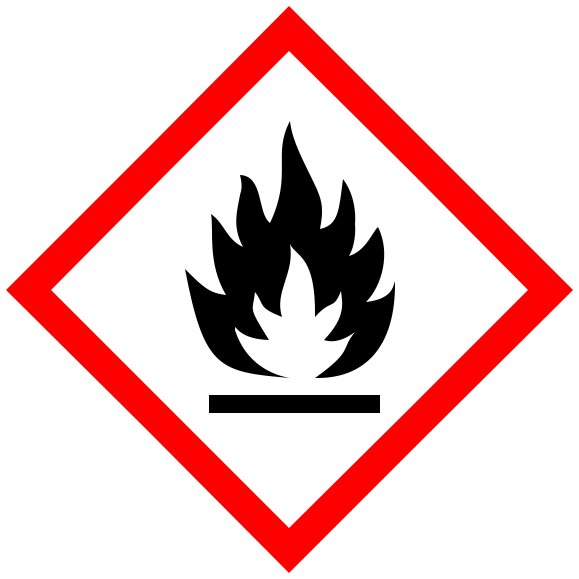

Danger
Tail gas (petroleum), thermal…
- Extremely flammable gas.
- May cause cancer <state route of exposure if it is conclusively proven that no other routes of exposure cause the hazard>.
- May cause genetic defects <state route of exposure if it is conclusively proven that no other routes of exposure cause the hazard>.
- Obtain special instructions before use.
- Keep away from heat, hot surfaces, sparks, open flames and other ignition sources. No smoking.
- Keep container tightly closed.
- Wear protective gloves/protective clothing/eye protection/face protection/hearing protection/…
- IF exposed or concerned:
- Get medical advice/attention.
- Store in a well-ventilated place.
Supplier name, address and telephone number· Product identifier·Nominal quantity
Need this as an actual label? Open Tail gas (petroleum)… in the GHS label constructor →
07 · Questions
Tail gas (petroleum), thermal… — frequently asked questions
What is the CAS number of Tail gas (petroleum), thermal…?
The CAS number of Tail gas (petroleum), thermal… is 68952-82-9. Its EC number is 273-176-1.
What does a Tail gas (petroleum), thermal… label have to show?
Under CLP Annex VI the label for Tail gas (petroleum), thermal… carries the pictograms Gas cylinder, Flame and Health hazard and the signal word is Danger.
Is Tail gas (petroleum), thermal… flammable?
Yes. CLP Annex VI assigns Tail gas (petroleum), thermal… H220 — extremely flammable gas.
Is Tail gas (petroleum), thermal… a carcinogen?
Yes. CLP Annex VI classifies Tail gas (petroleum), thermal… as a category 1A or 1B carcinogen and assigns it H350: may cause cancer.
How should Tail gas (petroleum), thermal… be stored?
CLP Annex VI assigns Tail gas (petroleum), thermal… the storage statement P403.
Nearby
Substances next to Tail gas (petroleum)…
Keep going: substances starting with T, or search the whole database by name, CAS number, pictogram or signal word.