Substance profile
3-chloropropene
3-chloropropene is a red liquid with a pungent, unpleasant odor.
01 · Identification
What 3-chloropropene is
3-chloropropene is a red liquid with a pungent, unpleasant odor. Its molecular formula is C3H5Cl and its molecular weight is 76.52 g/mol. It boils at 45 °C, melts at -134 °C, is miscible with water.
Under the GHS it carries the signal word Danger. It is classed as hazardous Air Pollutants (HAPs).
02 · Identifiers
3-chloropropene identifiers and molecular data
3-chloropropene CAS number and EC number
3-chloropropene molecular formula and molecular weight
Other names for 3-chloropropene
- allyl chloride
03 · GHS classification
3-chloropropene hazard classification
Harmonised classification under CLP Annex VI. This is the legally binding classification in the EU; other jurisdictions may differ.
3-chloropropene pictograms and signal word
3-chloropropene hazard class and category
| Hazard class | Category | From code | Pictogram |
|---|---|---|---|
| Flammable liquids GHS chapter 2.6 | Category 2 | H225 | GHS02 |
| Acute toxicity - oral GHS chapter 3.1 | Category 4 | H302 | GHS07 |
| Acute toxicity - dermal GHS chapter 3.1 | Category 4 | H312 | GHS07 |
| Acute toxicity - inhalation GHS chapter 3.1 | Category 4 | H332 | GHS07 |
| Skin corrosion/irritation GHS chapter 3.2 | Category 2 | H315 | GHS07 |
| Serious eye damage/eye irritation GHS chapter 3.3 | Category 2A | H319 | GHS07 |
| Germ cell mutagenicity GHS chapter 3.5 | Category 2 | H341 | GHS08 |
| Carcinogenicity GHS chapter 3.6 | Category 2 | H351 | GHS08 |
| Specific target organ toxicity - single exposure GHS chapter 3.8 | Category 3 | H335 | GHS07 |
| Specific target organ toxicity - repeated exposure GHS chapter 3.9 | Category 2 | H373 | GHS08 |
| Hazardous to the aquatic environment - acute GHS chapter 4.1 | Category 1 | H400 | GHS09 |
3-chloropropene hazard statements (H-codes)
| Code | Hazard statement |
|---|---|
| H225 | Highly flammable liquid and vapour. |
| H351 | Suspected of causing cancer <state route of exposure if it is conclusively proven that no other routes of exposure cause the hazard>. |
| H341 | Suspected of causing genetic defects <state route of exposure if it is conclusively proven that no other routes of exposure cause the hazard>. |
| H332 | Harmful if inhaled. |
| H312 | Harmful in contact with skin. |
| H302 | Harmful if swallowed. |
| H335 | May cause respiratory irritation. |
| H373 | May cause damage to organs <or state all organs affected, if known> through prolonged or repeated exposure <state route of exposure if it is conclusively proven that no other routes of exposure cause the hazard>. |
| H315 | Causes skin irritation. |
| H319 | Causes serious eye irritation. |
| H400 | Very toxic to aquatic life. |
This page lists only the codes assigned to 3-chloropropene. The full reference lives on the hazard statements hub, the precautionary statements hub and the GHS pictograms hub.
Safety Data Sheet
Getting an SDS for 3-chloropropene
A Safety Data Sheet is written for a product, not for a substance: the supplier of the grade you actually buy issues it, so two suppliers of 3-chloropropene issue two different sheets. That is why there is no single authoritative SDS for a substance to download — what there is, is the job of collecting the sheets for the products you hold and keeping them current as suppliers revise them.
04 · Precautionary statements
3-chloropropene precautionary statements
CLP Annex VI assigns 27 precautionary statements to 3-chloropropene. They are grouped the way a label groups them: what to do before handling, what to do when something has already happened, how to store it and how to dispose of it.
Prevention
What to do before and during handling so the hazard never happens.
Response
What to do once exposure, spillage or fire has already happened.
Disposal
What has to happen to the contents and the empty container.
Reading the notation. … is a blank the supplier fills in — not a truncated sentence.· [square brackets] mark a part printed only when it applies.
05 · Names in the regulation
3-chloropropene name in 23 EU languages
CLP Annex VI Part 3 is published in every language edition of the regulation, and the identification column is written out in each of them. Nothing below is translated by us: each line is the name as that edition prints it. Under Art. 18(2) the substance name from Annex VI is a lawful product identifier, so this is the wording to put on a label going to that market — and where the cell lists several designations, any one of them qualifies.
| Language | Name in CLP Annex VI Part 3 |
|---|---|
| Bulgarian български | 3-хлоропропен алилхлорид |
| Spanish español | 3-Cloropropeno cloruro de alilo |
| Czech čeština | 3-chlorprop-1-en allylchlorid |
| Danish dansk | 3-chlorpropen allylchlorid |
| German Deutsch | 3-Chlorpropen Allylchlorid |
| Estonian eesti | 3-kloropropeen allüülkloriid |
| Greek ελληνικά | 3-χλωροπροπένιο αλλυλοχλωρίδιο |
| English English | 3-chloropropene allyl chloride |
| French français | 3-chloropropène chlorure d'allyle |
| Croatian hrvatski | 3-klorpropen alil-klorid |
| Italian italiano | 3-cloropropene cloruro di allile |
| Latvian latviešu | 3-hlorpropēns alilhlorīds |
| Lithuanian lietuvių | 3-chlorpeopenas alilchloridas |
| Hungarian magyar | 3-klórpropén allil-klorid |
| Maltese Malti | 3-kloropropen klorur tal-allil |
| Dutch Nederlands | 3-chloorpropeen allylchloride |
| Polish polski | 3-chloropropen chlorek allilu |
| Portuguese português | 3-cloropropeno cloreto de alilo |
| Romanian română | 3-cloropropenă clorură de alil |
| Slovak slovenčina | 3-chlórpropén alylchlorid |
| Slovenian slovenščina | 3-kloropropen alil klorid |
| Finnish suomi | 3-klooripropeeni allyylikloridi |
| Swedish svenska | 3-klorpropen allylklorid |
All 23 language editions of Annex VI carry this entry. Irish is the twenty-fourth official EU language and has no line here for a different reason: no consolidated CLP text has ever been published in Irish, so there is no Irish edition of Annex VI to quote a name from. Source: consolidated CLP, CELEX 02008R1272, language editions. © European Union, https://eur-lex.europa.eu — only the electronic Official Journal of the European Union is authentic.
06 · Label elements
3-chloropropene GHS label elements
Everything CLP Annex VI fixes for 3-chloropropene, laid out the way it appears on a label. The greyed lines are the parts only the supplier can fill in.
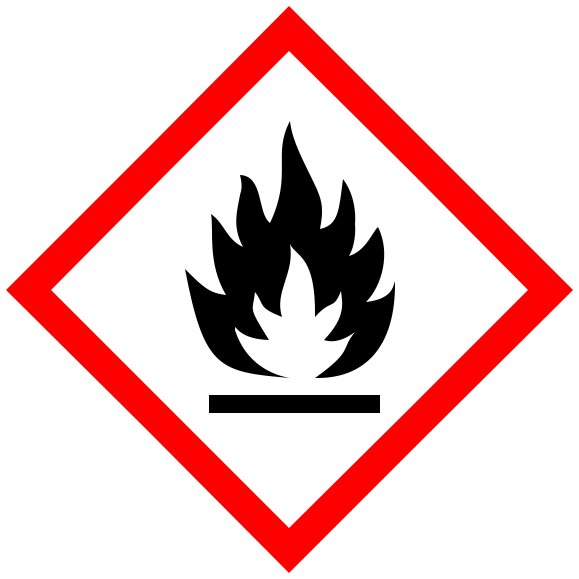
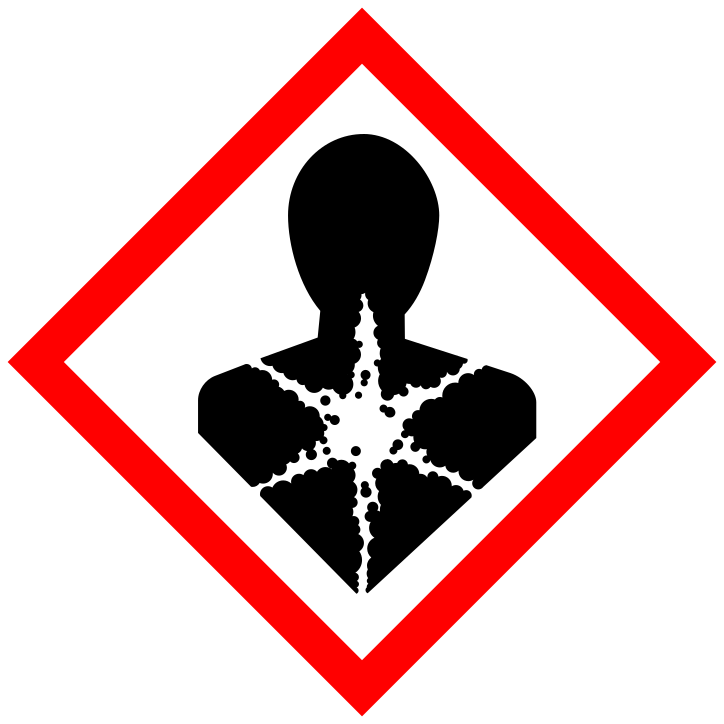

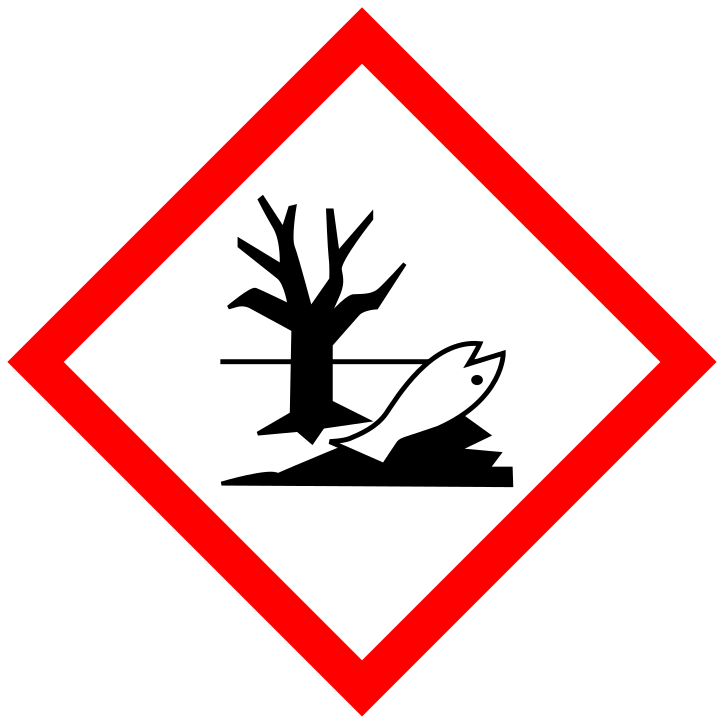
Danger
3-chloropropene
- Highly flammable liquid and vapour.
- Suspected of causing cancer <state route of exposure if it is conclusively proven that no other routes of exposure cause the hazard>.
- Suspected of causing genetic defects <state route of exposure if it is conclusively proven that no other routes of exposure cause the hazard>.
- Harmful if inhaled.
- Harmful in contact with skin.
- Harmful if swallowed.
- May cause respiratory irritation.
- May cause damage to organs <or state all organs affected, if known> through prolonged or repeated exposure <state route of exposure if it is conclusively proven that no other routes of exposure cause the hazard>.
- Causes skin irritation.
- Causes serious eye irritation.
- Very toxic to aquatic life.
- Obtain special instructions before use.
- Keep away from heat, hot surfaces, sparks, open flames and other ignition sources. No smoking.
- Keep container tightly closed.
- Use explosion-proof [electrical/ventilating/lighting/…] equipment.
- Use only non-sparking tools.
- Do not breathe dust/fume/gas/mist/vapours/spray.
- Wash … thoroughly after handling.
- Do not eat, drink or smoke when using this product.
- Use only outdoors or in a well-ventilated area.
- Avoid release to the environment.
- Wear protective gloves/protective clothing/eye protection/face protection/hearing protection/…
- IF SWALLOWED:
- IF ON SKIN:
- IF INHALED:
- IF IN EYES:
- IF exposed or concerned:
- Call a POISON CENTER/doctor/… if you feel unwell.
- Get medical advice/attention.
- Get medical advice/attention if you feel unwell.
- Rinse mouth.
- If skin irritation occurs:
- If eye irritation persists:
- Remove contact lenses, if present and easy to do. Continue rinsing.
- Wash with plenty of water/…
- Collect spillage.
- Store in a well-ventilated place.
- Dispose of contents/container to …
Supplier name, address and telephone number· Product identifier·Nominal quantity
Need this as an actual label? Open 3-chloropropene in the GHS label constructor →
07 · Health hazards
3-chloropropene health hazards and exposure limits
3-chloropropene hazard summary
Exposure to allyl chloride primarily occurs for workers in manufacturing plants. The acute (short-term) effects of allyl chloride from inhalation exposure in humans consists of irritation of the eyes and respiratory passages. Chronic (long-term) exposure to allyl chloride in humans causes injury to the liver and kidneys and the onset of pulmonary edema (fluid in the lungs). There are no human cancer data available for allyl chloride. Limited animal studies indicate that exposure to allyl chloride by gavage (placing the chemical experimentally in the stomachs of mice) caused an increase in the incidence of forestomach tumors. EPA has classified allyl chloride as a Group C, a possible human carcinogen.
Source: EPA Hazardous Air Pollutants
3-chloropropene carcinogenicity classification
Under the conditions of this bioassay no convincing evidence was presented for the carcinogenicity of allyl chloride in Osborne-Mendel rats of either sex. The results are suggestive that allyl chloride is carcinogenic in male and female B6C3F1 mice since the compound, when administered by gavage caused a low incidence of neoplastic and nonneoplastic lesions of the forestomach.
Source: US National Toxicology Program · TR-073: Bioassay of Allyl Chloride for Possible Carcinogenicity (CASRN 107-05-1) (1978 )
CLASSIFICATION: C; possible human carcinogen. BASIS FOR CLASSIFICATION: Classification is based on a low (but biologically important) incidence of forestomach tumors in female mice and positive results in a variety of genetic toxicity tests. Allyl chloride is an alkylating agent and structurally related to probable human carcinogens. HUMAN CARCINOGENICITY DATA: None. ANIMAL CARCINOGENICITY DATA: Limited.
Source: Hazardous Substances Data Bank (HSDB)
Evaluation: There is inadequate evidence in humans for the carcinogenicity of allyl chloride. There is inadequate evidence in experimental animals for the carcinogenicity of allyl chloride. Overall evaluation: Allyl chloride is not classifiable as to its carcinogenicity to humans (Group 3).
Source: Hazardous Substances Data Bank (HSDB)
An IARC group and a CLP classification answer different questions. IARC judges whether the evidence for cancer in humans is strong enough; CLP Annex VI is the legally binding EU classification. A substance can carry one and not the other.
3-chloropropene occupational exposure limits
| Limit | Value | Source |
|---|---|---|
| PEL | 1.0 [ppm] | Haz-Map, Information on Hazardous Chemicals and Occupational Diseases |
| PEL | 1 ppm (3 mg/m³) | Occupational Safety and Health Administration (OSHA) |
| PEL | TWA 1 ppm (3 mg/m3) See Appendix G | The National Institute for Occupational Safety and Health (NIOSH) |
| REL | 1 ppm (3 mg/m³) | Occupational Safety and Health Administration (OSHA) |
| REL | 2 ppm (6 mg/m³) | Occupational Safety and Health Administration (OSHA) |
| REL | TWA 1 ppm (3 mg/m3) ST 2 ppm (6 mg/m3) | The National Institute for Occupational Safety and Health (NIOSH) |
| IDLH | 250 ppm (NIOSH, 2024) | CAMEO Chemicals |
| IDLH | 250.0 [ppm] | Haz-Map, Information on Hazardous Chemicals and Occupational Diseases |
| IDLH | 250 ppm | Hazardous Substances Data Bank (HSDB) |
These are United States values. The European Union sets its own indicative and binding limits, and the figure that applies at a given workplace is the one in the local regulation — not the one shown here.
08 · Physical and chemical properties
3-chloropropene properties
Every value is shown with the conditions it was measured under and the source it came from. Where sources disagree, all values are listed rather than one being picked — the difference is usually a different form of the substance, not an error.
3-chloropropene boiling point
| Property | Value | Conditions | Source |
|---|---|---|---|
| Boiling point | 45 °C (113 °F) | NIOSH | |
| 45 °C (113 °F) | at 760 mmHg | CAMEO |
3-chloropropene melting point
| Property | Value | Conditions | Source |
|---|---|---|---|
| Melting point | -134.5 °C (-210.1 °F) | HSDB | |
| -134.44 °C (-210 °F) | NIOSH |
3-chloropropene density
| Property | Value | Conditions | Source |
|---|---|---|---|
| Density | 0.94 g/cm³ | NIOSH | |
| 0.938 g/cm³ | at 20 °C | HSDB | |
| 0.94 g/cm³ | at 20 °C | CAMEO |
3-chloropropene solubility
| Property | Value | Conditions | Source |
|---|---|---|---|
| Solubility | Miscible with alcohol, chloroform, ether, petrol ether | HSDB | |
| 0.4% | NIOSH | ||
| In water, 3,370 mg/L at 25 °C | at 25 °C | HSDB |
3-chloropropene vapor pressure
| Property | Value | Conditions | Source |
|---|---|---|---|
| Vapor pressure | 295 mmHg | NIOSH | |
| 340 mmHg | at 20 °C | CAMEO | |
| 368 mmHg | at 25 °C | HSDB |
3-chloropropene flash point
| Property | Value | Conditions | Source |
|---|---|---|---|
| Flash point | -31.7 °C (-25.1 °F) | CLOSED CUP | HSDB |
| -31.67 °C (-25 °F) | NIOSH |
3-chloropropene autoignition temperature
| Property | Value | Conditions | Source |
|---|---|---|---|
| Autoignition temperature | 391.67 °C (737 °F) | HSDB | |
| 390 °C (734 °F) | ICSC |
3-chloropropene lower explosive limit (LEL)
| Property | Value | Conditions | Source |
|---|---|---|---|
| Lower explosive limit (LEL) | 2.9 % by volume | HSDB | |
| 3.3 % by volume | CAMEO |
3-chloropropene upper explosive limit (UEL)
| Property | Value | Conditions | Source |
|---|---|---|---|
| Upper explosive limit (UEL) | 11.1 % by volume | HSDB | |
| 11.2 % by volume | CAMEO |
3-chloropropene vapor density
| Property | Value | Conditions | Source |
|---|---|---|---|
| Vapor density | 2.64 (air = 1) | HSDB | |
| 2.6 (air = 1) | ICSC |
3-chloropropene odor threshold
| Property | Value | Conditions | Source |
|---|---|---|---|
| Odor threshold | Recognition of allyl chloride in air was at 4.70x10⁻¹ ppm. | HSDB | |
| Odor Threshold Low: 0.48 [ppm] | Haz-Map | ||
| Odor Threshold High: 5.9 [ppm] | Haz-Map |
3-chloropropene critical temperature and pressure
| Property | Value | Conditions | Source |
|---|---|---|---|
| Critical temperature and pressure | 241.11 °C (466 °F) | HSDB |
3-chloropropene corrosivity
| Property | Value | Conditions | Source |
|---|---|---|---|
| Corrosivity | Allyl chloride will attack some forms of plastics, rubber, and coatings. | HSDB |
Values compiled from PubChem Laboratory Chemical Safety Summary. Temperatures converted to Fahrenheit for reference.
09 · Fire and explosion
3-chloropropene fire and explosion behaviour
These are descriptions rather than measured values, so they are kept out of the table above and quoted here with the source that reported them.
3-chloropropene fire potential
Dangerous fire and explosion hazard when exposed to heat or flame ...
Source: Hazardous Substances Data Bank (HSDB)
10 · Handling and storage
3-chloropropene storage and handling
3-chloropropene safe storage
Fireproof. Separated from food and feedstuffs and incompatible materials. See Chemical Dangers. Dry.
Source: ILO-WHO International Chemical Safety Cards (ICSCs)
3-chloropropene storage conditions
Ambient storage temperature, venting should be pressure-vacuum type.
Source: Hazardous Substances Data Bank (HSDB)
3-chloropropene incompatible materials
Contact with aluminum chloride, boron trifluoride, or sulfuric acid may cause a violent exothermic polymerization. Contact with aluminum, magnesium, zinc (or galvanized metals) may produce similar results.
Source: Hazardous Substances Data Bank (HSDB)
3-chloropropene reactivity
ALLYL CHLORIDE presents a serious fire and explosion hazard when exposed to heat, flame or oxidizing agents. Polymerizes violently and exothermically with Lewis acids (aluminum chloride, boron trifluoride, sulfuric acid) or metals (aluminum, magnesium, zinc, or galvanized metal) [MCA SD-99, 1973]. Incompatible with acids (nitric acid, chlorosulfonic acid, oleum), with strong bases (sodium hydroxide, potassium hydroxide), with ethyleneimine and ethylenediamine [Lewis, 3rd ed., 1993, p. 36]. Attempts to alkylate benzene or toluene using allyl chloride in the presence of ethylaluminum chlorides have led to explosions.
Source: CAMEO Chemicals
Planning storage for a mix of chemicals? Check 3-chloropropene in the storage compatibility matrix →
11 · Transport
3-chloropropene UN number and transport classification
Transport classification is a separate system from the GHS classification above. It decides how a package is marked and how a load may be carried; it does not follow from the workplace label, and the workplace label does not follow from it. The entries below are linked by CAS number, never by name.
3-chloropropene under UN 1100 — shipping name, class and packing group
Europe · ADR 2025, Table A
| Proper shipping name (3.1.2) | Class | Classification code | PG | Labels (column 5) |
|---|---|---|---|---|
| ALLYL CHLORIDE | 3 | FT1 | I | |

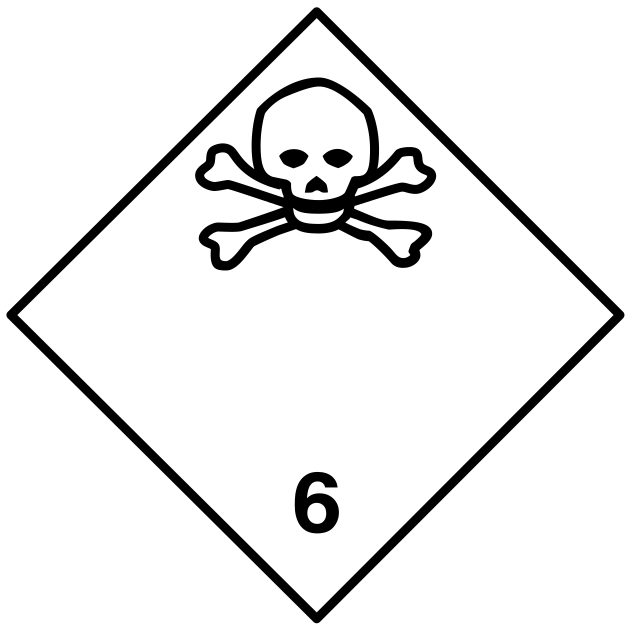
Source: ADR 2025, Table A of Chapter 3.2 · ECE/TRANS/352 Vol. I (UNECE). Class 3 is “Flammable liquids” (ADR 2.1.1.1).
United States · 49 CFR 172.101 Hazardous Materials Table
| Proper shipping name (column 2) | Class or division | PG | Labels (column 6) |
|---|---|---|---|
| Allyl chloride | 3 | I | |
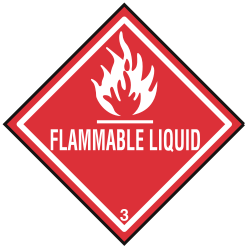

Source: 49 CFR 172.101 Hazardous Materials Table · eCFR, revision 2026-08-03. Class 3 is “Flammable and combustible liquid” (49 CFR 173.2).
12 · Questions
3-chloropropene — frequently asked questions
What is the CAS number of 3-chloropropene?
The CAS number of 3-chloropropene is 107-05-1. Its EC number is 203-457-6.
What is the chemical formula of 3-chloropropene?
The molecular formula of 3-chloropropene is C3H5Cl and its molecular weight is 76.52 g/mol.
What does a 3-chloropropene label have to show?
Under CLP Annex VI the label for 3-chloropropene carries the pictograms Flame, Health hazard, Exclamation mark and Environment and the signal word is Danger.
Is 3-chloropropene flammable?
Yes. CLP Annex VI assigns 3-chloropropene H225 — highly flammable liquid and vapour. Its flash point is -31.7 °C (-25 °F), a figure on which HSDB, NIOSH and NTP via CAMEO agree.
Is 3-chloropropene a carcinogen?
CLP Annex VI assigns 3-chloropropene H351 — suspected of causing cancer. That is category 2: the evidence points that way but is not conclusive. IARC places it in Group 3: not classifiable as to its carcinogenicity to humans.
What is the exposure limit for 3-chloropropene?
The US occupational exposure limit reported for 3-chloropropene is 1.0 [ppm] (Haz-Map, Information on Hazardous Chemicals and Occupational Diseases). Limits differ by country: the EU sets its own indicative and binding values, and the figure that applies at a given workplace is the one in the local regulation.
What is the boiling point of 3-chloropropene?
The boiling point of 3-chloropropene is 45 °C (113 °F), a figure on which NIOSH, NTP via CAMEO and ICSC agree.
What is the melting point of 3-chloropropene?
The melting point of 3-chloropropene is -134 °C (-210 °F), a figure on which HSDB, NIOSH and NTP via CAMEO agree.
How should 3-chloropropene be stored?
CLP Annex VI assigns 3-chloropropene the storage statement P403. Ambient storage temperature, venting should be pressure-vacuum type. (Hazardous Substances Data Bank (HSDB))
Nearby
Substances next to 3-chloropropene
Keep going: substances starting with 0–9, or search the whole database by name, CAS number, pictogram or signal word.